For years, humanoid robots lived in two places. Research labs and science fiction. They walked on stages. They performed careful demos. They made headlines.
But very few of them actually worked. Now that line has shifted.
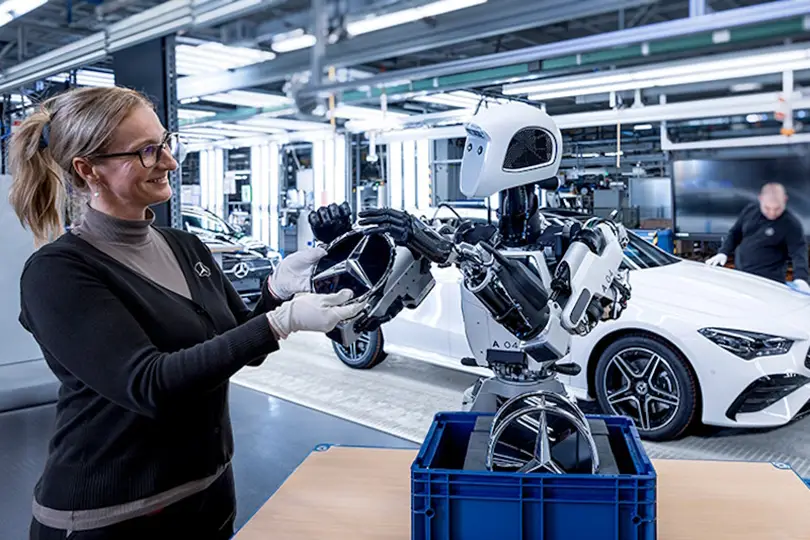
A humanoid robot named Apollo is stepping into real warehouses and production facilities. Not for a photo opportunity. Not for a one hour showcase. For actual tasks that move real products through real supply chains.
Behind Apollo stands Apptronik, a robotics company that recently raised 520 million dollars at a 5 billion dollar valuation. The project is supported by Google and Mercedes-Benz.
When that level of capital and industrial backing converges around a humanoid robot, it is not a publicity stunt. It is a strategic shift.
Not a Machine on a Pedestal. A Machine on the Floor.
Apollo is built roughly to human scale. About 5 feet 8 inches tall. Around 160 pounds. It can lift up to 55 pounds. It runs for about four hours on a battery that can be swapped in seconds.
But hardware specs do not explain why this moment matters.
What matters is intelligence.
Apollo is powered by AI systems connected to Gemini models developed with the involvement of Google DeepMind. That means this robot is not limited to rigid preprogrammed routines.
It can receive spoken instructions.
It can observe a demonstration.
It can plan multi step actions.
It can handle objects it has never encountered before.
In robotics research, this ability is tied to advances in multimodal AI. Instead of separating vision, language, and motor control into isolated systems, modern models integrate them. The result is context awareness. The machine interprets what it sees and hears, then converts that into physical action.
That bridge between perception and movement is what makes a humanoid practical rather than theatrical.
Why Warehouses Are the Real Test
Warehouses are not controlled laboratory environments. They are dynamic. Products change. Packaging shifts. Layouts evolve. Demand spikes.
Traditional automation works beautifully when every movement is fixed. Assembly lines are predictable. Conveyor belts repeat. Industrial robotic arms excel at precision tasks within clearly defined zones.
But warehouses are different. They require flexibility.
Research in industrial automation consistently shows that adaptive robotic systems improve operational stability and reduce process delays. When systems can adjust to variation rather than break down under it, productivity increases.
Apollo is already operating in controlled zones at partner facilities, including Mercedes-Benz, GXO Logistics, and Jabil. It unloads trailers. It moves parts between stations. It assists with picking and palletizing.
This is not simulation. This is integration.
Designed for Human Spaces
One reason humanoids are so compelling is architectural compatibility. Warehouses and factories were designed for human bodies.
Door heights. Shelf spacing. Tool dimensions. Staircases.
A machine that matches human scale can use existing infrastructure. It can carry standard containers. It can navigate familiar layouts. It can interact with equipment without requiring a complete redesign of the facility.
From a systems engineering perspective, this dramatically lowers deployment costs. The robot adapts to the building. The building does not need to adapt to the robot.
Safety Is Not Optional
Industrial robotics has historically relied on separation. Humans on one side. Machines on the other.
Apollo is built to operate near people.
It uses sensor systems to detect proximity. If something enters a safety zone, it slows or stops. Visual LED signals communicate its operational state. Transparency builds predictability. Predictability builds trust.
This shift reflects years of research in collaborative robotics. The goal is not isolation. It is coordination.
The Economics Behind the Headlines
A 520 million dollar investment signals confidence in scalability. Investors are betting that humanoid labor can reach commercial viability.
Apptronik, founded in 2016 out of academic robotics research, spent years refining human centered robotic systems. The current phase is not about proving that a humanoid can walk. It is about proving that it can work.
The economic argument is straightforward.
Labor shortages continue across logistics and manufacturing. Wage pressures are real. Turnover is high. Demand for faster fulfillment keeps rising.
A flexible humanoid robot does not replace entire teams. It absorbs repetitive, physically demanding tasks. It operates continuously. It integrates into digital workflow systems.
Most importantly, it can be retrained through software rather than mechanically rebuilt. That future proofs the investment in ways traditional fixed automation cannot.
The Global Competition
The race for humanoid robotics is accelerating. Chinese companies are advancing rapidly. Tesla is developing its own humanoid platform.
The decisive factor will not be marketing spectacle. It will be reliability at scale.
The first company to deliver a durable, adaptable, economically viable humanoid workforce solution will define the category.
Apollo is positioning itself at that intersection of AI capability and industrial practicality.
Beyond Logistics
Today, warehouses are the proving ground. Tomorrow, construction sites, energy facilities, electronics manufacturing, and even healthcare support environments may follow.
California, with its technology ecosystem and massive logistics infrastructure, stands at the center of this transformation.
The state has long served as a laboratory for technological change. Electric vehicles. Cloud computing. Generative AI. Now embodied AI.
Not Replacement. Redesign.
Every industrial revolution triggers anxiety. But history shows a more nuanced outcome. Jobs shift. Skill sets evolve. New roles appear.
Humanoid robots will require operators. AI supervisors. Maintenance technicians. Integration specialists. Workflow designers.
The conversation should not be framed as human versus machine. It should be framed as system redesign.
Apollo can operate autonomously or remain connected to continuous power. It can stand on fixed bases or move on legs. It can use tools built for human hands.
This is not about spectacle. It is about practicality.
A humanoid that understands instructions, adapts to change, and works inside existing infrastructure represents something rare in robotics. A system built for the world as it already exists.
The real transformation is not that a robot can lift 55 pounds. It is that a robot can understand what lifting those 55 pounds means within a larger workflow.
And that is where the industrial future quietly begins.