Six months ago I climbed inside a corpus.
Not a body. A language corpus. Google Ngram, with its 500 billion words from digitized books spanning two centuries. COHA, the Corpus of Historical American English, 400 million words, genre-balanced by decade: fiction, journalism, academic writing, popular nonfiction, all proportionally represented. NOW Corpus, live language from news, blogs, and interviews, 2010 to the present.
A brief note for those unfamiliar.
Corpus linguistics is the study of language through large, systematically collected bodies of real text. Not gut feeling. Not cultural intuition. Measured word frequencies, tracked across decades. Think of it as an MRI for a civilization’s nervous system: slow, methodical, and occasionally terrifying in what it reveals.
But an MRI does not read motives. It shows patterns. A corpus can tell us which words rose, which declined, which shifted in tone or context. It cannot, by itself, prove why a society changed. That part remains interpretation, and interpretation is exactly where the argument begins.
I was looking for one answer: how did Americans describe themselves? Not their politics. Not their economy. Themselves, as human beings. What words did they use for strength, for character, for a healthy mind?
What I found was uncomfortable.
Why Words Can Be Trusted, And Where They Lie
Before anything else, an honest disclaimer.
Google Ngram covers approximately 6% of all books ever published, roughly 155 billion words. That’s enormous, but not neutral. Academic texts become overrepresented over time, creating statistical artifacts. COHA is smaller but genre-balanced, which is precisely why I use both tools in cross-reference rather than treating either as an oracle.
Words in books reflect cultural shifts through at least three channels: what authors genuinely think, what the market considers sellable, and the living language writers attempt to reproduce in dialogue. Research on 766,513 American books found that the language of individualism, unique, personalize, self, all about me, rose steadily across the 20th century. Not a feeling. A measured frequency.
One more methodological note, because it matters.
The word lists below are an interpretive synthesis, not algorithmic output. They are not machine-generated rankings of the fifteen most common words in each era. They are my reconstruction, built from corpus trends, semantic shifts, and research literature across multiple sources. In other words: the data is real, but the arrangement is mine.
That said, the shifts themselves are documented. And here they are.
Seventy Years. Period by Period
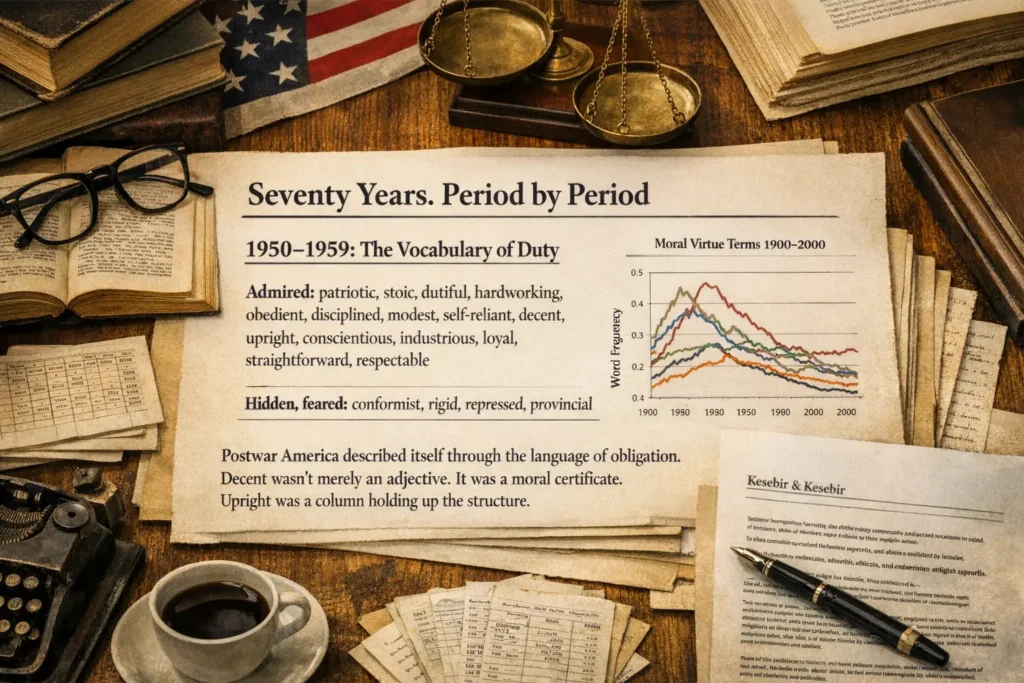
1950–1959: The Vocabulary of Duty
Admired: patriotic, stoic, dutiful, hardworking, obedient, disciplined, modest, self-reliant, decent, upright, conscientious, industrious, loyal, straightforward, respectable
Hidden, feared: conformist, rigid, repressed, provincial
Postwar America described itself through the language of obligation. Decent wasn’t merely an adjective. It was a moral certificate. Upright was an architectural metaphor: a person as a column holding up the structure.
Here, a crucial corpus fact. Social psychologists Pelin Kesebir and Selin Kesebir, who have both worked on questions of morality, virtue, and cultural change, tracked the frequency of moral character words across the 20th century and found that six of ten key virtue terms had already peaked before 1904. The 1950s, at least linguistically, may have been living on inherited moral vocabulary more than inventing new forms of it.
1960–1964: The First Fracture
Admired: idealistic, charismatic, inspired, sincere, passionate, committed, hopeful, progressive, sensitive, nonconformist
Emerging anxious words: rebellious, naive, restless, emotional, countercultural
Semantic reversal: rebellious, from deviant to heroic.
In 1955, the word was still close to a diagnostic category. By 1963, it looked increasingly like a brand. James Dean did not single-handedly create that shift, but he became one of its most visible cultural carriers. Rebellion began to acquire the prestige that conformity was starting to lose.
The DSM (Diagnostic and Statistical Manual of Mental Disorders) did not change. The dictionary, in practice, did. Linguists call this amelioration: a word with negative connotations acquiring positive ones. The speed here appears unusually fast. By historical standards, close to lightning.
1965–1969: The Language of Rupture
Admired: visionary, activist, outspoken, experimental, liberated, emancipated, spiritual, introspective, resilient, ideal-driven
Words as wounds: radical, traumatized, angry, alienated, conflicted, disillusioned
Vietnam-era discourse appears to have helped normalize traumatized well before PTSD entered DSM-III in 1980. That matters. In some cases, culture seems to name a pattern before medicine stabilizes it as a diagnosis. Not always. Not cleanly. But often enough to notice.
Language does not wait for institutions to certify experience. It improvises first.
1970–1979: The Decade of Cynicism and the First Narcissism
Admired: realistic, reflective, open-minded, soulful, adaptive, resilient, rational
Symptom words: cynical, disillusioned, anxious, apathetic, skeptical, depressed, distrustful, materialistic, hedonistic, narcissistic, emotionally distant, status-conscious
Semantic shift: individualistic, from free to alone.
Christopher Lasch captured something essential in 1979 with The Culture of Narcissism: American individualism, in his reading, had evolved from self-reliance into self-enclosure. The corpus evidence does not prove his thesis outright, but it does move in a compatible direction. Individualist language continued its sustained rise in this period.
The word itself did not necessarily change. The architecture around it did.
1980–1984: The Corporate Human
Admired: confident, motivated, career-oriented, competitive, entrepreneurial, bold, decisive, energetic, ambitious, self-assured
The other side: flashy, greedy, opportunistic, superficial, neurotic, image-conscious
Semantic shift: bold, from brave to branded.
Before the 1980s, bold more often described an act performed in the face of fear. Afterward, it increasingly attached itself to communication style, brand positioning, a packaging decision, a professional persona.
Reagan and Thatcher did not, by themselves, rewrite the vocabulary of strength. But the political-economic climate they helped consolidate appears to have rewarded a different register of self-description: less moral, more performative, more market-facing. Notably, corpus data shows that general moral language, good, bad, moral, evil, had been falling sharply from 1900 to 1980 before beginning an unexpected rebound. That rebound overlaps with a moment when moral language was increasingly reabsorbed into ideological conflict.
1985–1994: Irony as Defense Mechanism
Admired: pragmatic, assertive, strategic, self-made, driven, authentic, reflective, creative, introverted, self-aware
Dominant symptoms: yuppie, ironic, detached, sarcastic, existential, alienated, melancholic, raw, restless, insecure
This is the period when emotional becomes ambivalent: either spiritual depth or mood disorder, depending entirely on context.
The irony of the decade was not just wit. It often functioned as armor. A generation increasingly skeptical of institutions did not always know how to be sincere in public without sounding naive. So distance became style. Sarcasm became, at times, the only socially safe form of honesty.
1995–2004: Anxiety and Its Recode
Admired: tech-savvy, individualistic, open-minded, resilient, realistic, compassionate, conscientious, emotionally aware
Symptom words: edgy, paranoid, cynical, nihilistic, anxious, traumatized, guarded, suspicious, nationalistic, resigned
This period is bisected by September 11, 2001, with unusual clarity. Before: cool as aesthetic vacancy, detachment as cultural sophistication. After: resilient increasingly became the default adjective for any American community, institution, or individual who had survived disruption. The word appears to have moved from descriptive toward normative.
Here an important empirical marker. From 1979 to 2009, empathic concern among American college students declined by 48%, and perspective-taking by 34%. The sharpest drop came after 2000. This is not anecdote. It is a meta-analysis of 72 studies involving 13,737 subjects, conducted by Konrath, O’Brien, and Hsing at the University of Michigan. The same broad inflection point, post-2000, appears in corpus work as well. The structural causes likely run deeper than any single event.
2005–2014: The Rise of Therapy Language
Admired: self-expressive, empowered, innovative, empathetic, entrepreneurial, authentic, inclusive, vulnerable, open-minded, self-branded, connected, politically engaged
Symptom words: burned out, mentally exhausted, anxious, triggered, fragile, hyperaware, disconnected, multitasking, woke
Semantic reversal: vulnerable, from weakness to depth.
Brené Brown’s 2010 TED Talk did not single-handedly flip the polarity of vulnerable, but it very likely accelerated and popularized a shift already underway. Before: vulnerability as something to conceal. After: vulnerability as a mark of authenticity, depth, and courage. Not a total reversal overnight. More a rapid public consolidation of a new moral tone.
In parallel, the data on personal pronouns tells its own story. From 1960 to 2008, use of first-person singular pronouns, I, me, rose by 42%, first-person plural, we, us, fell by 10%, and second-person, you, your, quadrupled. We speak to ourselves and about ourselves, while simultaneously addressing our audience more directly.
The collective we does not disappear entirely. But it grows quieter.
2015–2019: The Era of Performative Virtue
Admired: mindful, adaptive, diverse, transparent, compassionate, curated, public, self-promoting
Symptom words: traumatized, exhausted, hypervigilant, burned out, performative, outraged, distrustful
Semantic shift: curated, from museum term to identity description.
Social platform algorithms did not invent self-presentation, but they intensified a new form of it: not mere publicity, but editorial control over one’s own image. Curated identity is what happens when a person manages impressions the way a gallery curator manages an exhibition: selecting what to show, removing what does not fit, adjusting for audience and sequence.
One plausible side effect is a growing difficulty in distinguishing the performed from the actually lived. Not for everyone. Not always. But enough to leave a lexical trace.
2020–2025: The Vocabulary of Diagnosis
Admired: resilient, emotionally intelligent, digitally fluent, community-driven, self-aware, hopeful
Symptom words: traumatized, self-diagnosing, overstimulated, disillusioned, lonely, hyperindividual, burned out, dysregulated, gaslit, triggered, neurodivergent
Self-diagnosing is the offspring of TikTok and therapy-speak. But the platform is only part of the explanation.
Research tracking 50 virtue-related words across the 20th century found that 74% of them declined in frequency over the period: honesty, patience, compassion, wisdom, humility, among others. Lexical vacuums do not stay empty. They tend to be filled. Clinical terms, anxiety, depression, trauma, dysregulation, migrated from specialist discourse into ordinary speech.
This is not simply the medicalization of life. It may also be an attempt to name distress in a culture where older moral and communal vocabularies no longer feel adequate. That is not a final conclusion. It is, at this stage, the strongest interpretation the pattern seems to invite.
One complicating footnote. Updated empathy data through 2018 suggests that after 2009, both empathic concern and perspective-taking began to recover. The curve is not linear. Whether that reflects collective trauma, digital fatigue, generational correction, or something else entirely, the evidence is not yet sufficient for a clean verdict.
What the Full Arc Actually Shows
If you compress seventy years into a single movement, the shift looks something like this:
We moved from the language of obligation toward the language of internal legitimacy. From words describing what I owe others to words describing what others must recognize in me. From decent and upright to authentic and self-diagnosing.
That is not necessarily decay. It is not necessarily progress either. It is a change of architecture.
Marcus Aurelius wrote that a man’s life is colored by his thoughts. I would add: by the words available to describe those thoughts. When obedience was admirable, obedience was performed. When authenticity became admirable, authenticity was performed. The content changed. The performance remained.
The fact that Americans now possess precise vocabulary for anxiety, burnout, hypervigilance, and emotional exhaustion is a genuine achievement. The question, which I will not pretend to settle here, is whether naming something relieves it, or merely makes it more legible.
The Stoics would say that distinction matters enormously.
A Note on the Data
The word lists in this analysis are an interpretive synthesis, not algorithmic output. Primary sources: Google Ngram Viewer, COHA, NOW Corpus. Research base: Twenge, Campbell and Gentile; Konrath, O’Brien and Hsing; Kesebir and Kesebir; Hamilton, Leskovec and Jurafsky.
Corpus evidence can show frequencies, pressure points, and shifts in usage across time. But perhaps its deeper value lies elsewhere: it reminds us that language is never merely a tool for describing reality, but one of the structures through which reality is perceived, organized, and lived. And if that is true, then listening more carefully to the words a culture repeats may also teach us to handle our own language with greater precision, caution, and responsibility.
•••
About the Author
Dimitriy Wolf is a communication strategist, mentor, and entrepreneur. He helps founders and experts cut through noise, sharpen their thinking, and communicate with precision and structure. A relentless book collector, he is now working to write something worthy of the shelves he’s built.
INSTAGRAM
www.instagram.com/dimitriywolf
LINKEDIN
www.linkedin.com/in/dimitriy-wolf