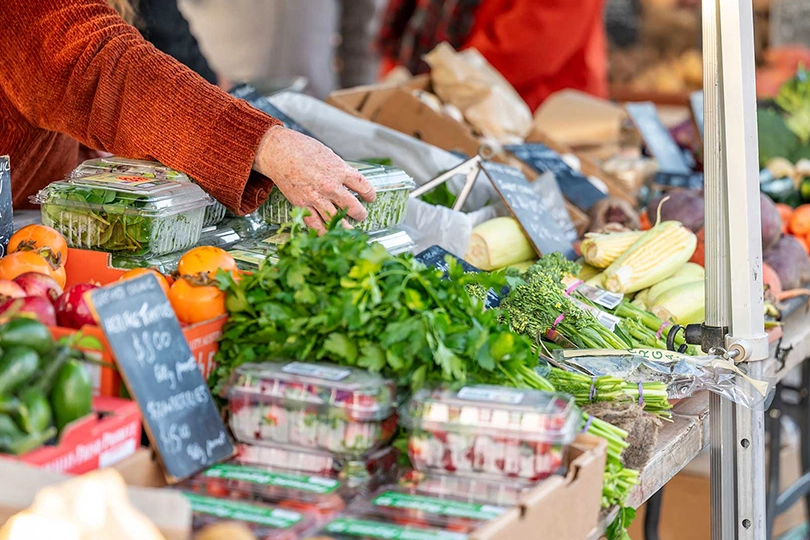
A routine trip to the supermarket has become one of the most painful parts of the family budget. Americans are buying the same eggs, meat, milk, and vegetables, but leaving far more money at the register. Grocery prices in the United States have risen about 33% since 2019. According to an Associated Press analysis, this is the sharpest seven-year increase in half a century.
Inflation may have slowed, but groceries have not become cheap again. Slower inflation means that prices are rising less quickly. It does not mean that they are returning to previous levels. If a product first rises by 20% and then adds another 3%, it has not become more affordable. It is simply becoming more expensive at a slower pace.
The contrast with the previous period is striking. From 2012 through 2019, U.S. grocery prices increased by only 6.4%. Then the situation changed rapidly. Between January 2021 and January 2023, prices climbed by about 21%. The pandemic disrupted production and logistics, companies struggled with worker shortages, transportation and energy became more expensive, and Russia’s war against Ukraine added pressure to global markets for grain, fertilizer, and fuel.
The pace has moderated since the most severe inflationary period, but the accumulated increase has not disappeared. According to the U.S. Department of Agriculture, food prices in June 2026 were 3% higher than a year earlier. Food purchased for home consumption was 2.7% more expensive, while food away from home increased by 3.4%. This is no longer the double-digit inflation of 2022, but families paying roughly one-third more than in 2019 may feel little relief.
Beef has become the clearest symbol of this new reality. According to the U.S. Bureau of Labor Statistics, the average price of regular ground beef reached $6.825 per pound in June 2026. That was 11.5% higher than a year earlier and approximately 79% above the level at the beginning of 2019. Lean and extra lean ground beef averaged $8.65 per pound.
The U.S. cattle herd has fallen to its lowest level in approximately 75 years. Drought damaged grazing land, feed and fuel became more expensive, and ranchers reduced their herds. Rebuilding those herds cannot happen quickly. Even better weather would not produce an immediate decline in beef prices.
Demand for beef also remains strong. Limited supply is colliding with the preference of millions of families for ground beef, steaks, and grilling meat. The USDA expects beef and veal prices to increase by an average of another 10.7% in 2026. By June, prices in the category were already 11.8% higher than a year earlier. For shoppers, this means that one of the largest sources of pressure on grocery bills is not going away yet.
The increases are not evenly distributed. In June 2026, fresh vegetables cost 9.9% more than a year earlier, while sugar and sweets were up 6.9%. The average price of ground coffee reached approximately $9.46 per pound, which was 16.3% higher than the previous year.
Not every product is rising at the same time. Eggs, which earlier became a symbol of food inflation because of avian influenza outbreaks, averaged $2.14 per dozen in June. That was 43.3% lower than a year earlier. The USDA expects the average price of eggs to fall sharply in 2026 as the population of laying hens and egg production recover. Chicken and some pork products are also showing calmer price movement. Individual items can become cheaper even while the overall grocery basket continues to cost more.
Food purchases cannot be postponed like a new phone or a piece of furniture. Lower-income families feel the increase most because groceries take a larger share of their budgets. Some households are reducing meat purchases, abandoning familiar brands, and turning to food banks for assistance.
The behavior of higher-income shoppers is changing as well. Consumers are comparing stores, choosing private-label products, using coupons, and buying larger packages. Saving money on groceries has become a normal financial strategy rather than something associated only with hardship.
Why are prices not returning to previous levels? Wages, rent, insurance, energy, packaging, and transportation all cost more. New tariffs may increase the price of imported food and raw materials, while extreme weather, animal diseases, and international conflicts create additional disruptions. A broad return to 2019 price levels now appears unlikely.
Analysts describe today’s price level as a new normal, but that does not mean every item will only become more expensive. Eggs have already shown that recovering production can create a significant decline. Still, falling prices in a few categories are not enough to erase the overall 33% increase.
In its July outlook, the USDA forecast that all food prices would rise by 3.1% in 2026. Food purchased for home consumption is expected to increase by 2.7%, while restaurant and other foodservice prices may rise by 3.5%. The forecast for all food in 2027 is also 3.1%, although the range of uncertainty is unusually wide. The central forecast for grocery prices is an increase of 2.9%.
This means federal analysts are not expecting a broad and sudden decline. Even if inflation remains close to its historical average, it will be added to an already elevated price base. A grocery basket that cost $100 in 2019 now costs about $133. After another increase of 3.1%, its hypothetical price would approach $137. The percentage may look small, but over a year the difference can become hundreds or thousands of dollars.
Shoppers are being forced to adapt. Meal planning, comparing unit prices, replacing expensive ingredients, freezing food, buying seasonal produce, and choosing store brands can help. Personal savings strategies do not change the larger fact that U.S. groceries have experienced the biggest price surge in a generation.
The question is no longer only when the increases will stop. The more important question is how long American families can keep adjusting their budgets to the new cost of basic necessities.