Tesla is doing something most companies avoid at all costs. It is walking away from its own legends.
In the second quarter of 2026, Tesla will officially stop producing the Model S and Model X. Elon Musk described the move as an honorable retirement, a respectful exit for the vehicles that helped define the company.
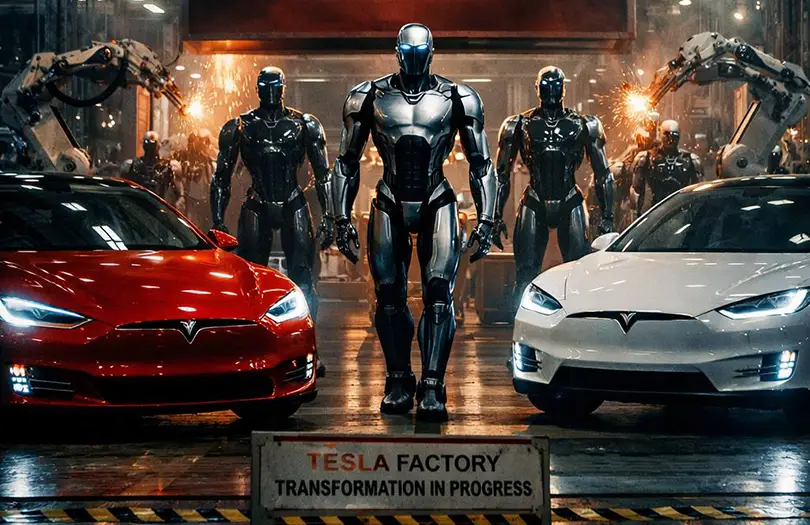
But beneath the calm language lies a major transformation. This decision is not about cleaning up a product lineup. It is about changing the future direction of Tesla itself.
The Cars That Built the Myth
There was a time when the Model S felt like science fiction on wheels. It was fast, silent, minimalist, and unapologetically different. It challenged gasoline dominance and embarrassed luxury brands that had ruled for decades.
The Model X followed with equal ambition. Falcon Wing doors were not practical in the traditional sense, but they made a statement. Tesla was not interested in playing it safe.
These cars turned Tesla into a cultural symbol. Owning one meant you believed in technology, progress, and a future that arrived earlier than expected.
They were not just vehicles. They were proof that bold ideas could survive reality.
Why Icons Eventually Lose Momentum
Markets do not reward nostalgia. They reward efficiency.
Over time, Model S and Model X drifted away from the center of demand. Their prices rose to around 95,000 and 100,000 dollars. Meanwhile, the electric vehicle market expanded rapidly, offering capable alternatives at far lower prices.
Tesla itself accelerated the shift. Model 3 and Model Y became the backbone of the company. In 2025, they accounted for 97 percent of all Tesla deliveries.
These cars fit real life better. They were easier to afford, easier to justify, and easier to scale.
The data left little room for sentiment.
A Strategic Goodbye, Not a Retreat
Tesla is not replacing Model S and Model X with new luxury flagships. That detail matters.
This is not a pause or a redesign. It is a deliberate exit.
Customers are being encouraged to place final orders while inventory remains. Once those cars are gone, production ends permanently.
In an industry obsessed with legacy, Tesla chose clarity. When a product no longer serves the mission, it steps aside.
Fremont Factory Gets a New Purpose
The most revealing part of this story happens on the factory floor.
Tesla’s Fremont facility will be fully converted to produce humanoid robots called Optimus. The same space once used for premium vehicles will now build machines designed to work alongside humans.
This is not a symbolic experiment. Elon Musk has stated that Tesla aims to reach production of up to one million robots per year.
That scale places Optimus at the center of Tesla’s future, not the edges.
Why Robots Change Everything
Humanoid robots may sound futuristic, but the economic logic is very real.
Industries across the United States face growing labor shortages. Physical work remains essential, yet fewer people are willing or able to do it. Automation has already transformed factories, but it lacks flexibility.
A general purpose robot that can walk, lift, and adapt could redefine productivity.
From a scientific standpoint, Tesla’s advantage lies in its AI systems, vision processing, and manufacturing expertise. The same neural networks used for autonomous driving can be applied to robotic movement and decision making.
Optimus is not a toy. It is an extension of Tesla’s AI philosophy.
Tesla’s Identity Shift Becomes Official
For years, analysts debated whether Tesla was a car company or a technology company.
This decision answers the question.
Tesla is becoming an AI driven industrial platform. Cars are one application. Robots may become the largest one.
Model 3 and Model Y remain critical. They fund research, production, and global expansion. But they are no longer the headline.
Optimus is.
What This Means for American Consumers
For US buyers, Tesla’s lineup becomes simpler. Affordable electric vehicles stay. Ultra premium options fade away.
This reflects broader consumer behavior. Buyers prioritize value, charging access, and reliability over exclusivity.
For investors, the message is clearer and riskier. Tesla is doubling down on artificial intelligence and automation rather than luxury branding.
For competitors, the move raises an uncomfortable question. What happens when the market leader stops competing in the same game?
The Legacy That Will Not Disappear
Model S and Model X will not be forgotten.
They forced the auto industry to accelerate. They normalized software updates, large touchscreens, and electric performance. They reshaped expectations.
Their retirement does not erase their impact. It confirms it.
They completed their mission.
The Bigger Picture
Tesla is not shrinking. It is refocusing.
By stepping away from its past, the company is clearing space for something larger than cars. Something that could redefine how work is done, how factories operate, and how humans interact with machines.
The end of Model S and Model X is not a loss.
It is a signal.
The future Tesla is building no longer lives only on the road. It walks, learns, and works.