There is a quiet tragedy happening in kitchens all over the world.
A person stands in front of the refrigerator late at night, exhausted after another day of trying to “be good.” They skipped breakfast, ate a tiny lunch, ignored cravings, drank more coffee than water, and spent the whole day fighting hunger. Then suddenly it happens. The cereal box opens. The cookies disappear. Bread, sweets, leftovers, anything within reach.
Afterward comes the familiar shame.
“I have no discipline.”
“I ruined everything.”
“I just need more willpower.”
But what if the problem was never a lack of discipline?
What if the real problem is that millions of people have been taught to fear food more than they understand it?
For years the dieting world has sold the same fantasy: eat less, shrink portions, ignore hunger, avoid pleasure, stay strict. And for a while it works.
Until the body fights back.
Because the human body is not a machine that quietly accepts starvation. It is a survival system. When it senses restriction, hunger becomes louder, cravings become obsessive, and food suddenly occupies every thought.
That is why so many people are trapped in the same exhausting cycle: restriction, cravings, overeating, guilt, repeat.
Ironically, some of the most effective foods for weight loss are not tiny “diet foods” at all. They are foods that actually satisfy you.
This realization recently exploded across nutrition discussions on Twitter, where experts began sharing something refreshingly simple: certain foods allow people to eat larger portions, stay full longer, and naturally reduce overeating without feeling miserable.
And the list surprised many people because it included foods most dieters wrongly learned to fear.
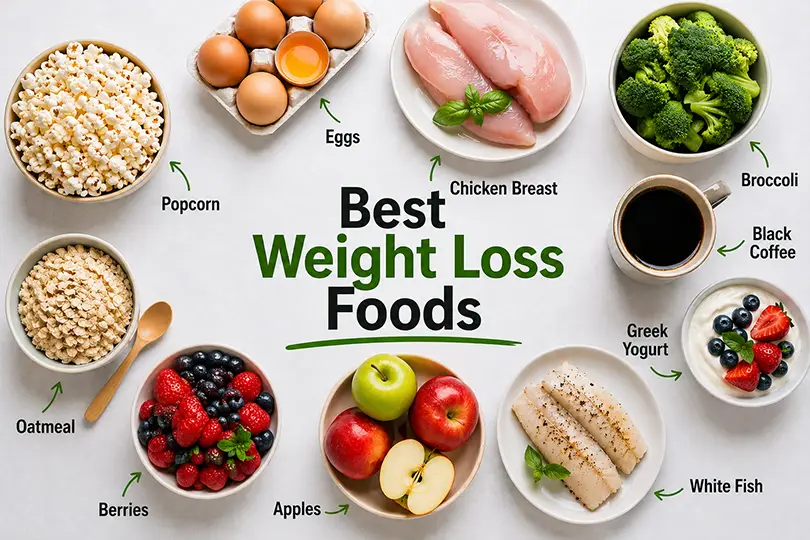
Take popcorn 🍿
Not movie theater popcorn drowning in butter. Real air popped popcorn.
A huge bowl can feel incredibly satisfying while containing surprisingly few calories. It fills physical space in the stomach, gives the brain a sense of abundance, and helps reduce the psychological panic that often comes with dieting.
That matters more than people realize.
Human hunger is not only biological. It is emotional, visual, and psychological.
Sometimes people do not need more sugar or fat. They simply need to feel like they truly ate enough.
Modern dieting rarely understands this. It often asks people to survive on portions that leave both the stomach and the brain feeling deprived.
And deprivation always has consequences.
That is why foods high in protein and fiber quietly outperform many trendy diet products.
Eggs 🍳 were unfairly demonized for years. Yet research consistently shows they are highly filling. A breakfast with eggs often keeps people fuller much longer than sugary cereals or ultra processed snack bars marketed as “healthy.”
The difference is simple.
Some foods calm hunger.
Others stimulate more hunger.
And modern food companies became incredibly skilled at designing products that keep people eating.
Soft textures. Fast digestion. Sugar combined with fat. Foods that disappear quickly and barely trigger fullness before another craving arrives.
The problem is not always overeating.
Sometimes the real problem is eating foods that never truly satisfy.
Chicken breast 🍗 became a cliché in fitness culture, but the science behind it remains strong. Protein requires more energy to digest, helps preserve muscle mass, and reduces hunger hormones more effectively than many processed foods.
Broccoli 🥦 works in a similar way through volume and fiber. A large serving physically fills the stomach while adding relatively few calories. It slows digestion and creates a lasting sense of fullness.
This is one of the biggest misunderstandings in modern dieting: people think successful weight loss comes from eating as little as possible.
In reality, sustainable weight loss often comes from learning how to stay full without overeating.
That is a completely different mindset.
Coffee ☕ Even black coffee tells an interesting story. Many people think they are hungry when in reality they are mentally exhausted. Caffeine can temporarily reduce appetite and increase alertness, but more importantly, it reveals how often emotional fatigue disguises itself as physical hunger.
After a stressful day, very few people crave steamed vegetables.
They crave comfort. Crunchy foods. Sweet foods. Warm foods. Foods connected to relief.
This is not weakness. It is human psychology.
Food became emotional medicine for many people long before they realized it.
That is also why foods like Greek yogurt 🥣 and berries 🍓 work so well. They create satisfaction without the crash. They feel enjoyable rather than punishing.
And enjoyment matters.
Because diets built entirely on suffering rarely survive real life.
The people who maintain healthy weight long term are usually not the people constantly starving themselves. They are the people who learned how to eat in a way that feels sustainable, calming, and normal.
The same is true for oatmeal 🥣
For years carbohydrates became the villain of the internet. But slow digesting carbohydrates can actually stabilize energy, reduce cravings, and prevent nighttime binge eating.
The issue was never simply carbs.
The issue was always the relationship between hunger, fullness, and food quality.
An apple 🍎 illustrates this perfectly. It slows eating down, requires chewing, and creates fullness gradually. In a world built around hyper processed foods engineered for speed and overconsumption, something as simple as chewing slowly becomes powerful again.
And perhaps that is the uncomfortable truth hidden underneath the entire weight loss industry:
Most people are not failing because they are lazy.
They are failing because they are trying to fight millions of years of human biology with tiny portions, constant restriction, and shame.
Real health rarely looks dramatic.
Usually it looks boring in the best possible way. Enough protein. Enough fiber. Enough volume. Enough nourishment. Enough food to stop the war inside your own mind. Because maybe the goal was never to become someone who eats the least.
Maybe the real goal is becoming someone who no longer spends every waking hour thinking about food. And for many people, that changes everything.