When 33-year-old Jasmine thinks about her life, she reflects on how far she and her two children, ages 13 and 5, have come.
She arrived in Sacramento from Afghanistan in 2017 to join her husband, but unfortunately, her abuse began not long after. Isolated, her husband told her she’d lose the children if she went to authorities. It was her worst fear. With no money, job, English language skills or knowledge about her rights, she and her children stayed quiet and suffered.
The violence escalated one day after her husband physically abused her for buying oranges “without his permission,” says Jasmine, who is using a pseudonym to protect her identity. Barefoot, she ran out of the house with her children and slept in a park. With no place to go, she returned home the next day where the abuse continued.
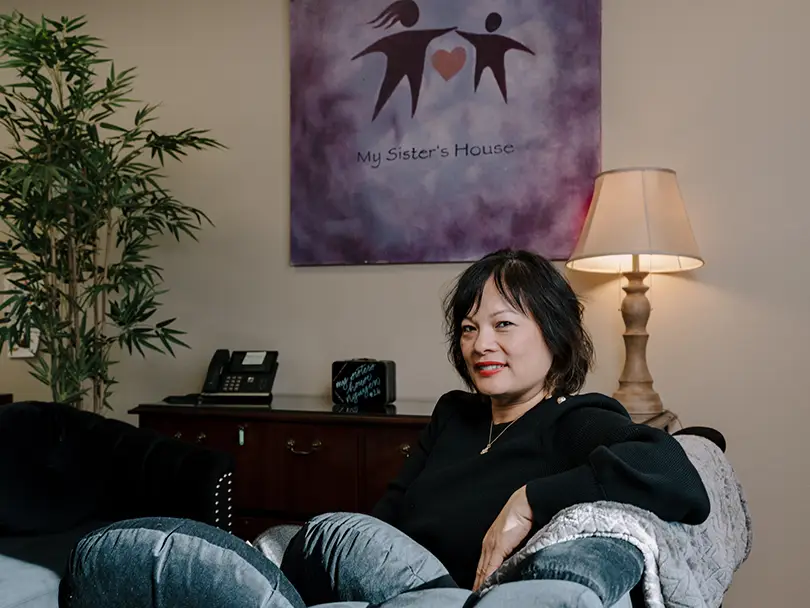
That night, she called My Sister’s House, a local domestic violence shelter geared toward helping Asian and Pacific Islander women and children.
“By the time I came to My Sister’s House, I was very helpless and hopeless,” she says. “It was a lot of trauma we’d been through.”
For women like Jasmine seeking a safe place to land, My Sister’s House has been a lifesaver.
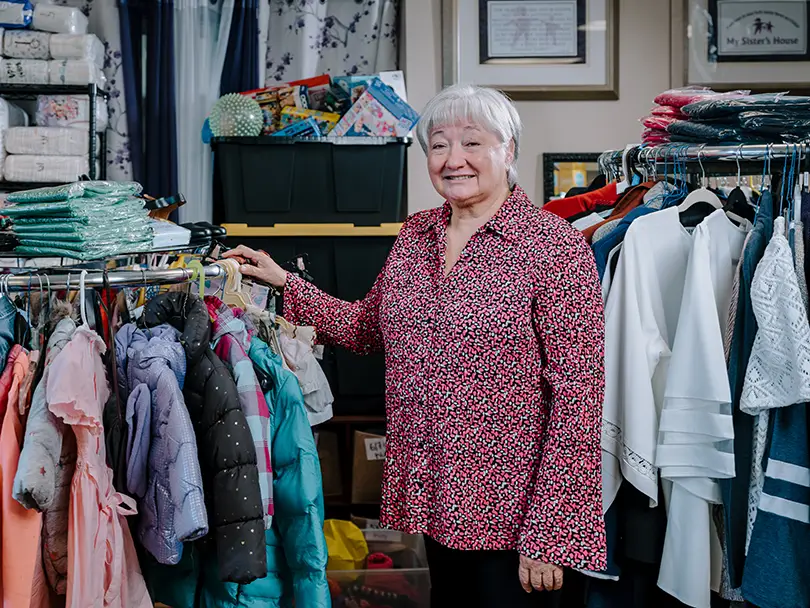
Marta Pena-Lane, cultural advocate with My Sister’s House, says serving Asian and Pacific Islander women with sensitivity to their language and cultural needs was the catalyst to starting the nonprofit in January 2001. The shelter’s website can be translated into more than 20 different languages and they offer a 24-hour multilingual helpline, shelter program, legal aid, counseling sessions and other resources.
“We cater to these people so that language is not a barrier at all,” Pena-Lane says.
Domestic violence is a growing problem in the Sacramento region, and data from the California Department of Justice shows that calls for domestic violence incidents in Sacramento have mostly increased on a year-by-year basis. In 2023 and 2024, a majority of these calls involved a weapon.
The National Intimate Partner and Sexual Violence Survey published in 2022 revealed that 27% of Asian and Pacific Islander women surveyed reported experiencing physical violence, sexual violence or stalking by an intimate partner at some point in their lives.
But, violence against women affects all racial and ethnic groups — the same survey found that approximately 63% of non-Hispanic multiracial women, 57% of American Indian or Alaska Native women, 53% of Black women, 48% of non-Hispanic white women, and 42% of Hispanic women surveyed experienced violence.
Not all domestic violence incidents make it into a police report. And many women don’t know their rights or trust law enforcement.
“So, they stay,” Pena-Lane says. She adds that some victims may find reporting challenging as they are still “entrenched in the dynamics of their culture.”
📌 This month marks the organization’s 25th year of service in Sacramento. The organization is planning a 25th Anniversary Gala on Thursday, Jan. 22 at the Greek Orthodox Church on Alhambra Boulevard.
“We are a small mighty team and we need to be here,” says CEO Christine Nguyen. “In domestic violence, we do not celebrate the volume of people that we serve. We celebrate one life that we save at a time.”
In 2025, My Sister’s House provided 19,646 nights of safety to women and children, responded to more than 3,800 calls to their helpline and provided legal aid to 880 survivors, according to Nguyen.
Nguyen highlights how crucial their services are to the community as they triage calls every day from survivors asking for some form of support. But with only 18 beds available throughout the year, it sometimes takes months for a spot to become available.
“There’s never a day where the beds are empty,” she says.
And the beds are simply not enough, Pena-Lane says, adding that they have expanded their services to include women from all backgrounds.
For Alina, 28, she went through 11 months of verbal, physical and sexual abuse by her husband after she arrived from Pakistan in 2022. He told her he no longer wanted to be married and gave her a month to get out. Luckily, her friend was able to point her to My Sister’s House, and while waiting for her month to be up while living with her husband, her friends taught her how to drive and get a license. But she still needed so much more to help support herself, she says.
“Here, I was like a newborn baby,” says Alina, who is also using a pseudonym to protect her identity. “My Sister’s House and their people helped me with everything.”
With legal aid, she began divorce proceedings and received spousal support. She began working at My Sister’s Café, an initiative by the nonprofit that helps domestic violence survivors “get back on their feet,” finished cosmetology school and began working at a beauty salon.
“I can’t imagine if I didn’t find My Sister’s House. I don’t know where I would be,” she says.
For both Jasmine and Alina, they also fought a silent battle within their own cultures. Both women’s families wanted them to stay with their husbands, not wanting them to fall into the cultural stigma and shame that follows divorced women.
Alina says she misses her mom very much, but deep in her heart she knows returning to Pakistan is risky.
“I think if I go back, I’m not going to be safe,” she says. In Sacramento, she continues to rebuild herself every day, having moved into a new studio just two months ago with help from My Sister’s House.
Jasmine says is proud she’s not raising her children in an abusive environment. Counseling has helped her recognize the patterns of abuse, encouraged her to live a healthy lifestyle, and build self-confidence as she and her children heal.
“It opened my eyes that I was suffering so much and carrying a heavy burden of shame, guilt and blame on myself, which abuse does to a person,” Jasmine says.
The whole family is in the process of healing, but more than anything, she says she knows she is safe now.
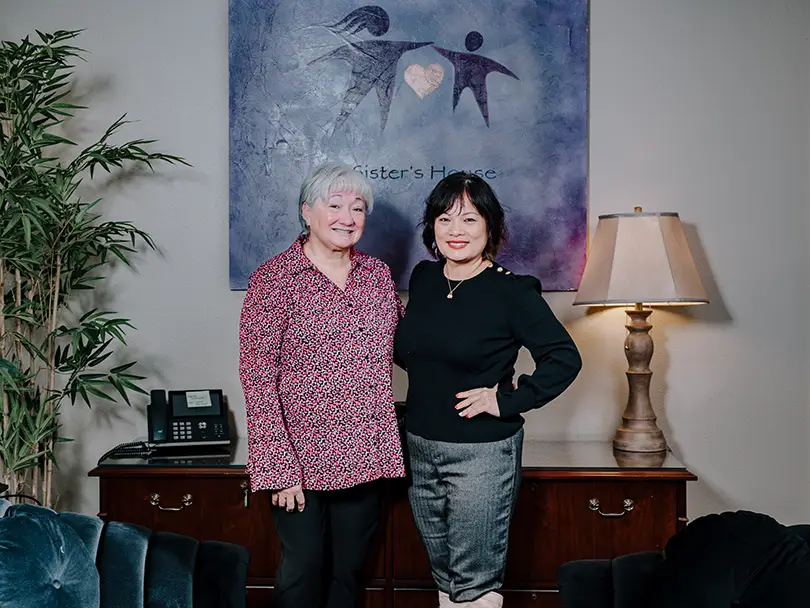
Women like Jasmine and Alina, who have received the full breadth of wraparound services are prime examples of why My Sister’s House exists. “I see beyond the woman,” Nguyen says. “I’m seeing into the future of her children, and what we are preventing her children from seeing by saving her.”
This story is part of the Solving Sacramento journalism collaborative. Our partners include California Groundbreakers, Capital Public Radio, Hmong Daily News, Russian America Media, Sacramento Business Journal, Sacramento News & Review and Sacramento Observer. Support stories like these here, and sign up for our monthly newsletter.
By Amritpal Kaur Sandhu-Longoria