For decades, flying has been a compromise. You save money, but you give up comfort. Tight seats, limited legroom, awkward neck angles, and the constant attempt to fall asleep in a position your body clearly rejects. Most people accept it as part of the deal.
Now that deal is starting to change.
United Airlines is preparing to introduce a new seating concept called Relax Row, and it could reshape how millions of people experience long haul travel. This is not just a nicer seat or a small upgrade. It is a fundamental shift in how economy class is designed.
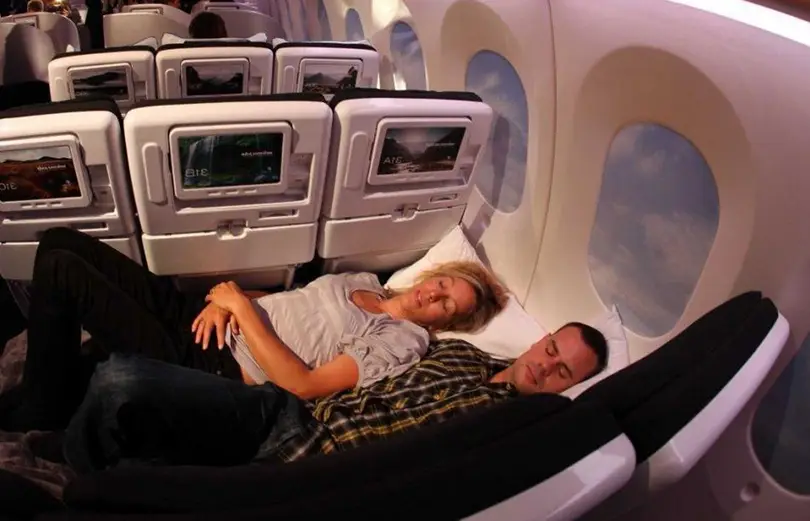
The concept is simple, but powerful. A standard row of three seats transforms into a flat surface. Footrests lift, gaps disappear, and the entire row becomes a space where a passenger can actually lie down. Not halfway reclined. Not twisted sideways. Fully stretched out.
Add a mattress, a blanket, and extra pillows, and suddenly the experience moves from survival mode to something that feels close to real rest.
At first glance, this may sound like a comfort upgrade. In reality, it goes much deeper.
Sleep science has been clear for years. The position of your body directly affects how well you recover. When you sleep sitting upright, your body struggles to enter deeper sleep stages. Blood circulation is less efficient. Muscles stay partially tense. Your brain does not fully reset.
That is why after a long flight, many people feel more than just tired. They feel foggy, irritable, slower to react, and less focused. Studies on circadian rhythm disruption show that poor sleep during travel can impact productivity, mood, and even immune response for days.
In other words, the way we currently fly is not just uncomfortable. It has real biological consequences.
This is what makes the idea of lie flat seating in economy so important. It is not about luxury. It is about recovery.
And the timing is not random.
Long haul travel is growing again. Remote work allows people to move more freely. International routes are getting busier. At the same time, passengers are becoming more aware of how travel affects their bodies. People track sleep, measure stress, and actively look for ways to reduce fatigue.
Comfort is no longer just a preference. It is part of a broader wellness mindset.
Relax Row fits directly into that shift.
What makes this rollout even more significant is its scale. By 2027, more than 200 Boeing 787 and Boeing 777 aircraft are expected to include these transformed rows. That is not a niche experiment. That is a large scale operational decision.
It also signals confidence.
Airlines do not redesign cabins lightly. Every inch of space is calculated. Every seat is tied to revenue. Introducing a new format means the numbers behind it make sense.
And that brings us to the business side of the story.
For years, airlines have been optimizing premium cabins. Business and first class have evolved into highly refined products. Private suites, full beds, personalized service. But growth in that segment is naturally limited.
Economy class, on the other hand, represents the majority of passengers. Even a small improvement there can create a massive impact.
Relax Row sits in a very interesting position. It is not traditional economy, but it is not full business class either. It creates a new middle layer. A product for people who are willing to pay more for real rest, but not ready to spend several times the ticket price.
If priced correctly, this could unlock a new revenue stream while also improving customer satisfaction.
And then comes the competitive effect.
If this concept proves successful, other airlines will not wait. Aviation is highly competitive, and passenger expectations spread quickly. What feels like innovation today often becomes standard tomorrow.
We have seen this before. Personal screens, better meals, onboard Wi Fi. At one point, these were premium features. Today, they are expected.
Lie flat economy seating could follow the same path.
There is also a human side to this story that is easy to overlook.
Travel is not just about getting from one place to another. It is about how you feel when you arrive. Whether you are ready for a meeting, able to enjoy a vacation, or present with your family.
A good flight experience does not end when the plane lands. It carries into everything that comes after.
This is especially important for families.
United is also planning to include travel kits and soft toys for children, which shows that this concept is not limited to business travelers. It is designed for real people with real needs. Parents who want their kids to sleep. Travelers who want to arrive without exhaustion.
It is a small detail, but it reflects a larger shift. Airlines are starting to think about passengers as people, not just seat numbers.
Of course, one key question remains.
Price.
United has not announced how much Relax Row will cost, and this will ultimately determine how widely it is adopted. If the price gap is too large, it may stay a niche option. If it feels accessible, it could change booking behavior across the board.
Many travelers already spend extra on better seats, extra legroom, or early boarding. The difference here is that the value is more tangible. Sleep is not a bonus. It is a necessity.
And people are increasingly willing to pay for things that directly improve how they feel.
There is also a psychological shift happening.
For a long time, discomfort in economy class was normalized. It was seen as something you simply had to endure. But expectations evolve.
Once people experience something better, it becomes very hard to go back.
If even a portion of passengers try lying down during a long flight, the perception of what is acceptable will change.
And that is how industries transform. Not overnight, but through a series of upgrades that slowly redefine the baseline.
Relax Row may be one of those moments.
A point where flying starts to move away from endurance and closer to experience.
A step toward making long distance travel not just possible, but genuinely comfortable.
And maybe, a few years from now, we will look back at the era of upright sleeping in economy with a mix of disbelief and relief.
Wondering how we ever accepted it as normal.