
Joi Tikoi serves as Assistant Superintendent of Gateway Community Charter schools in Sacramento, and if you stop to think about it, that title explains almost nothing about the true weight of her work. Behind her are not just nine schools, but thousands of children, hundreds of teachers and staff, and many family stories, each one held together by trust and respect. At this level, a decision loses its local flexibility almost instantly. But it also sets off a chain reaction: change moves through campuses, budgets, expectations, and only then becomes reality.
Serving as an educator for over thirty years, she has traveled a path that changes the way a person sees things. She taught school in Florida and Tennessee, then spent five years in Fiji, teaching children in a local public school and an international school in Nadi. That experience of living inside another language and way of life, rather than simply studying it from the outside, would later shape everything she went on to do in California.
Her day is made up of decisions that parents barely notice, yet if those decisions are not made, the school begins to falter. Funding depends not on whether a child is enrolled, but on whether that child steps into the classroom in the morning. Getting students to classrooms is a struggle for every district, every school, every teacher, and often parents. And then there is the trust of parents, many of whom speak English as a second language, and for whom school is the first place where they seriously encounter the culture of a new country. We spoke with her about what responsibility looks like when behind you there is not one door, but an entire network. And here is the thing: this is not about control at all. It is about weight. The kind no one notices.
The conversation with Joi Tikoi quickly moves away from the formal language of job descriptions, because job descriptions explain absolutely nothing here. Her work is a constant choice between decisions, each of which immediately echoes not in one office, but across all the schools at once.

If you compare leading one school with leading an entire system, when did you feel that the rules of the game had completely changed?
Managing one school is easier, although that does not mean there is less responsibility, or that you can do whatever you want. At the level of a single school, you remain the sole authority on site, and in your hands is what we call local control. You see a problem, make a decision, and almost immediately see the result. There is a certain clarity in that speed, and later you begin to miss it.
Moving to the level of the whole system changes the logic. You can no longer think only about the issue that happened this morning in one specific classroom. Your horizon now covers all the schools at once. One wrong decision in one place quickly spreads throughout the whole structure in circles that are very difficult to pull back together.
She says this calmly, but you can feel that behind her words is the experience of explaining things that are not obvious.
That is why the process inevitably slows down. We consult with lawyers, review the education code, look at the law, and try to understand how a decision will work not just today, but a year or two from now. You cannot operate here by saying, “Let’s try it and roll it back later,” because there will be no rollback. Too many people will already be built into the new reality, and any attempt to reverse course will lead to chaos. Mistakes at this level are expensive, not only in money, but in trust, in stability, in the nerves of teachers and parents.

So speed is the price you pay for scale?
In a way, yes. And I understand that this causes frustration both within the team and among parents. People think, why does it take so long, why can’t you just make the decision? But when you are responsible not for one door, but for an entire network, slowing down is not weakness and not bureaucratic inertia. It is the only way to avoid creating problems whose consequences you will be cleaning up for years.
At the level of a single school, you can correct a mistake quickly: you see what is not working, change it, and tomorrow you are already living differently. At the level of nine schools, that luxury disappears, because while you are fixing one situation, all eight of the others may already be moving in the wrong direction, and synchronizing everything afterward becomes nearly impossible. That is why we have to calculate all possible consequences in advance and make only those decisions that can stand the test not of today’s mood, but of time.
The decisions Joi Tikoi is talking about rarely come down to someone’s incompetence or unwillingness to act. Much more often, they come down to numbers, to those invisible calculations parents never see, the ones that determine whether the air conditioning in a classroom will work and whether there is enough money for one more English teacher.
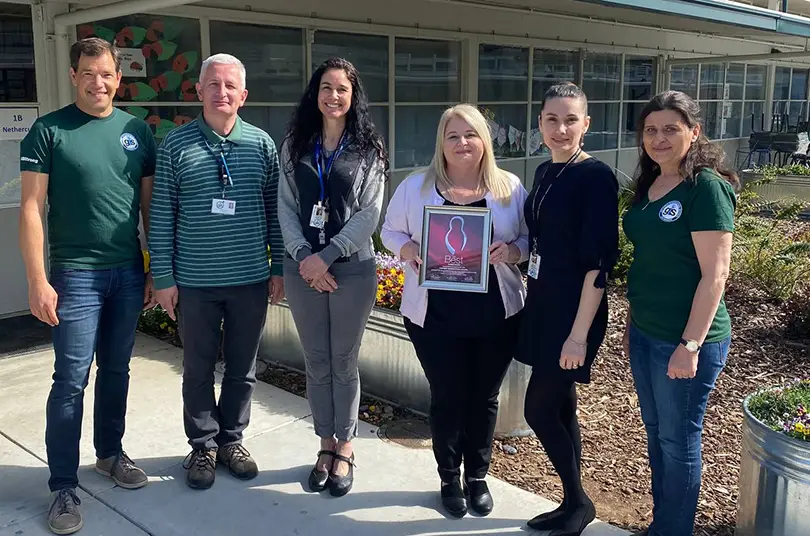
In practical terms, what are the main limitations? How much of everything comes down to funding?
Funding is both the clearest and the most complicated part of the system. Almost everything depends on it, but it is structured in such a way that there is almost no stability. In California, schools receive money not by the number of enrolled students, but by actual attendance: if a child does not show up, there is no money for that day, even though the school itself continues operating the same way. Teachers are there, bills still arrive, expenses remain the same.
In some states, funding is tied to enrollment, and that gives at least a degree of stability. Here it is different, and every day you depend on attendance, on the season, on outside circumstances you do not control.
There are additional funding categories for children from low income families, for students whose first language is not English, for homeless students, or for those in foster care. The idea behind this system is understandable: to direct more resources where they are truly needed.
She falls silent for a few seconds, as if deciding whether it is worth going deeper into details that are rarely spoken aloud.
But charter schools are in a special position, because we do not have the same access to funding as traditional district schools. We do not receive local property tax funds in the same volume, and although formally we are entitled to part of that money depending on how many of our students live in a given district, in practice the numbers are completely different. There are separate grants and support programs, but access to them is limited, and the application process requires so much time and bureaucratic effort that sometimes it is easier to abandon the idea than to go through the whole process with no guarantee of success.

Does that directly affect how you distribute resources within the system?
Directly. Take transportation, for example. Traditional schools have separate budgets for buses, while we do not have that line item at all, and any expense related to getting children to school comes out of our base funding, from the same money that pays teachers’ salaries, buys instructional materials, and repairs the roof. Every time we spend money to make sure a child gets to school, we take it away from something else, and that is not a figure of speech. That is plain accounting reality.
It is a similar story with buildings. There is a special infrastructure grant for charter schools, but obtaining it is a complex, multi-step process, and no one can guarantee that you will receive it in the end. So, you are constantly in a situation where every yes means no to something else, and it becomes a constant balancing act between needs, none of which can simply be postponed.

You said that mistakes at this level are costly, and that this is not only about money, but about trust. In your opinion, what is the biggest misconception about school leaders today?
I often run into the assumption that principals or administrators are automatically not on people’s side. That we want to hide something, to protect the school rather than support them or the child. They come in ready for conflict because they themselves may have had a negative experience in school, with teachers, with a principal, with a boss, or with the system as a whole. And they bring that past experience into the room with them, sometimes projecting it onto us.
Sometimes, I literally have to persuade a person: listen, I am on your side, I am on your child’s side. If you need help, you need to ask me, because I am the one who can organize that help for you. But it takes time and energy to say that, to be heard, and to be believed, and sometimes those are exactly the things in shortest supply.
She says this without resentment, more as a fact of life she has learned to work with.
And there is another misconception I hear all the time: that leaders and teachers do not need gratitude because that’s what they’re paid to do. That is not true. They work far more than what is written in their job descriptions, stay late at school, take work home on weekends. And they deserve appreciation equally. Money matters, but it does not cancel out basic human regard for one another.
We had been talking about mistrust coming from the outside. But within the system itself there is also constant tension between what regulations and reporting require, and what teachers and children actually need every day.

How do you maintain that balance?
In reality, there is no separation. The needs of students and the needs of teachers are our administrative priorities. If a teacher does not feel supported and does not receive fair pay, that teacher leaves, and children lose stability and the quality of instruction.
So, the first thing we look at is safety, then instructional materials, then competitive salaries and benefits. When those basic things are in place, the teacher stays, and the child has a chance to move through the school year without disruption.
She says this calmly, as if it is a principle that needs no further explanation.
How do you measure success now, when you are responsible not for one school, but for a network? Is there a difference in what you consider a result?
Some things have stayed the same. I still look at academic indicators, only now not for one school on the state dashboard, but for all nine at once. But the work I do around improving those indicators has changed. There is more responsibility now, and I think not only about how to improve one point in the system, but about how to transfer what works well in one school to the others.
If one school has found a way to help students with low English proficiency improve quickly, I want the other schools to know about it the next day. If somewhere they have figured out how to attract and retain enrollment, that should not remain the secret of one principal.
Another indicator that has become critically important to me is retention. Not just recruiting students, though that matters too, but keeping them enrolled in our schools. Bringing a family into a school is only half the job. You have to make the child want to stay, to be interested, to feel that this is their place, that they belong here. And that is no longer about academic metrics. It is about atmosphere, about school culture, about how a child is greeted in the morning at the door.
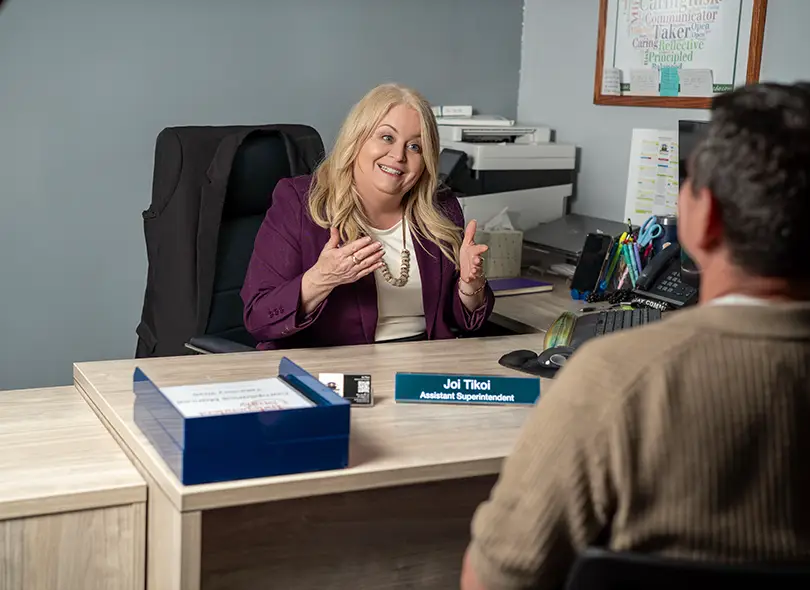
You mentioned school culture, but culture often runs into habit: “we have always done it this way.” Have you had to push against that habit at the system level?
Almost every day. Schools, like any organizations, quickly accumulate rituals that once made sense, but now remain simply because “that is how it is done.” My task is not to destroy those rituals on arrival, but to help people see that there is another way, that familiar does not always mean right or most effective.
I often encounter resistance that sounds like, “we have never done it this way.” And here it is important not to make a person feel that they were wrong, but to show that another possibility has appeared, one they simply had not considered. Because often people do not reject the new thing out of stubbornness. They just have never been shown another way. And if you come not with criticism, but with the question, “what if we try doing it in a way that leaves you more time for children and less time for paperwork?” the conversation changes completely.
A conversation about the system inevitably arrives at the point where processes and decisions step into the background. Because at some point everything comes down to the person themselves, to how they understand their role inside this structure, and why they are here at all.
What kind of leadership is even possible in education today?
Leadership has to have heart. Right now, everyone talks about school plans and success indicators, but if you remove children from the picture, nothing remains.
I recently read about two types of leaders: builders and careerists. You can build a school, or you can build a career, and those are not the same thing.
If a person enters education without an inner understanding of why they are here, the work very quickly turns into a set of tasks.
But school is not tasks. It is people. And if you do not care what happens to them next, it is impossible to remain in this system for long.
Education has always been an opportunity for me. It is something that can change the trajectory of a life, lift a person out of poverty, give them a chance to see another horizon. And when you truly understand that, you start looking at your work differently, not as reporting and meetings, but as what you are actually doing to improve the lives of others.
This way of thinking did not appear on its own.

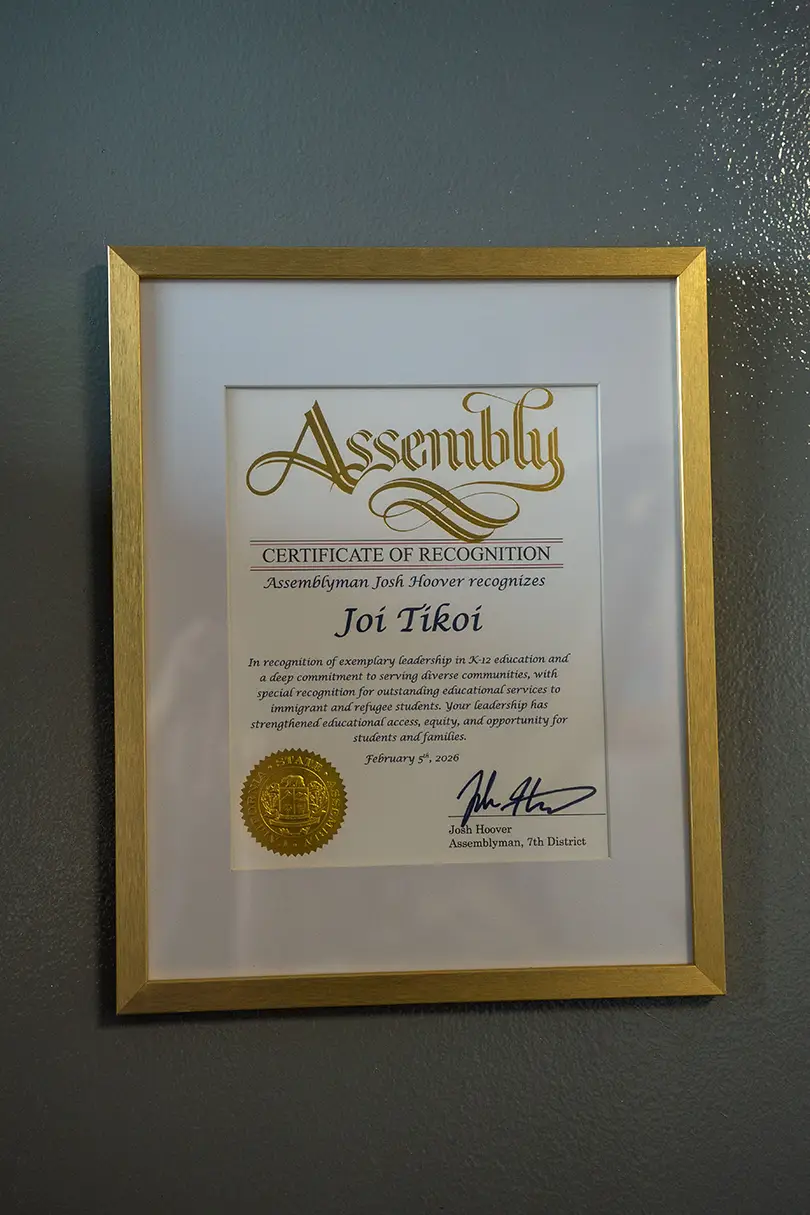

Was there a moment when you realized that your experience outside the United States would shape how you work here?
I do not think I formulated it so directly at the time. But when you live and work in another country, you yourself end up in the position of someone who does not fully understand the language, the system, the rules, and that is a very sobering experience. In Fiji, I saw how children exist in several cultural realities at once, how they move between languages and customs without losing themselves. And when I returned to California and began working with students whose first language was not English, I saw things differently.
I understood that it was not only about language, and not only about teaching methods. It was about how a person feels inside the system, whether they feel accepted as a whole, with their accent, with their family story, with their culture. Whether they can lean on who they already are, rather than giving it up in order to become “like everyone else.” And that, perhaps, is when it became obvious to me: a school cannot ask a child to forget who they are. On the contrary, it should give that child the opportunity to use it as a strength, not as an obstacle.
Joi falls silent, and there is no awkwardness in the pause, only the sense that the subject has been exhausted exactly as much as it could be in a conversation that does not pretend to offer final truths.
She looks out the window, where beyond the glass there is an ordinary schoolyard. Children are running there. The very ones we had been talking about for the past forty minutes.
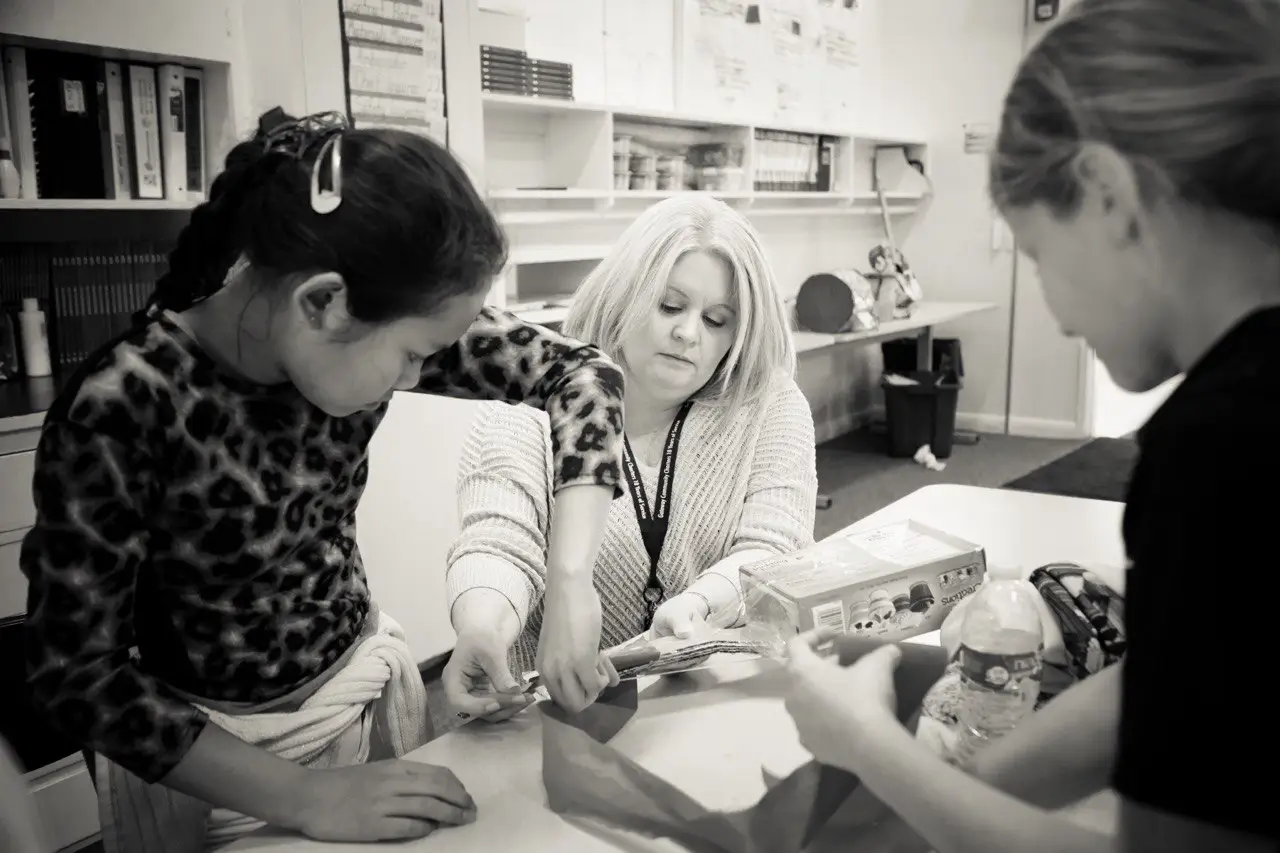
There are almost no grand declarations in a conversation with Joi Tikoi, and no attempt to draw a final line. Her day is still made up of decisions that rarely become visible beyond the school, yet it is precisely from those decisions that what parents call stability is built: a functioning classroom, a teacher who did not leave in the middle of the year, a child who feels understood, even if they cannot yet explain it in words.
And if at the beginning of the conversation it seemed that we were talking about a system, about rules, limitations, funding, and scale, by the end that feeling gives way to something else. Behind all these structures, behind reports and budgets, behind endless approvals and difficult conversations, there is not some abstract educational machine. There are children, sitting in classrooms right now, learning not only math and English, but also how to be together, how to hear one another, how not to lose themselves in a new culture while still becoming part of something larger.
And when you see how calmly people like Joi Tikoi carry that system on their shoulders, you begin to understand: it is not about big words. It is about the fact that tomorrow these children will walk out of those classrooms and build their lives. And who they become depends on how we speak to them today.
FROM PUBLISHERAt Gateway Community Charter schools, what you see on the surface is a functioning system. What you don’t see is the level of precision, responsibility, and human commitment required to keep it that way every single day. Leaders like Joi Tikoi are not simply managing schools, they are shaping the conditions in which thousands of children grow, learn, and define their future. The strength of this system lies not in policies or structures alone, but in the people who carry it with consistency, clarity, and care. And if we are serious about the future of our children, then the role of leaders at this level is not just important, it is foundational.