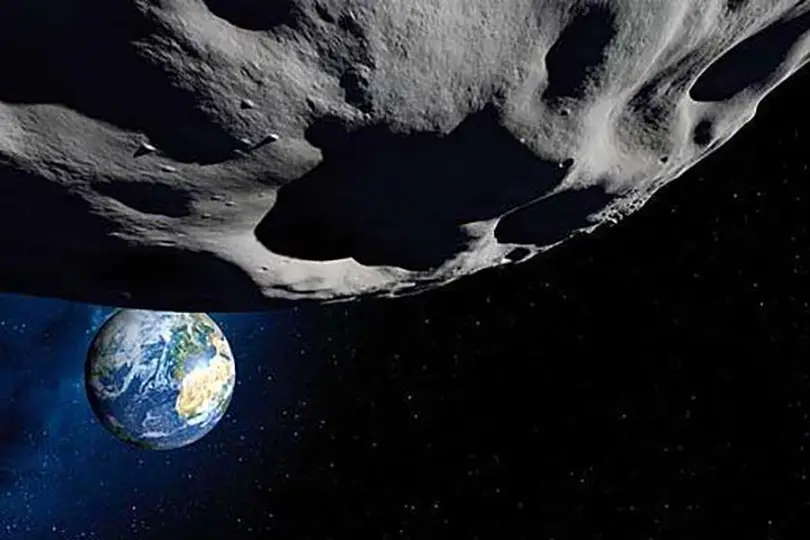
There are moments when space stops feeling distant and abstract and suddenly becomes real. Not just something scientists study, but something that touches everyday life. The story of the asteroid Apophis is one of those moments.
In a few short years, this massive rock will pass incredibly close to Earth. Close enough that it will not just be tracked by scientists, but actually seen by ordinary people looking up at the night sky. For many, it will be the first time witnessing something from deep space moving past our planet in real time.
Apophis is not a small object. At around 370 meters wide, it is roughly the size of three football stadiums. If something like this were to hit Earth, the consequences would be serious on a regional scale. That is why it has attracted so much attention since its discovery.
When scientists at NASA first identified Apophis in 2004, early calculations created a wave of concern. There was a moment when the probability of impact seemed real enough to trigger global discussion. For a brief time, this asteroid became one of the most closely watched objects in the solar system.
But science is a process of refinement. As observations improved, the predicted path of Apophis became clearer. Today, experts agree that it will not collide with Earth in the foreseeable future. That fact is important and often overlooked in dramatic headlines.
So if it is not going to hit us, why does it matter so much
Because of how close it will come.
To understand this, imagine the distance to the Moon. Now imagine something ten times closer than that, moving across the sky. That is the scale of this event. Even more striking, Apophis will pass within the region where many of our satellites operate. These are the systems that support navigation, communication, weather tracking, and much of modern life.
This kind of close approach is extremely rare for an object of this size. It is not just another asteroid passing by. It is a once in a lifetime opportunity for science.
And scientists are preparing for it in a big way.
During the flyby, researchers will collect an enormous amount of data. Radar systems will map its surface in detail. Telescopes will analyze its composition. Scientists will study how sunlight affects its motion and how Earth’s gravity subtly reshapes its path.
This last point is especially fascinating. When Apophis swings past Earth, it will not simply continue unchanged. Our planet’s gravity will tug on it, slightly altering its orbit. It is like watching a natural experiment unfold on a cosmic stage.
There is also a deeper layer of research involved. Scientists are interested in forces that are almost invisible. One of them is known as the Yarkovsky effect. It comes from the way an asteroid absorbs sunlight and releases heat. Over long periods, this tiny push can change the direction of its journey.
Apophis gives scientists a rare chance to measure this effect with real precision. That knowledge could be critical in the future when predicting the paths of other asteroids.
And this brings us to the bigger picture.
For most of human history, we could only watch the sky and hope for the best. If a large object was on a collision course, there was nothing we could do. Today, that is no longer true.
In 2022, the DART mission proved that it is possible to change the path of an asteroid. By crashing a spacecraft into a small asteroid, scientists successfully altered its orbit. It was a simple idea, but a powerful demonstration.
It showed that humanity is beginning to develop the tools needed to defend the planet.
Apophis will not require such action. It is not a threat. But it plays a crucial role in testing our readiness. It allows scientists to refine observation techniques, improve prediction models, and strengthen international cooperation.
There is also something deeply human about this story.
When Apophis passes by, millions of people may step outside and look up. They will see a moving point of light and know that it is a real object, a massive rock from the depths of space, passing close to our world.
That moment changes perspective.
It reminds us that Earth is not isolated. We are part of a larger cosmic environment filled with motion, energy, and occasional surprises. But it also highlights how far we have come.
We are no longer passive observers. We are learning, adapting, and preparing.
The fear that once surrounded asteroids is slowly being replaced by understanding. Instead of asking what if we start asking how. How do we track them. How do we predict their paths. How do we respond if one ever becomes a real threat.
This shift matters.
Because while catastrophic impacts are extremely rare, smaller events are part of Earth’s history. And the difference today is that we have knowledge on our side.
Apophis is not a warning. It is an opportunity.
An opportunity to study, to prepare, and to remind ourselves that science is not just about distant theories. It is about real events that shape our future.
When this asteroid passes Earth, it will not be a moment of danger. It will be a moment of progress. A moment when humanity looks up, not with fear, but with curiosity and confidence.
✅ And perhaps that is the most powerful change of all.