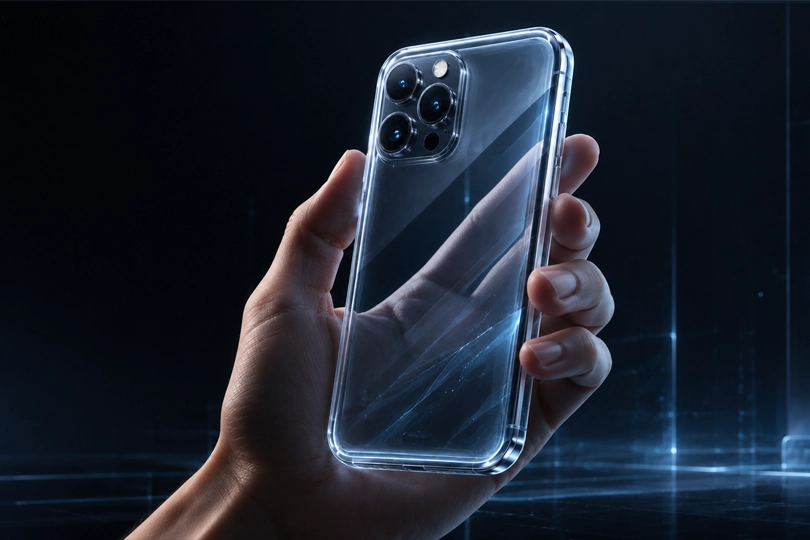
An iPhone that looks almost like a single piece of glass has remained a beautiful design dream for years. Apple has gradually removed buttons, reduced bezels, changed the shape of the body, and tried to make the screen the central element of the device. In 2027, the company may come closer to that vision than ever before.
According to Bloomberg journalist Mark Gurman, Apple is developing anniversary iPhone Pro models with a radically redesigned body. The glass on the front and back could curve around the sides, leaving only a thin metal band between the two sections. Visually, the phone is expected to resemble a nearly seamless glass monolith.
The presentation could be timed to mark the twentieth anniversary of the iPhone. Steve Jobs introduced the first Apple smartphone on January 9, 2007, and it went on sale in the United States on June 29 of that year. If the reports prove accurate, the anniversary model will be more than another routine upgrade. It will be an attempt to remind people why the original iPhone changed the entire mobile industry.
An Almost Seamless Glass Body
Current iPhones already have glass panels on the front and back, but a clearly visible metal frame sits between them. In the rumored 2027 models, the balance of materials could change dramatically. The metal section may become much thinner, while the glass could flow smoothly around the sides.
This does not necessarily mean the phone will be made entirely from glass. Metal may still be needed to strengthen the structure, manage heat, support antennas, and protect internal components. However, it could become far less noticeable. The continuous glass surface would become the main visual feature of the phone.
According to Gurman, Apple is considering two anniversary models that may carry the internal codes V73 and V74. They are expected to replace the future iPhone Pro and iPhone Pro Max. This suggests that the new design is not intended for a small experimental release. It could define Apple’s main flagship phones.
Bloomberg previously reported that Apple wants to create an almost bezel free iPhone with glass that curves around the edges. The display could cover nearly the entire front surface. It is still unclear whether Apple will be able to hide the front camera and sensors completely beneath the display. Those details may change before mass production begins.
When the Body and Interface Become One
The rumored design fits naturally with the Liquid Glass visual direction used in Apple software. Transparent elements, reflections, lighting effects, and a sense of depth are meant to make the interface feel like part of the device itself.
If the body glass flows smoothly into the screen, the boundary between software and hardware could become less visible. Icons, panels, and notifications may appear to sit inside the transparent surface. This could become one of the clearest examples of Apple’s long standing approach to designing hardware and software as a single experience.
It is not yet clear whether the curved glass could introduce new controls. In theory, the side surfaces could display notifications, camera tools, or touch sensitive buttons. However, there is no confirmed information about such features. Apple may choose to keep the change mostly visual if additional touch areas prove inconvenient or cause accidental input.
The company already knows how cautiously many users view curved screens. Similar designs from other manufacturers often looked impressive but sometimes created glare, image distortion, and problems with screen protectors. Apple will need to make the curve noticeable enough to create a fresh appearance while keeping it subtle enough for everyday use.
Why the Fully Glass Version May Have Been Canceled
Reports about the anniversary iPhone have been contradictory. Jefferies analysts claimed that Apple may have abandoned a more ambitious fully glass device because of poor manufacturing yields. In simple terms, producing the body reliably and in large quantities may have been too difficult and expensive.
Mark Gurman later clarified that the glass focused anniversary iPhone had not disappeared from Apple’s plans. According to his information, Pro models with curved front and back glass panels and a metal band between them remain in development. These reports may refer to two different concepts. Apple could have canceled or delayed the boldest version while continuing to test a more practical design.
This would be consistent with the normal development process for consumer electronics. Companies build many prototypes, test different materials, and reject ideas that cannot be manufactured reliably at a scale of millions of devices. Even if the overall appearance has already been chosen, the thickness of the metal band, the curve of the glass, and the placement of internal components may change repeatedly.
Beautiful, Expensive, and Potentially Fragile
A glass monolith may look stunning during a presentation, but buyers will have a more practical question. What happens after the first drop? The more glass a phone uses, the harder it becomes to protect the device from impacts and scratches.
Apple will need to strengthen both the material and the internal structure. Simply making the glass thicker may not be enough because that could increase the weight of the phone. The company may need a new generation of protective glass, a complex internal frame, or a special method for joining glass and metal components.
Repairability raises another serious concern. If the front panel, side edges, and back appear to form one continuous structure, replacing a damaged section could become more expensive. Buyers will want to know whether a service center can replace only the broken piece or whether a large part of the body must be changed.
Cooling is another engineering challenge. Metal transfers heat from the processor and battery more efficiently than glass. The thin metal band may need to perform an important technical role, not just a decorative one. This will matter most in Pro models, which are designed for gaming, video editing, photography, and other demanding tasks.
Glass can also behave differently depending on its thickness, shape, internal tension, and the way it is attached to the frame. A curved edge may help distribute some forces, but it can also create vulnerable areas if the structure is not carefully engineered. Real durability will depend on far more than the appearance of the material.
A Case Could Change Everything Again
The most ironic part of the rumored redesign is that many owners will immediately place the glass body inside a protective case. The more impressive and expensive the new iPhone becomes, the stronger the desire to protect it from damage.
Accessory manufacturers may genuinely need to prepare early. Curved glass edges could require cases with more precise dimensions, reinforced corners, and a structure that does not interfere with possible touch controls. Standard screen protectors may also be unsuitable if the display curves on all four sides.
For Apple, this is a familiar paradox. The company spends years refining materials, shape, and the physical feel of a device. The buyer then covers the result with transparent plastic a few minutes after opening the box. The anniversary model could make that decision even harder. Owners may have to choose between enjoying the design without a case and protecting a very expensive phone from everyday accidents.
What the Anniversary iPhone Could Become
More than a year remains before the expected presentation, so current reports should not be treated as final specifications. Apple has not officially confirmed the appearance of the device, the number of models, or the possible name. The company could adjust the construction, delay certain technologies, or remove some ideas entirely.
Even the name of the anniversary lineup remains unknown. Following Apple’s normal sequence, the company could be approaching the iPhone 19 name in 2027. However, it may move directly to iPhone 20 to emphasize the anniversary. Apple used a similar approach in 2017 when it introduced the iPhone X after the iPhone 8 to mark ten years of the smartphone.
The real story is not simply about using more glass. Apple is searching for a new and instantly recognizable form for a device that has become extremely difficult to redesign in a radical way. Cameras, antennas, speakers, batteries, processors, and cooling systems still need to fit inside a thin and durable body. Making that body look like a glass monolith would require serious engineering work.
If Apple finds the right balance between beauty, strength, repairability, and everyday comfort, the anniversary iPhone could become the most memorable redesign in years. If it does not, users may receive another stunning smartphone that feels too fragile to carry without a case.
Would you use an almost glass iPhone without additional protection?