Walnuts rarely need an introduction. They are already in our kitchens, tucked into baking supplies or saved for a favorite salad. Yet their most useful role may be the simplest: a measured handful worked into everyday meals. Understanding the portion, the evidence, and what they replace in your diet makes them far more useful than any dramatic health claim.
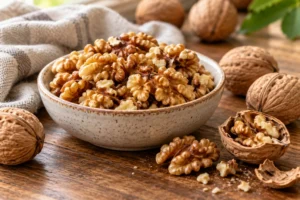
A typical serving is about 1 ounce, or 28 grams, of shelled walnuts. That is approximately 14 halves, equivalent to seven whole kernels. It provides roughly 185 calories, 4 grams of protein, and 2 grams of fiber, with most of its fat coming from unsaturated sources. Weighing a serving once helps you recognize it later.
Walnuts are particularly notable for alpha-linolenic acid, or ALA, a plant-based omega-3 fat. One serving supplies about 2.5 grams. The body cannot make ALA, so it must come from food. However, it differs from EPA and DHA, the omega-3 fats found in fatty fish. Only a limited amount of ALA is converted into those forms. Walnuts therefore offer a valuable plant source of omega-3 without being a complete substitute for fish.
The strongest evidence for their health benefits concerns cholesterol. In the Walnuts and Healthy Aging study, known as WAHA, researchers enrolled 708 adults ages 63 to 79 in Barcelona, Spain, and Loma Linda, California. One group ate walnuts daily for two years, while another avoided them. The walnut portions ranged from approximately 30 to 60 grams a day, depending on participants’ energy needs.
The reduction in LDL cholesterol was an average of 4.3 mg/dL greater in the walnut group than in the control group. LDL is often called “bad” cholesterol because elevated levels contribute to cardiovascular risk. This was a modest improvement in a measurable risk factor. It did not establish that walnuts alone prevent heart attacks, and it provides no reason to stop prescribed medication. The California Walnut Commission funded the study, a relevant detail when considering the findings and the value of independent confirmation.
The practical lesson is to think about replacement. Walnuts can take the place of a sugary snack, add texture to oatmeal without a sweet topping, or bring crunch to a salad that might otherwise need a rich dressing. Adding them after a full meal has a different effect on your intake. The question is not simply whether walnuts are nutritious, but how they change the food you eat over the course of an ordinary day.
Their reputation as “brain food” requires more restraint. A walnut kernel resembles a miniature brain, but its shape says nothing about its medical effects. In WAHA, two years of walnut consumption did not improve cognitive performance across the overall group of healthy older adults. Additional analyses suggested possibilities for further research, rather than proof that walnuts prevent dementia or reliably improve memory. They can belong in a varied diet without carrying promises the evidence cannot support.
Gut health is another area of interest. Small controlled trials have found changes in the composition of the gut microbiota after walnut consumption. In one study, participants ate 42 grams daily for three weeks. These results help scientists investigate how food interacts with intestinal microorganisms. They do not establish walnuts as a treatment for digestive disease. A change in certain bacteria is not the same as a demonstrated improvement in symptoms or long-term health.
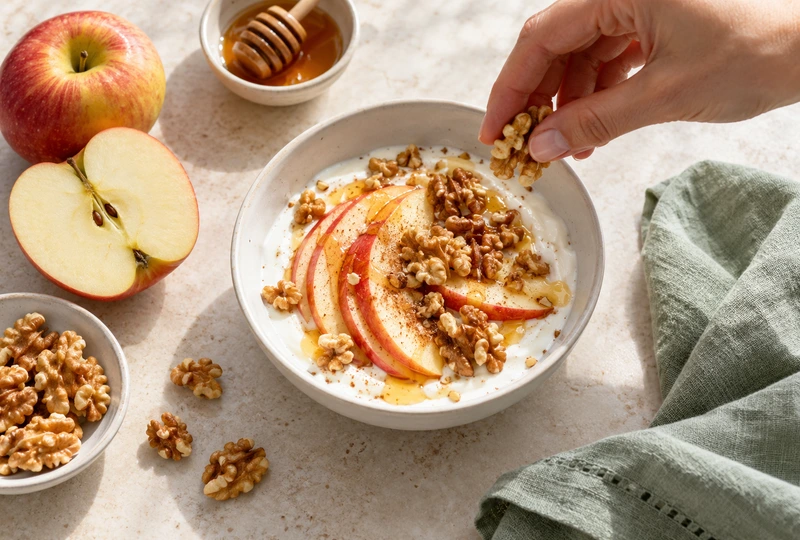
For everyday eating, start with appetite and convenience. Try a measured portion with an apple or plain yogurt and notice whether it helps you feel satisfied until your next meal. You can also divide the portion between breakfast and lunch. Participants in the walnut group in WAHA did not gain weight on average over two years, but that does not make unlimited amounts a sensible choice. Walnuts remain calorie-dense, and honey, chocolate, or sugar coatings add more calories.
Choose products with a straightforward ingredient list. Plain, unsalted walnuts are an easy option, while raw or roasted varieties can fit according to your preference. Check for added oil, sugar, and salt rather than relying on claims on the front of the package. If a large bag seems economical, consider how quickly you will use it and whether you have space to keep the remainder cold.
You do not need to soak walnuts overnight to “activate” their nutrients. A study examining several types of nuts, including walnuts, did not support claims that soaking improves mineral availability. Storage deserves more attention: keep shelled walnuts in a tightly sealed container in the refrigerator and freeze supplies intended for longer storage. Cold slows rancidity, and a sealed container helps prevent the kernels from absorbing odors. An open bowl beside a warm stove is less suitable.
Discard walnuts with mold, a pronounced rancid smell, or a sharply unpleasant taste. Roasting does not rescue spoiled kernels, and baking them into a cake only hides the problem. Mild astringency from the thin skin can be normal, but an unmistakably stale flavor is a reason to stop eating.
Walnuts are unsuitable for anyone with a walnut allergy; even a small amount can cause a serious reaction. Difficulty breathing or swelling of the tongue or throat after eating requires emergency help. Whole nuts are also a choking hazard for young children, so preparation must match their developmental stage. Anyone following a medically prescribed diet should check how walnuts fit into it with their healthcare professional.
A useful habit can be simple and sustainable: measure a serving, find a place for it in food you already enjoy, and store the rest properly. Sprinkle walnuts over roasted vegetables, add them to breakfast, or keep a portion ready for a busy afternoon. Their appeal lies in being familiar, versatile, and easy to use. Before reaching for your usual snack, ask what a small handful could replace.