Apple Trains Humanoid Robots in Virtual Homes, Then Tests Them in the Real World
A robot entering an unfamiliar home faces an obstacle course that most people barely notice. Chairs are pushed away from tables. Doors are partly open. A coffee table blocks the shortest route across a room.
For a human, navigating these obstacles is routine. For a humanoid robot, it requires a remarkable amount of coordination. Apple researchers are exploring a new approach to that challenge with HALO, a system designed to generate adaptable whole-body movements. Instead of depending entirely on demonstrations collected in real buildings, the researchers trained much of the system using computer-generated environments. Their training process incorporated 1,000 simulated homes, allowing the model to encounter different layouts and visual conditions.
The idea is straightforward but powerful: a robot should not need to practice every possible movement in every possible living room before it can function in a new one. The research demonstrations feature a Unitree G1 humanoid robot performing tasks such as moving sideways through doorways, crouching beneath tables, pushing boxes, following a person, and sitting on furniture.
Those actions may look simple on video. In practice, each requires the machine to coordinate balance, perception, and motion planning while responding to the environment. HALO uses a layered control system. One component interprets instructions and breaks them into smaller tasks. Another plans sequences of body movements using visual information. A lower-level controller translates those plans into physical joint movements.
Consider a request to sit in a chair.
The robot cannot simply bend its knees. It must approach the chair, determine where the seat is, orient its body, and lower itself without losing balance. Each part of the sequence depends on what the robot sees and how its body is positioned. The researchers also addressed a persistent problem in robotics: computer simulations rarely look exactly like reality. Lighting changes throughout the day. Cameras produce noise. Furniture has unexpected textures and reflections. To make the training process more robust, the team introduced visual variations that included blur, different lighting conditions, and changes in image appearance.
That work is important because a system that performs beautifully in a simulated room may struggle when confronted with a real hallway. The research does not mean Apple has announced a consumer humanoid robot. HALO is a technical demonstration of motion and perception capabilities, not a finished household product.
There is still a substantial gap between navigating around furniture and reliably completing useful chores.
A practical home robot would need to manipulate a wide range of objects, understand changing human instructions, avoid harming pets or children, and operate safely for long periods without constant supervision. Affordability would be another challenge. Advanced robotics hardware, computing equipment, maintenance, and energy requirements can all make a machine difficult to bring into ordinary households.
Even so, the approach could have wider implications.
Collecting real-world training data is expensive and time-consuming. Virtual environments offer a way to generate many different situations without physically rearranging thousands of rooms. If techniques like HALO continue to improve, researchers may be able to train more capable robots with fewer real-world demonstrations.
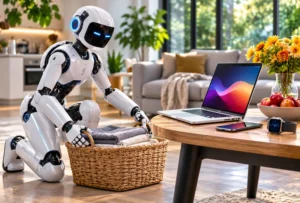
That could matter not only for homes but also for warehouses, assisted-living environments, laboratories, and other spaces built primarily for humans. The most interesting aspect of HALO may not be any single trick performed by the robot. It is the possibility of teaching machines general movement skills that transfer from unfamiliar simulations into unfamiliar real places. The robot still has a long way to go before it can fold laundry, load a dishwasher, or safely help an older adult around the house. But it is beginning to learn one of the first essential skills: how to move through a world that was never designed for robots.
If a reliable household robot became affordable, which task would you hand over first? Share this story with someone who follows the future of technology.