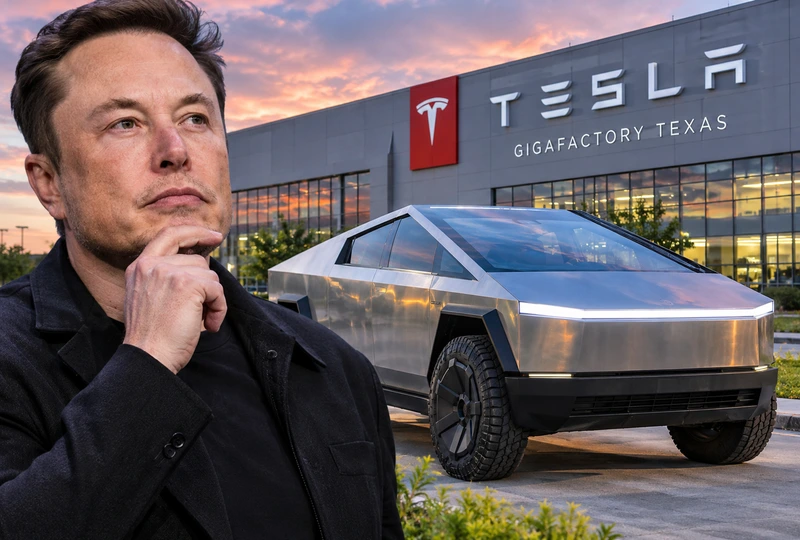
Tesla is preparing to move away from one of the most recognizable vehicles it has ever built. On November 6, 2026, Elon Musk announced that the company plans to wind down Cybertruck production at Gigafactory Texas around the middle of 2027, freeing manufacturing capacity for its autonomous Cybercab. The announcement marks a striking change in priorities. Just a few years ago, Cybertruck was presented as a breakthrough that could transform America’s pickup market. Now Tesla is directing more of its attention toward a future in which cars operate without human drivers.
The shift also raises an uncomfortable question: how did a vehicle that generated enormous publicity struggle to turn that attention into sustained sales?
When Cybertruck was unveiled in California in November 2019, it looked unlike almost anything else on the road. Its sharply angled stainless-steel body challenged decades of conventional automotive design. Tesla promoted its durability, towing capability, electric performance, and distinctive appearance. The unveiling attracted worldwide attention, partly because of an unexpected moment during a demonstration. A metal ball thrown at the supposedly durable side window cracked the glass. The incident became a viral sensation, but it did little to diminish the intense curiosity surrounding the vehicle.
For years, Cybertruck remained one of Tesla’s most anticipated products.
Deliveries finally began in late 2023, considerably later than originally expected. By then, the electric-vehicle market had become more competitive, and the production model arrived with prices far above the entry-level figure Tesla had advertised in 2019.
The original presentation suggested a starting price below $40,000. When customer deliveries began, the available vehicle was significantly more expensive. Subsequent changes to configurations and pricing complicated the product’s position in the market.
The sales figures tell an even clearer story.
According to Kelley Blue Book estimates, Tesla sold 38,965 Cybertrucks in the United States in 2024. That number dropped to 20,237 in 2025, a decline of approximately 48%. Sales during the first nine months of 2026 were estimated at roughly 11,600 vehicles. Those numbers stand in sharp contrast to Musk’s earlier expectations of annual Cybertruck sales reaching around 250,000 units. Although forecasts are not guarantees, the difference between the company’s ambitions and actual demand helps explain why Tesla is reconsidering the model’s future. Price was not the only obstacle. Cybertruck’s unconventional styling made it instantly recognizable but also narrowed its appeal. Buyers of full-size pickups often place considerable emphasis on practicality, reliability, service access, and predictable ownership costs. Cybertruck offered something different: a dramatic design statement combined with electric performance and innovative engineering. That combination attracted a dedicated audience, but it did not translate into the broad mainstream demand Tesla had anticipated.
The vehicle also faced multiple recalls involving hardware and other safety-related concerns. Some problems could be addressed through software updates, while others required physical repairs. The recalls added to questions about the ownership experience, although no single factor fully explains the model’s sales performance.
Tesla’s next priority is Cybercab.
Unveiled in 2024, Cybercab is a two-seat vehicle designed around autonomous transportation rather than traditional private ownership. Its concept eliminates the steering wheel and pedals, reflecting Tesla’s ambition to operate a large network of self-driving vehicles. Musk said that reducing Cybertruck production at the Texas factory would make room for increased Cybercab output. The decision suggests that Tesla sees greater long-term opportunity in autonomous mobility than in expanding its unconventional pickup business.
The implications extend beyond a single vehicle.
Tesla has increasingly positioned artificial intelligence, autonomous driving, and robotics as central parts of its future. Its decision to wind down Cybertruck production fits that broader direction, even as its mainstream electric vehicles remain essential to the business.
However, autonomous transportation brings challenges of its own. Manufacturing a vehicle designed without conventional controls is only part of the equation. Large-scale deployment depends on technical reliability, regulatory approval, passenger safety, insurance, and public confidence. A robotaxi network must demonstrate that its vehicles can handle complicated real-world driving conditions consistently and safely. Expanding production does not, by itself, resolve those questions.
There is also uncertainty surrounding Cybertruck itself.
Musk’s announcement specifically addressed production at Gigafactory Texas. He did not confirm whether the vehicle would be manufactured elsewhere or permanently discontinued. Tesla has also not provided a detailed public timetable for selling remaining inventory or explaining how long particular replacement components will remain available. Existing owners therefore have practical reasons to follow the company’s next announcements. A reduction in production does not automatically mean that service and support will end, but it can influence perceptions of future parts availability and resale value. For California drivers, the story has particular relevance. Tesla is closely associated with the state’s technology and automotive industries, and Cybertruck remains a conspicuous presence on California roads. The vehicle’s possible departure from production will be watched by owners, prospective buyers, and electric-vehicle enthusiasts.
Whether Cybertruck eventually becomes a collectible curiosity or a cautionary example of an overly ambitious product remains to be seen. Its unusual appearance and technological innovations have already secured it a place in automotive history. The larger significance may be what comes next. Tesla is betting that the future of transportation will be shaped less by eye-catching vehicles owned by individual drivers and more by autonomous fleets capable of providing transportation on demand.
That vision is ambitious, and its success is far from guaranteed.
Cybertruck showed that Tesla could capture global attention with a radical idea. Cybercab will test whether the company can convert an equally radical vision into a reliable, scalable transportation business.
Share this story with friends, family, and fellow electric-vehicle enthusiasts. The future of Cybertruck remains uncertain, but Tesla’s change in direction could have lasting consequences for the automotive industry.