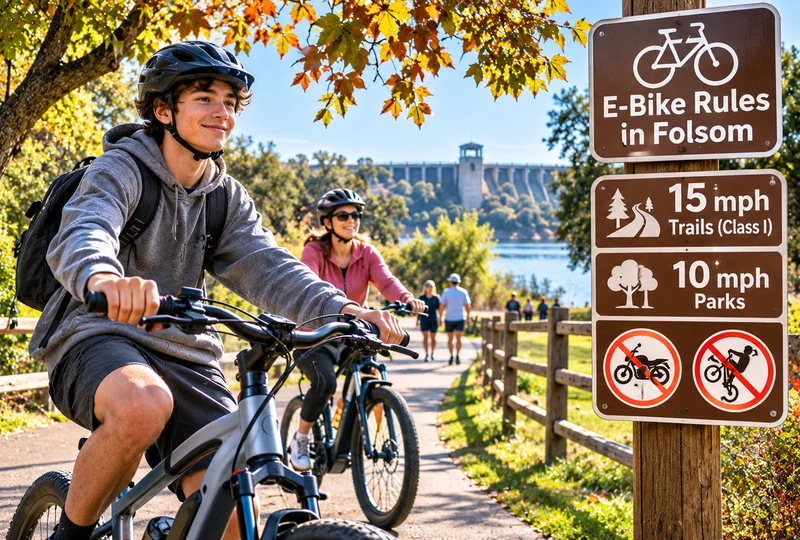
A teenager rides an electric bicycle to soccer practice. A family enjoys an afternoon walk along a neighborhood trail. A commuter uses an e-bike to avoid traffic on the way to work. These everyday activities have become increasingly common in Folsom, where electric bicycles are changing how people move around the city. But as more riders share trails, parks, and public spaces, concerns about speed and safety have grown.
Folsom officials have now approved a new set of regulations intended to address those concerns. On November 10, 2026, the City Council gave final approval to an ordinance updating rules that had remained largely unchanged since 2013. The legislation establishes speed limits for electric bicycles, restricts where they can operate, prohibits dangerous riding behavior, and introduces fines that can reach $500. The changes also affect electric scooters and certain other motorized devices.
For families, the new rules could have an immediate impact on daily routines. A route that was previously used without much thought may now have a posted speed limit or restrictions on certain types of vehicles. Parents of teenagers who regularly ride e-bikes to school, sports practices, or friends’ homes will have particular reason to pay attention.
The ordinance is scheduled to become effective 30 days after adoption. City officials plan to introduce signs and educational materials before moving into active enforcement, giving residents time to understand the changes.
One of the most important provisions concerns Folsom’s Class I bicycle trails. These paved routes are separated from regular vehicle traffic and often serve several purposes at once. Cyclists use them for transportation, runners use them for exercise, and families enjoy them for walking. Under the new ordinance, the maximum speed for e-bikes on these trails will be 15 miles per hour.
The limit is lower in most park settings. Electric bicycles traveling on ordinary paved pathways inside city parks will be restricted to 10 mph. However, a designated Class I trail passing through a park will continue to have a 15 mph limit. That distinction means riders cannot simply assume that every paved path follows the same rule.
The location of a trail matters just as much as its appearance.
The city is also restricting e-bike use to designated paved routes within parks. Riding across athletic fields, playgrounds, lawns, landscaped areas, and other areas not intended for bicycles will be prohibited. Youth sports organizations had raised concerns about riders entering playing fields during practices and damaging surfaces that require maintenance and are used by children.
Some of the strongest provisions address riding behavior rather than speed alone. Wheelies, reckless maneuvers, and failure to yield to pedestrians are prohibited. Riders cannot carry passengers on bicycles that are not designed to accommodate them, and modifications intended to increase a vehicle’s speed beyond its designed capabilities are also restricted.
The ordinance maintains an important distinction between conventional electric bicycles and electric motorcycles, often called e-motos. Although some powerful electric motorcycles resemble oversized bicycles, they do not automatically qualify as legal e-bikes. Electric motorcycles remain prohibited on city bicycle trails. Owners should verify the classification of their equipment before assuming it can be used wherever ordinary bicycles are permitted.
Violations could become expensive, especially when they happen repeatedly. The first administrative citation carries a $100 fine. A second violation within one year increases the amount to $250, while subsequent violations during that period can result in $500 penalties.
Parents should be aware that the ordinance allows financial responsibility for violations committed by riders under 18 to be assigned to a parent or legal guardian. The rules also preserve procedures for contesting citations through administrative hearings and seeking judicial review. For households with teenagers who use electric bicycles independently, understanding these provisions could prevent an unpleasant surprise.
City officials have emphasized that enforcement is intended to focus on safety, not simply on collecting fines. Police representatives have indicated that circumstances will matter when officers respond to violations. A child who unknowingly enters a restricted park while traveling to a sports practice may be told to dismount and walk the bicycle rather than immediately receive a citation.
Dangerous stunts, repeated violations, and riding that threatens pedestrians or nearby vehicles are a different matter. Those behaviors are among the reasons city leaders decided that more specific regulations were necessary.
Another major change gives Folsom’s Parks and Recreation director authority to establish additional restrictions at individual parks or along particular routes when safety concerns justify them. Any such restrictions must be communicated through appropriate signage.
Several parks have been identified for further consideration, including Ernie Sheldon Park, Hazel McFarland Park, Mayan Park, Rodeo Park, Livermore Park, Cross Creek Park, and Commons Park. Their inclusion does not mean that every location already has the same complete ban. Decisions will depend on the layout of each park, trail connections, and documented safety concerns.
Rodeo Park and Livermore Park present a particular challenge because Class I trails connect areas used for recreation and transportation. Officials want to avoid restrictions that would unnecessarily interrupt important routes between neighborhoods. The city must therefore consider both public safety and the practical needs of residents who depend on bicycles for everyday travel.
The debate has also highlighted the importance of examining evidence before introducing restrictions. At Econome Family Park and Prospector Park, the fire department recorded 12 responses over three years, but none involved electric bicycles. That detail suggests that complaints and assumptions should be considered alongside actual incident records.
Accessibility is another concern. Some residents rely on adaptive electric bicycles or three-wheeled electric cycles because of mobility limitations. For these individuals, an electrically assisted vehicle may provide essential independence. City officials will need to consider those needs when deciding how park-specific restrictions are implemented.
Folsom plans to support the ordinance with public education. New signs will identify restricted park areas and explain speed limits on Class I trails. Information will also be distributed through city communications, social media, and other outreach materials.
The City Council expects to review the regulations approximately six months after implementation. Officials will be able to evaluate complaints, enforcement results, and whether the restrictions are working as intended. Adjustments may follow if particular provisions create unintended problems or fail to improve safety.
For riders, the practical steps are relatively simple: identify the class of your electric bicycle, respect the posted speed limit, stay on permitted pathways, and give pedestrians the right of way. Parents should discuss the rules with younger riders, particularly the restrictions on stunts, carrying passengers, and entering sports fields or playground areas.
The broader challenge for Folsom is finding a balance between a growing form of transportation and the needs of everyone sharing public space. Electric bicycles offer convenience, mobility, and opportunities for recreation, but their benefits depend on responsible use.
The new ordinance does not eliminate e-bikes from Folsom’s transportation network. Instead, it establishes clearer expectations about where and how they can be ridden. Whether the changes succeed will depend on effective communication, reasonable enforcement, and the willingness of riders to respect others.
📣 Save this article and share it with friends, neighbors, and parents whose children ride e-bikes. Knowing the new rules could help families avoid fines and make local trails safer for everyone.