California has always been a place where people look ahead rather than back. The state has a long history of reinvention, from agricultural roots to the birth of Hollywood, from aerospace innovation to world changing technology. As climate, population patterns and global trends shift, the question of what California’s major cities will look like by 2050 is becoming more relevant.
Planners, architects and scientists are studying how people will live, move and work thirty years from now. Their predictions describe cities that remain recognizable but become more thoughtful, more sustainable and more human centered.
SACRAMENTO 2050 • A CAPITAL GUIDED BY NATURE
Sacramento has always lived next to rivers, fertile land and green corridors. This natural background will play a central role in how the city grows. By 2050 Sacramento is expected to turn into one of the most environmentally responsible capitals in the country. Instead of expanding outward, the city will focus on compact development that brings housing, work and recreation closer together.
New districts will rely on advanced systems that collect, purify and recycle stormwater. These systems will help the city handle hotter summers, longer dry periods and heavier rain events. Areas that are currently paved will gradually be transformed into gardens, shaded squares and community green spaces where residents can rest, socialize and cool down during hot weather. Walking and cycling routes will become safer and more continuous which will encourage people to move through the city without cars.
Buildings in Sacramento will be designed to use less energy and support natural ventilation. Many structures will have transparent facades that let in natural light, solar panels arranged to adapt to seasonal sunlight, and roofs covered with vegetation that lowers heat and provides small habitat zones for insects and birds. In residential areas children will have access to shaded playgrounds while older residents will benefit from quiet green courtyards.
The most important change will be the relationship between people and nature. Sacramento of 2050 will not place nature on the edges of the city. Instead, parks, restored riverbanks and tree lined streets will shape the experience of living in the capital. The city will feel cooler, greener and more balanced than it is today.
LOS ANGELES 2050 • A CITY OF SHORT DISTANCES
Los Angeles is known around the world for its freeways, long commutes and neighborhoods that stretch for miles. But planners believe that the Los Angeles of the future will be very different. The city is moving toward the idea of short distance living, where necessities are available very close to home.
By 2050 many districts will resemble compact urban villages. People will be able to work remotely in shared spaces, walk to cafes, visit clinics and parks without long drives, and reach the ocean or the valley with clean electric transit. New rapid lines will connect key hubs, making travel smoother and less stressful.
The city is also preparing for rising temperatures and changing water availability. Large projects will expand shade using drought resistant trees. Older concrete corridors will be redesigned to slow water runoff and store it underground. Buildings will rely on natural airflow whenever possible. Homes will use reflective materials that keep indoor temperatures down without consuming extra energy.
Transport will change as well. More residents will use electric cars, while many deliveries will be handled by automated vehicles and air based transportation systems. Streets will feel calmer and air quality will improve. Visitors will still recognize Los Angeles, but the city will feel more unified and much more comfortable for everyday life.
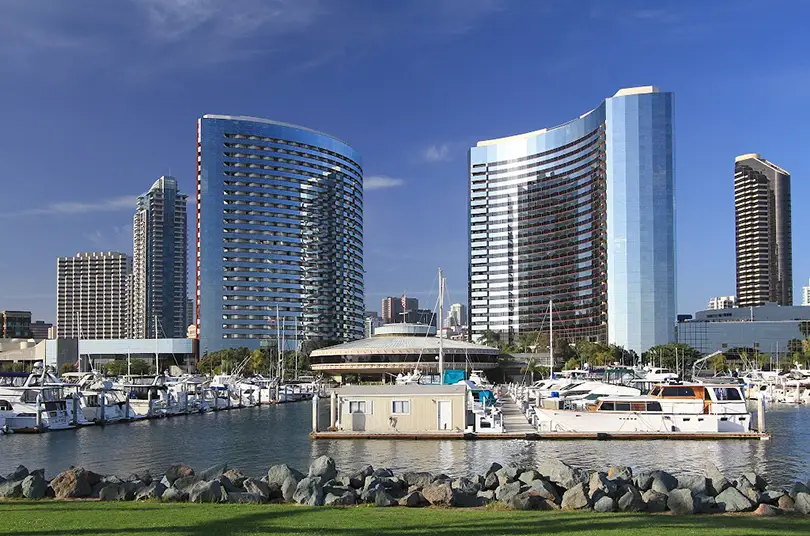
SAN DIEGO 2050 • A COASTAL CENTER OF OCEAN TECHNOLOGY
San Diego has always lived next to the Pacific Ocean. This connection will define its future even more deeply than today. The city plans to build a strong economic and scientific identity around ocean energy and coastal research. Wave powered generators, tidal energy installations and underwater turbines will work alongside solar fields on rooftops and hillsides.
As sea levels change, San Diego will adopt protective measures that rely on natural strength rather than heavy concrete. Researchers are developing coastal parks that rise in subtle steps and break wave energy. These parks will also give residents and visitors new places to walk, relax and enjoy the coastline. Restored reefs and plant filled terraces will protect the shoreline while supporting marine life.
Neighborhoods near the ocean will be built with materials that handle moisture and salt, and their layouts will use open breezeways that circulate fresh air throughout the day. San Diego will also continue to attract scientists and medical researchers. Research districts will expand, mixing laboratories, housing and education centers into walkable environments.
A SHARED FUTURE FOR THREE CITIES
While each city has its own identity, Sacramento, Los Angeles and San Diego share several major goals. By 2050 the cities will be greener, with more open spaces, better shade and more water smart landscapes. They will be more compact which will reduce commute times and energy use. They will be better prepared for climate shifts, whether through cooling corridors in Los Angeles, riverbank restoration in Sacramento or adaptive coastlines in San Diego. Clean energy will supply a significant part of their daily needs. Above all, the cities will be designed around people. Comfort and well being will guide decisions about transportation, housing and public spaces.
California has always been a home for experiments. In the next decades those experiments will become everyday reality. The cities of 2050 will still feel familiar, but they will run on cleaner energy, be easier to navigate and offer a healthier relationship with the environment. The future will not arrive suddenly. It will appear one street, one project and one neighborhood at a time until the entire landscape feels renewed.