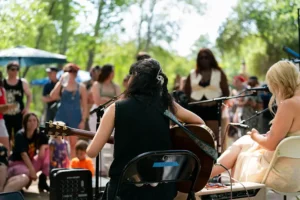
The Sacramento Poetry Center was abuzz with adoration for the group of writers gathered to celebrate the September release of “Then & Now,” the third and latest anthology from Sacramento Latino writer’s group Escritores del Nuevo Sol.
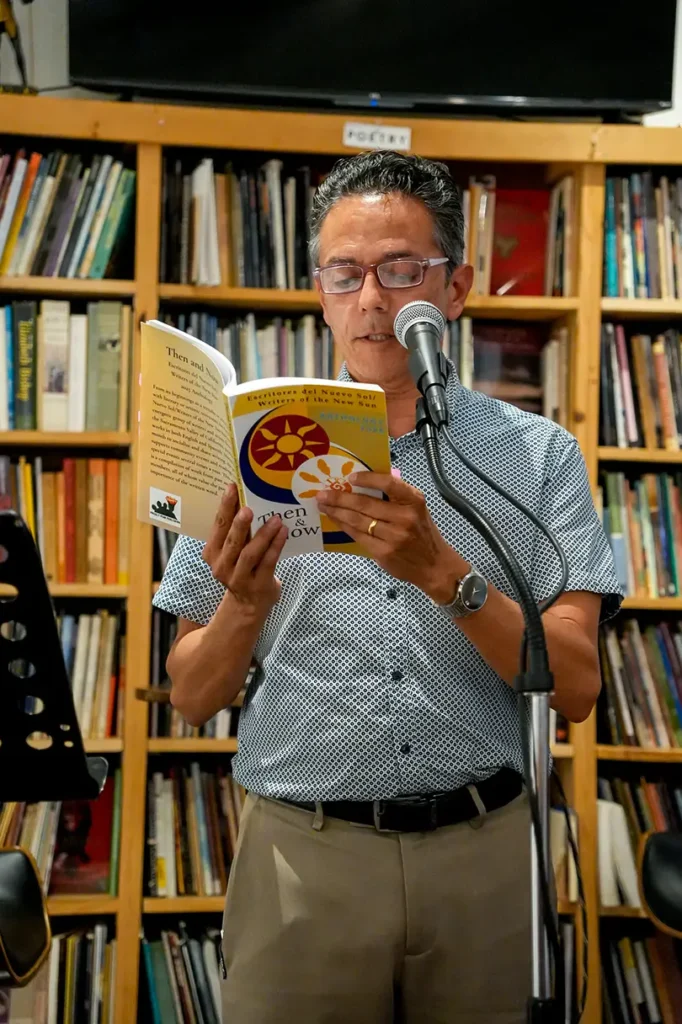
Among the crowd were poets and writers who had been part of the group from its start. Others were celebrated writers, poets, humorists and still others were newer to the group. A wide variety of ages and lived experiences, but all sharing a passion to continue a tradition of gathering and sharing stories; just as Chicano writers have done in Sacramento for decades.
A woman, short in stature but renowned in deed, Chicano sage and writer Graciela B. Ramírez, faced a crowd of people so different from herself and each other, yet culturally, they all tread the same historic path.
Ramírez, a founding member of Escritores del Nuevo Sol, told the story of the group’s earliest efforts: a bookstore founded by a group at Sacramento State, who saw the prolific works being created by Mexican American writers in Sacramento and recognized the need to share those works.
“We were creating a lot of poetry and books, but we didn’t have a place to sell them, or at least to show it,” Ramírez said. “They started everything with $200 that they collected by selling sweet bread at Sac State. … The place was so small that the poetry readings [were held] outside the bookstore.”
Escritores del Nuevo Sol published their first anthology in 2004. Over two decades later, some of the group’s writers have moved out of the region. There are new members now, but the group has kept this tradition long enough that it has the solemn opportunity to memorialize members who have died.
In “Then & Now,” which is divided into two sections, aptly titled “Then” and “Now,” Escritores del Nuevo Sol provides a platform for their writers to share their work while recording the group’s history. In the first section of the book, co-founder Arturo Mantecón reveals the timeline from the group’s earliest iterations. Another founding member, Francisco X. Alarcón is given tribute by Escritores current de facto leader, Paul Aponte.
The remaining pages, under the “Now” title, showcase the group’s current 19 members. This section opens with another record of significant recent history for Escritores del Nuevo Sol including the acknowledgement of a Senate resolution to honor two of the group’s most senior members: Graciela B Ramírez and JoAnn Anglin.
One of the group’s newest members, Marco Antonio Contreras, joined in September of 2024. The inclusion in “Then & Now” of his story, “Trump International Hotel, Las Vegas,” about being cooped up on New Year’s eve while explosions are heard from below, is his first piece published with the group.
Contreras’ non-fiction essay draws from his experience as an intern writing for LA Weekly and the Stockton Record just out of college. But when the group has their monthly meetings, he’s been challenged to attempt to hone his voice around new methods of expression in poetry and fiction writing.
“I’m with these people all the time and I’m a little bit shy in that when I’m sharing, I feel like a wannabe poet,” Contreras said. “My goal is to enjoy myself, grow as a writer and to find my writer’s voice.”
In the time he’s been a member, Contreras has already noted a shift in how he approaches writing. After being given the opportunity to share his work with such experienced writers, Contreras tries to recruit like-minded people who could take part in carrying on the act of writing from the perspective of a Chicano writer. He said he’s seen three or four members join the group since his initiation, but still considers himself a newbie.
“I am always amazed when I hear them sharing their poetry or their short stories or essays,” he said. “These writers, they’ve been published many times in different books or publications. Some of them were professors — I think most of them are retired — and they really have accepted me into the group.”
Ramírez said that, by sticking with Escritores del Nuevo Sol and giving writers who have a shared culture in being a creative person with roots in Mexico, she’s able to enjoy watching young writers who are not unlike her and the other founding members.
“I’ve been involved in all this since probably the early ’60s and I am really moved when I come and see that everything has continued,” Ramírez said. “That, no matter what happened to us, we are here. … When I think about these things, I see especially young people continuing our culture … writing about us, our own experiences, in our own culture, we know that we’ll be here forever. That’s our preservation, teaching the next generation.”
This story is part of the Solving Sacramento journalism collaborative. This story was funded by the City of Sacramento’s Arts and Creative Economy Journalism Grant to Solving Sacramento. Following our journalism code of ethics, the city had no editorial influence over this story. Our partners include California Groundbreakers, Capital Public Radio, Hmong Daily News, Outword, Russian America Media, Sacramento Business Journal, Sacramento News & Review and Sacramento Observer. Sign up for our “Sac Art Pulse” newsletter here.
By Casey Rafter