You probably didn’t even notice the exact moment it happened. At some point in life, you stopped believing your body could truly rebuild itself.
When you were a kid, losing a tooth was almost boring. It fell out, and another one grew back. Simple. Natural. Your body just handled it. No loans. No surgery. No metal screws drilled into your jaw. No sterile dental lights above your face while your entire nervous system screamed.
Then adulthood quietly changed the rules.
Now if you lose a tooth, the world tells you to prepare. Implants. Prosthetics. Drilling. Cutting. Bone grafts. Titanium posts. Months of healing. Thousands of dollars. And most people accept it, because “that’s just how it is.”
But what if that was never the full truth?
Right now, Japan may be doing something far bigger than improving dentistry. It may be challenging one of the deepest assumptions we’ve had about the human body.
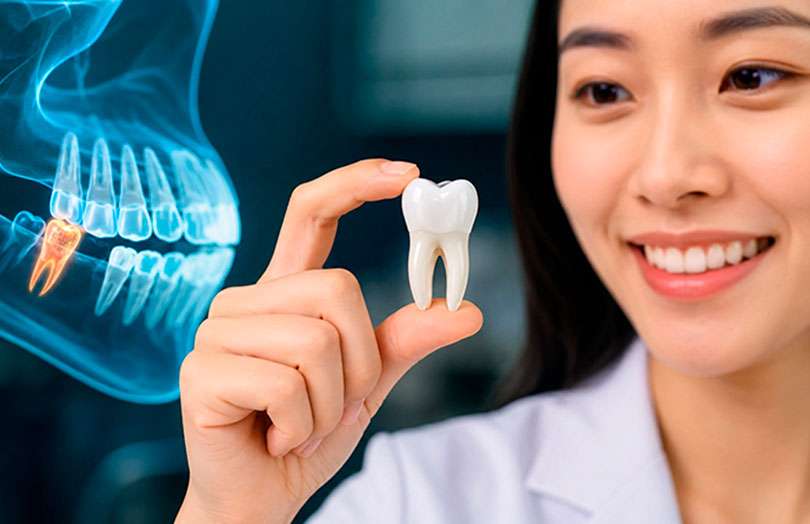
Japanese scientists are testing a drug called TRG-035 that could help adults grow new natural teeth.
Not artificial replacements.
Not removable dentures.
Not mechanical fixes.
Real teeth.
Yes, it sounds like science fiction. Like one of those futuristic headlines people share without believing. But this is rooted in real biological research, and the implications are massive.
Here’s the mind blowing part.
Your body may still carry dormant tooth buds, the hidden biological potential to grow additional teeth. The reason this normally doesn’t happen is because of a protein called USAG-1, which suppresses that process.
In simple terms, nature may not have deleted your ability to regrow teeth. It may have just switched it off.
And TRG-035 is designed to block that blocker.
When USAG-1 is inhibited, those dormant mechanisms may activate, potentially allowing the body to do something most adults assumed was impossible: grow a new tooth again.
Pause for a second.
This is bigger than dental news.
This could completely reshape how we think about healing, aging, and the limits of the body itself.
For decades, we’ve been taught that adulthood is a one way street. Lose something, replace it. Damage something, manage it. Your body isn’t rebuilding, it’s declining.
But what if some of those limits were never permanent?
What if they were biological switches we simply didn’t know how to control yet?
That possibility is what makes this story hit so hard.
Because it’s not just about teeth.
It’s about hope.
Think about how many people delay dental care because of cost.
How many hide their smile in photos.
How many chew on one side of their mouth.
How many live with fear of the dentist not because they’re careless, but because they associate treatment with pain, money, and helplessness.
Now imagine hearing this instead:
“Instead of replacing the tooth, we may help your body regrow one.”
That sentence alone feels like it belongs in another century.
And maybe that’s exactly the point.
The future of medicine may not always be about adding more synthetic solutions. Sometimes it may be about reactivating what the body already knew how to do before we assumed it couldn’t.
For years, humanity has obsessed over external technology. Faster phones. Smarter AI. Better machines.
But some of the most revolutionary breakthroughs may come from rediscovering the dormant technology inside us.
Today, it’s teeth.
Tomorrow, cartilage?
Damaged tissues?
Maybe one day even organs?
Suddenly, regeneration stops sounding like fantasy and starts sounding like biology we’re only beginning to understand.
And that idea is both exciting and unsettling.
Because every major breakthrough forces society to confront an uncomfortable truth:
How much suffering did we normalize simply because we thought there was no other option?
How many painful procedures were accepted not because they were ideal, but because they were the best available at the time?
If Japan succeeds, future generations may look back at dental implants the way we look at ancient medical tools. Necessary for their era, but shockingly primitive.
Imagine someone in 2045 saying:
“You mean people used to drill metal into their skulls because they couldn’t regrow teeth?”
That’s not an impossible conversation anymore.
Of course, this doesn’t mean dentists disappear tomorrow. Human trials are still ongoing. Long term safety matters. Science takes time. Responsible medicine should.
But even now, the psychological shift has already begun.
Because once people realize the body may be more capable than they were told, something changes.
They stop seeing biology only as decline.
They start seeing possibility.
And maybe that’s why this story spreads so fast.
It touches something deeply personal.
Every person knows what it feels like to lose something. Health. Strength. Confidence. Time.
So when science whispers, “Some things may be recoverable,” people listen.
Not because it’s just about enamel and molars.
Because it challenges the larger belief that loss is always final.
Maybe the biggest breakthrough here isn’t dental.
Maybe it’s philosophical.
For generations, we’ve been sold a quiet assumption: once something important is gone, your only option is replacement.
But what if restoration becomes real?
What if the body we underestimated still has hidden blueprints?
That changes more than medicine. That changes identity.
We are living in a strange era where technology can either replace humans or help humans reclaim themselves.
And that distinction matters.
Because there’s a profound difference between becoming more artificial and becoming more restored.
Japan’s research may be opening a door that was never truly locked, only biologically suppressed.
And if that door opens, millions of people may have to rethink what “permanent loss” actually means.
Maybe the scariest part is not that new teeth could grow.
Maybe it’s realizing how many impossible things were only impossible because nobody had found the switch yet.
So here’s the real question:
What else inside the human body have we mistakenly called irreversible?
Because if nature left more backup systems than we realized, then the future of medicine may not be about building humans from scratch.
It may be about waking up the parts of us that were sleeping all along.
And that possibility is far more powerful than a perfect smile.
What if the biggest lie we ever accepted was this:
“It’s gone forever.”