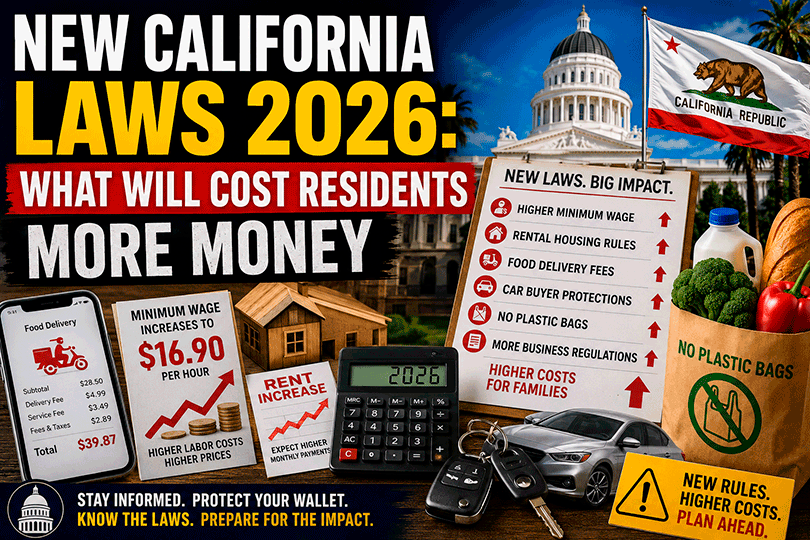
Summer 2026 has become the first real test of California’s newest laws. Six months ago, lawmakers introduced a series of changes aimed at protecting workers, renters, consumers, and the environment. At the time, many people saw them as just another round of political decisions coming out of Sacramento.
Today, the effects are becoming much harder to ignore.
Not because politicians are talking about them.
Because residents are seeing them in their bank accounts.
One of the most significant changes this year was the increase in California’s minimum wage to $16.90 per hour. For hundreds of thousands of workers, that means more money coming in each month. In a state where the cost of living remains among the highest in the country, every extra dollar matters.
But economics rarely works in a straight line.
When labor costs rise, businesses face higher operating expenses. To stay profitable, many companies adjust prices. Restaurants raise menu prices. Coffee shops charge more for drinks. Service providers increase rates. Small businesses look for ways to absorb costs while staying competitive.
As a result, many Californians are paying more for everyday goods and services than they were just a year ago.
The housing market is facing similar pressures.
California continues to strengthen protections for renters and increase standards for rental properties. From a tenant’s perspective, these changes make sense. People deserve safe, well maintained homes and responsive landlords.
However, every new requirement comes with a cost.
Property owners must invest more in maintenance, repairs, compliance, and equipment upgrades. Those expenses do not simply disappear. In many cases, they eventually find their way into rental prices.
For families already struggling with housing costs, that possibility is becoming a growing concern.
Another area seeing noticeable changes is food delivery.
Over the last decade, Californians have become accustomed to having meals, groceries, and household items delivered with a few taps on a smartphone. Convenience has become part of everyday life.
New regulations now require delivery platforms to provide stronger customer protections and more transparency. Consumers benefit from improved refund policies and clearer communication when problems occur.
That sounds like good news.
But companies also face higher compliance costs.
And when costs increase, businesses often respond by adding fees, raising service charges, or adjusting pricing structures.
Many users have already noticed that convenience is becoming a little more expensive.
Even environmental policies are affecting household budgets.
California continues to lead the nation in environmental regulation. New restrictions on plastic bags and packaging are designed to reduce waste and encourage sustainable alternatives.
The goal is understandable.
Yet alternative materials are often more expensive. Retailers absorb part of the cost, but much of it eventually reaches consumers through higher prices on everyday purchases.
Individually, these increases may seem small.
A few cents here.
A dollar there.
A slightly higher delivery fee.
A more expensive grocery bill.
But when added together over weeks and months, they create a very different financial picture.
What makes this situation particularly interesting is that most of these laws were created with good intentions.
Protect workers.
Support renters.
Improve consumer rights.
Promote environmental responsibility.
Few people would argue against those goals.
The challenge is that major reforms are rarely free.
Someone always pays for change.
And more often than not, that cost is shared by ordinary residents.
California has long served as America’s policy laboratory. Many ideas that begin here eventually spread across the country. That is why the changes taking place today matter far beyond Los Angeles, San Francisco, or Sacramento.
They offer a glimpse into what the future may look like elsewhere.
Six months into 2026, that future is becoming easier to see.
Not in political speeches.
Not in government reports.
But in monthly bills.
In rent payments.
In service fees.
In grocery receipts.
And in the everyday financial decisions families make across California.
The question is no longer whether these laws are changing the economy.
The real question is how much those changes will ultimately cost the people who call California home.