For decades, flying faster than sound felt like one of those futuristic ideas that never quite lived up to its promise.
The Concorde proved it was possible. Passengers could cross the Atlantic in about three hours and experience a level of speed that still feels impressive today. But there was a problem that technology could not overcome at the time.
The noise.
Every time a supersonic aircraft broke the sound barrier, it created a powerful sonic boom that could be heard for miles. Communities complained. Regulators stepped in. Eventually, the dream of routine supersonic passenger travel faded away.
Now NASA believes it has found a way to change that.
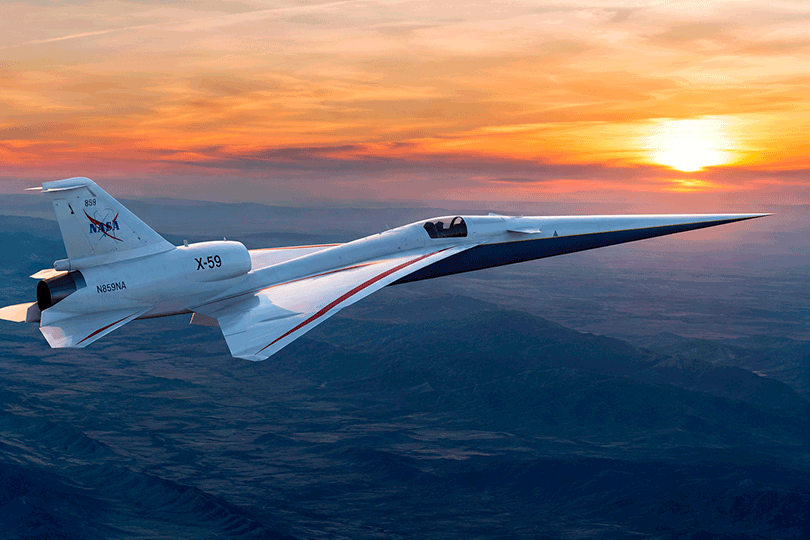
The agency’s experimental X 59 aircraft is moving toward its first major supersonic flight tests, bringing the world closer to a future where crossing the United States could take just 2.5 hours instead of six.
Imagine boarding a flight in New York and landing in Los Angeles before most people finish a workday meeting.
That is the future NASA is trying to build.
The X 59 is unlike any aircraft currently flying. Its unusually long and narrow shape is not designed to look futuristic. Every line of the aircraft serves a purpose.
Engineers have spent years shaping the plane to solve the biggest challenge in supersonic aviation.
Instead of producing the explosive sonic boom that made earlier aircraft controversial, the X 59 is designed to create a much softer sound that NASA describes as a gentle thump.
That may sound like a small improvement.
In reality, it could change the entire aviation industry.
If communities on the ground no longer experience disruptive sonic booms, regulators could eventually allow supersonic flights over populated areas. That would open routes that have been impossible for decades and make high speed air travel commercially viable again.
The aircraft is currently undergoing safety evaluations and system testing in California as engineers prepare for the next phase of development.
When fully tested, the X 59 is expected to reach speeds of up to Mach 1.6, or roughly 1,960 kilometers per hour. Its planned cruising speed is around Mach 1.4.
For comparison, most commercial airliners travel at less than half that speed.
The result could be one of the biggest leaps in passenger aviation since the arrival of the jet age.
What makes this project especially fascinating is that it is not simply about getting somewhere faster.
It is about changing the way people think about distance.
Cities separated by thousands of miles could feel much closer. Business travel could become dramatically more efficient. Tourism could expand in ways that are difficult to imagine today.
History shows that every major transportation breakthrough reshapes society.
Railroads connected nations.
Jet aircraft connected continents.
Quiet supersonic travel could redefine global mobility once again.
Many aviation enthusiasts already see the X 59 as the spiritual successor to Concorde. The difference is that NASA is not trying to recreate the past.
It is trying to solve the problem that prevented the future from arriving sooner.
The aircraft has already completed a series of successful low speed test flights. The upcoming supersonic phase will reveal whether decades of research can finally overcome one of aviation’s greatest challenges.
If it succeeds, the return of supersonic passenger travel may no longer be a dream.
It may simply be the next chapter in the story of flight.