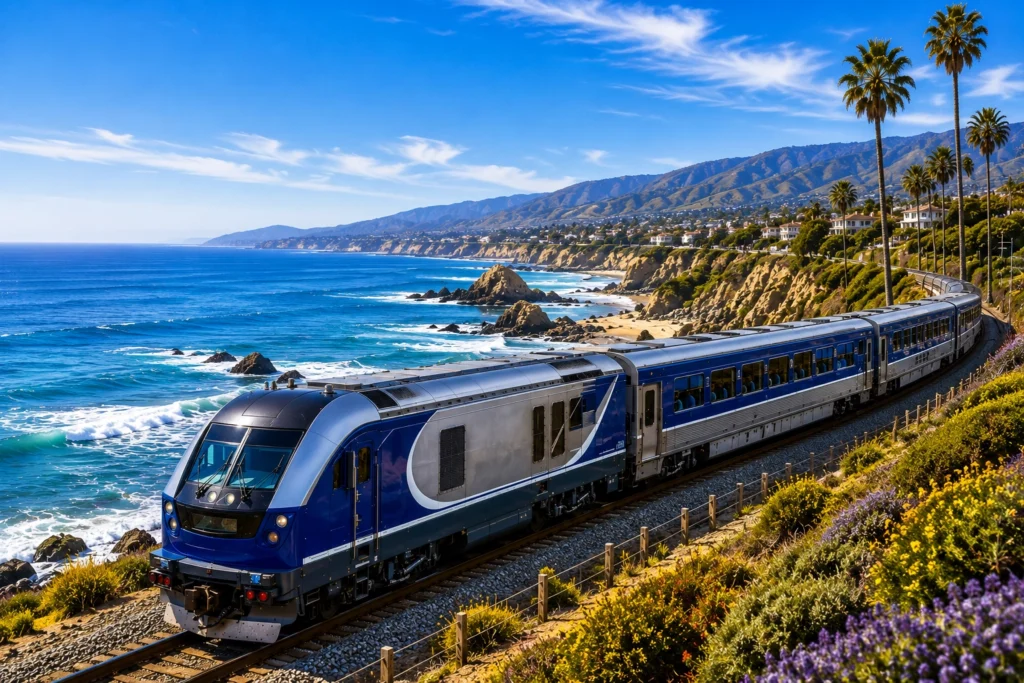
Pacific Surfliner Gains Momentum as More Californians Choose the Train
Not long ago, traveling between San Diego and Los Angeles meant only one realistic option for many Southern California residents: driving, sitting in traffic for hours, paying for gas, and searching for parking. That familiar pattern is gradually changing. More passengers are choosing Pacific Surfliner, one of the busiest intercity rail routes in the United States.
From January 1 through March 30, 2026, passengers took 600,751 trips aboard Pacific Surfliner. That represents a 38.1% increase compared with the same period in the previous fiscal year. Such strong growth cannot be explained by tourism or seasonal demand alone. It shows that passenger rail is once again becoming an important part of daily life in Southern California.
Pacific Surfliner operates along a 351-mile route between San Diego and San Luis Obispo. Its trains serve 29 stations across San Diego, Orange, Los Angeles, Ventura, Santa Barbara, and San Luis Obispo counties. The route connects major cities, coastal communities, tourist destinations, universities, business centers, and popular recreation areas.
For some passengers, the train provides a way to commute without the daily stress of driving. For others, it offers an easier way to spend a weekend in Santa Barbara, attend an event in Los Angeles, or visit the coast without worrying about parking. For families, the train ride can become part of the experience, especially along sections where the tracks run beside the Pacific Ocean.
Additional Trains Have Returned
The increase in ridership coincided with the gradual restoration of service to its pre-pandemic schedule. On January 26, 2026, a 13th daily round trip was added between Los Angeles and San Diego. The corridor now offers 13 daily round trips on this segment, matching the level of service available before the pandemic.
The schedule also includes five daily round trips between San Diego and Goleta and two full-corridor round trips between San Diego and San Luis Obispo. Additional departures reduce the time passengers must wait and provide greater flexibility when planning a workday, business meeting, or short vacation.
The restoration of three daily round trips was made possible by a $27.1 million federal grant. The Federal Railroad Administration awarded the funding through its Restoration and Enhancement Grant Program. The grant can help cover operating costs for up to six years.
This is about more than adding several lines to a timetable. For a passenger, another departure can mean a more convenient travel time, a shorter wait, and a realistic opportunity to choose the train instead of driving. The more frequently trains operate, the easier it becomes for residents to incorporate rail travel into their everyday lives.
Why Californians Are Choosing the Train
Pacific Surfliner’s biggest advantage is not limited to its scenic views. The train helps passengers avoid some of the costs and frustrations associated with driving across Southern California.
Instead of spending several hours behind the wheel, passengers can work, read, spend time with family, or simply rest. Most trains provide power outlets, complimentary Wi-Fi, and storage for luggage and bicycles. The onboard Market Café offers food and beverages. These features are especially useful for travelers who need to spend the day in another city and return home in the evening.
Cars remain essential in many parts of California. However, along routes connecting major coastal cities, the train is becoming a practical alternative. Passengers do not have to pay for parking in downtown Los Angeles, sit in traffic on Interstate 5, or worry about driving home while tired after a long day.
Passenger rail also benefits local businesses and tourism. Riders visit restaurants, hotels, stores, sporting events, beaches, and cultural attractions. Additional trains can bring more visitors not only to major cities but also to smaller coastal communities.
More Than a Tourist Train
Pacific Surfliner is often viewed as a scenic tourist train, but its role is much broader. Students, employees, military personnel, families, and people traveling to appointments, meetings, and events also depend on the service.
The route connects San Diego, Oceanside, San Juan Capistrano, Irvine, Anaheim, Fullerton, Los Angeles, Ventura, Santa Barbara, and other cities. At certain stations, passengers can transfer to local public transportation or use Amtrak Connection buses.
Bus connections extend the route’s reach. Travelers can continue to Oakland, Palm Springs, Palm Desert, Riverside, Solvang, Paso Robles, and other destinations. Passengers planning a complicated itinerary should check transfer times carefully because not every connection is guaranteed.
The increase in ridership demonstrates that demand for these connections already exists. People are willing to use public transportation when it offers a convenient schedule, understandable transfers, and enough departures throughout the day.
Reliability Remains a Challenge
Pacific Surfliner is attracting more passengers, but the service continues to face operational challenges. According to the quarterly report, 81.6% of trains reached their final destination within 15 minutes of the scheduled arrival time. California transportation officials have established a performance target of 90%.
A short delay may not matter much during a recreational trip. For someone traveling to work, an airport, a medical appointment, or an important meeting, however, a late arrival can disrupt the entire day.
Rail conditions, shared tracks with freight trains, construction projects, and natural hazards can all affect reliability. The section near San Clemente remains especially vulnerable. Coastal erosion and landslides have repeatedly forced temporary service suspensions in that area.
Passengers should check current schedules and service alerts before traveling. The official Pacific Surfliner website publishes information about construction, closures, and potential delays.
As ridership grows, reliability becomes even more important. If passengers cannot depend on arrival times, some will return to their cars. Expanding the route requires more than adding trains. Officials must also strengthen infrastructure, protect coastal tracks, and improve schedule performance.
What the 38% Increase Really Means
The 38.1% increase does not mean Southern California is abandoning the automobile. It does, however, reveal a meaningful change in passenger behavior. When convenient service is available, people are willing to try the train and make it part of their transportation routine.
Before the pandemic, Pacific Surfliner handled nearly 2.8 million passenger trips annually. Ridership climbed above 2 million again in 2024, representing an increase of approximately 20%. The latest figures suggest that the recovery is continuing and could accelerate as the expanded schedule attracts more riders.
Pacific Surfliner is one of Amtrak’s busiest state-supported routes. Its development matters beyond the railroad industry. It affects mobility, air quality, access to jobs, and the region’s ability to accommodate population growth without endlessly expanding highways.
Not every train journey replaces a car trip, but many do reduce traffic pressure. If convenient passenger rail continues to expand, residents will have greater freedom to choose how they travel. Driving will no longer be the only practical way to move between major coastal cities.
Southern California Needs Transportation Choices
The most important result of Pacific Surfliner’s growth is not the record itself. It is confirmation that demand exists. Southern California residents want the ability to choose between driving and taking the train. They are prepared to use passenger rail for work, school, recreation, and events when the schedule meets their needs.
Additional service between Los Angeles and San Diego has restored operations to pre-pandemic levels. Federal funding is helping support the expanded schedule, but long-term success will depend on state investment, reliable infrastructure, and consistent service quality.
The 600,751 trips recorded in three months show that Pacific Surfliner is no longer only an option for tourists. It is becoming an increasingly important transportation link for Southern California. The more convenient and reliable the route becomes, the more residents will be able to leave their cars at home, at least occasionally.
Would you choose the train for your next trip between Southern California cities?