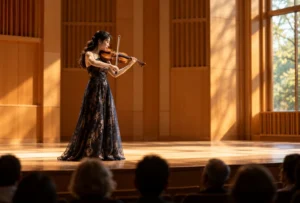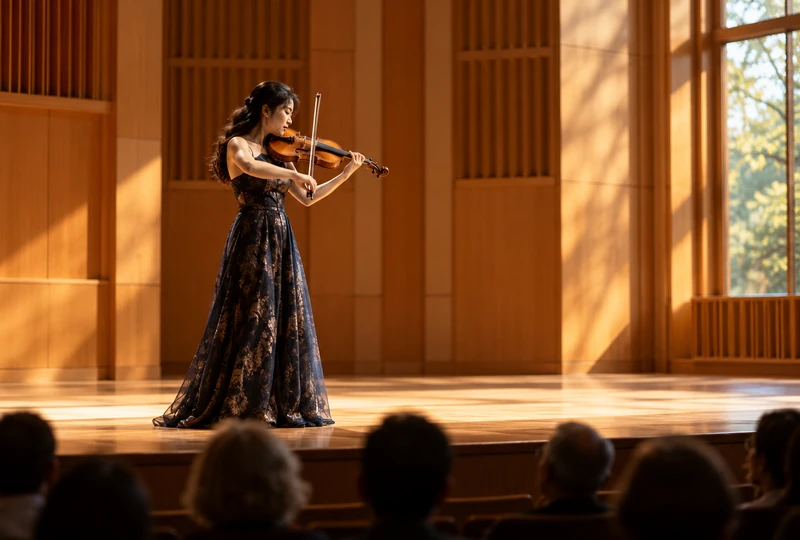
Not every memorable concert requires a ticket or an entire evening. On Thursday, November 5, violinist Sheng-Ching Hsu is scheduled to perform a free solo recital at the Ann E. Pitzer Center in Davis. The Shinkoskey Noon Concert begins at 12:05 p.m. and ends at 1 p.m., making it possible to hear a complete program in less time than many people spend on an ordinary lunch. For students, campus employees and nearby residents, it is a small opening in the middle of a weekday.
The program crosses several musical worlds. UC Davis lists Reena Esmail’s Varsha, J.S. Bach’s Sonata in C Major, Shahab Pāranj’s Sarv, marked as a premiere, and Paul Ben-Haim’s Sonata in G. Those names and works do not ask listeners to arrive with a course in music history. They offer a sequence of distinct voices, with an unfamiliar piece appearing beside a composer many people recognize. Part of the pleasure of a live recital is hearing how one performer connects those voices without the distraction of an orchestra or elaborate staging. The word “premiere” is especially worth noticing. It means audiences will hear Sarv at a moment when it is being introduced in performance, according to the university’s program. UC Davis does not specify on the event page whether this is a world, U.S. or local premiere, so it would be misleading to assign it a larger label. What is clear is that the piece is being singled out as new within this concert. A listener who attends will have a chance to respond to it before the work has become familiar.
Hsu’s background gives the afternoon another point of interest. The university says she made her first public appearance at age six in Taiwan as both a violinist and pianist. Her later performances have taken her to venues including Carnegie Hall, Lincoln Center and Walt Disney Concert Hall, as well as stages outside the United States. A short campus recital is therefore not a lesser version of a major-city performance. It is an opportunity to hear an experienced artist at close range, in a setting where the distance between stage and audience feels different. For someone new to solo violin, the format can be surprisingly direct. There is no accompaniment to soften a transition or cover a pause. The sound comes from one instrument and the choices of the person playing it: how a phrase begins, how long it is allowed to breathe, where the energy turns. You need not identify every technical decision to sense the difference between a restrained passage and a forceful one. Listening closely for even a few minutes can make the hour feel less like background music and more like a conversation conducted without words.
The mix of composers also gives readers a simple way into the program. You might arrive curious about Bach and leave thinking about the premiere, or come for a new name and discover something in the older sonata. No one has to know in advance which piece will be the favorite. That uncertainty is one advantage of a live, mixed program: it can surprise the listener without asking for an expensive commitment or an unfamiliar evening schedule.
The practical details are straightforward. The recital is listed for Thursday, November 5, from 12:05 to 1 p.m. at the Ann E. Pitzer Center on the UC Davis campus. The event is free. A local Davis music listing gives the address as 144 Hutchison Drive. As with any campus visit, allow time to find the room and check current parking or transit information before leaving; the concert announcement does not promise free parking. The university event page is the best place to confirm a last-minute change in time or program.
Free admission matters beyond the price. It lets someone try a form of music that might otherwise feel formal or inaccessible. A student can step out of a routine day, a neighbor can bring a friend, and someone who has never attended a violin recital can find out whether the experience speaks to them. There is no need to turn the outing into a test of taste. The invitation is simply to listen.
If you go with someone, compare notes afterward. A favorite passage, a surprising sound or a question about the new work can be a more rewarding souvenir than a photograph of the stage.
We have not heard this performance and cannot predict how Hsu will interpret each work. The program, venue and time are confirmed by UC Davis; the response to the music will belong to the room on November 5. In a week full of obligations, an hour set aside for careful listening may be the most unexpected appointment on the calendar.
Official event details:
https://arts.ucdavis.edu/events/sheng-ching-hsu-solo-violin