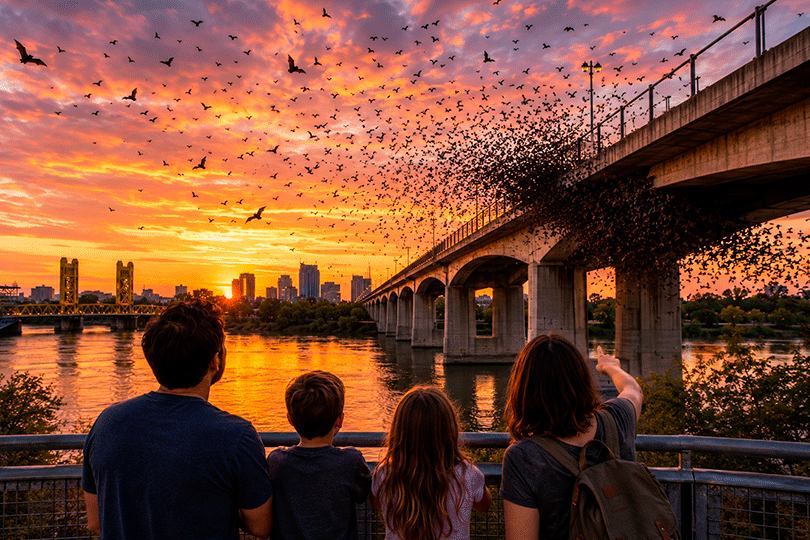
Every day, thousands of cars cross Yolo Causeway between Davis and Sacramento. Yet few drivers realize that one of Northern California’s most remarkable natural attractions is hidden right beneath the bridge. During the warmer months, about 250,000 bats make their home there.
The real show begins after sunset. First, a few bats appear from the narrow openings under the bridge. Then more and more emerge, forming a long, moving stream above the water. Within minutes, a vast living cloud fills the sky and heads out for a night of hunting.
Yolo Causeway is home to the largest urban colony of Mexican free tailed bats in California. They spend the day inside narrow gaps and joints in the concrete structure. In the evening, they spread out over wetlands, rice fields, orchards, and farmland across Yolo and Sacramento counties.
The bridge is an almost perfect shelter. Asphalt warmed by the sun helps the structure hold a comfortable temperature. Deep gaps and expansion joints protect the bats from many predators. The surrounding landscape is also full of insects, so the colony does not have to travel far to find food.
The loss of natural habitat may be another reason so many bats settled beneath the bridge. Urban development and the removal of older trees have reduced the number of hollow trees and other safe roosting places. As a result, a structure built by people has unexpectedly become an important part of the local ecosystem.
The bats are much smaller than the enormous evening swarm might suggest. An adult is usually about 3.4 to 4.3 inches long, with a wingspan of roughly 12 inches. Their long, narrow wings allow them to fly at extraordinary speeds. Members of this species have been recorded flying horizontally at about 99 miles per hour, making them some of the fastest animals in the world.
These bats provide a valuable service to people and the environment. They eat moths, mosquitoes, flying ants, beetles, and many other insects. In a single night, a colony this large can consume an enormous number of pests. That makes their presence especially valuable to nearby farms and orchards.
During summer, the space beneath the bridge becomes a giant nursery. Females usually give birth to one pup near the end of June. While the pups remain in the roost, their mothers leave to hunt. When they return, each mother must find her own baby among thousands of others. She recognizes it by its voice and scent.
Young bats begin flying on their own at about five weeks old. Their first flights can be dangerous. Predators may wait below the bridge, while falcons and other birds of prey sometimes hunt young bats in the air.
Despite the frightening way bats are often shown in movies, they do not seek out people and usually prefer to keep their distance. They do not try to become tangled in anyone’s hair, and they do not chase visitors. Watching the evening flight from a safe location can be an exciting and peaceful experience.
Wild bats should never be touched with bare hands. If a bat is lying on the ground, appears injured, or cannot fly, keep pets away and contact a wildlife rescue organization. Visitors should not enter the space beneath the bridge, shine bright lights at the colony, or move closer just to take a photograph.
Yolo Basin Foundation offers seasonal Bat Talk and Tour programs. Visitors learn about local bat species, meet ambassador animals used for education, travel through the surrounding wetlands, and watch the evening flight from a safe viewing area. The full experience usually lasts about three hours and is suitable for families with children.
All official tours for the 2026 season have sold out. Interested visitors can join the waiting list or subscribe for updates about the next season. Anyone planning an independent visit should check current access rules and conditions before leaving home. Stopping along Interstate 80 or trying to walk beneath the causeway is dangerous.
Bats face growing pressure from habitat loss, pesticides, climate change, disease, and human disturbance. Large colonies have declined in many places. Fear and misinformation can make the problem worse when people destroy roosting sites without understanding the important role bats play.
The story of Yolo Causeway shows how city infrastructure can become part of nature in the most unexpected way. The bridge was built for traffic, but its warm concrete spaces became a home for a quarter of a million living creatures. Every evening, they rise over the water and create a breathtaking natural spectacle that most nearby drivers never know is happening.