California has always sold the same dream to the world.
Freedom. Reinvention. Sunlight. Endless possibility.
It is the place where people arrive to become someone else. Actors, founders, surfers, millionaires, spiritual gurus, exhausted dreamers holding overpriced coffee while pretending they have their lives together. California feels less like a state and more like a global mood board for modern life.
And yet beneath all the polished perfection, beneath the palm trees and startup culture and carefully curated happiness, California quietly hides something deeply strange.
Some of its laws sound completely insane.
Not metaphorically insane. Literally insane.
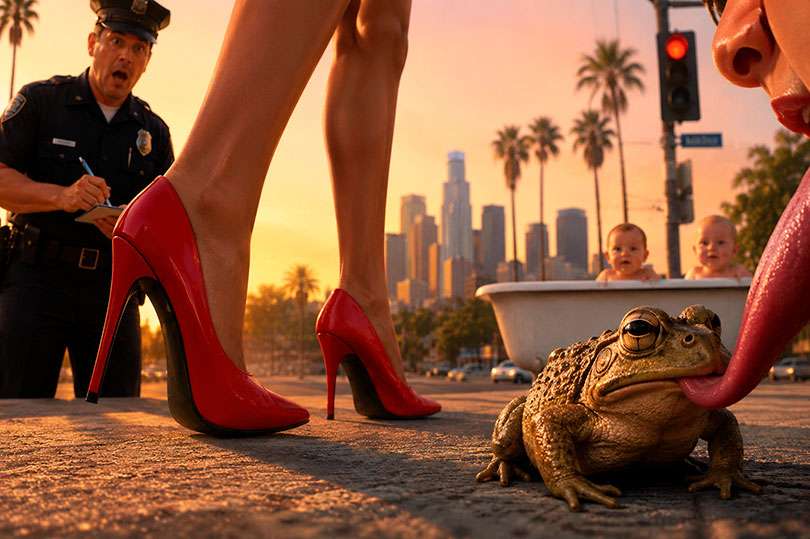
In one California city, it is illegal to eat frogs that die during frog jumping contests.
In another, women once needed a permit to wear high heels above a certain height.
Los Angeles officially banned frog licking.
Some towns reportedly prohibited underwater whistling.
And somewhere in the middle of all this legal absurdity, an invisible question appears:
What kind of world creates rules like these?
At first, stories like this feel like internet comedy. The kind of random trivia people repost at two in the morning with captions like “America is unreal.”
But the deeper you look, the more fascinating these laws become.
Because strange laws are never really about laws.
They are about fear.
Embarrassment.
Chaos.
Human behavior.
And society’s endless attempt to control things that were never fully controllable in the first place.
Take the high heel permit law in Carmel.
The internet loves mocking it because it sounds ridiculous. But the story behind it is surprisingly human. The sidewalks were uneven. Tourists kept falling. Injuries turned into lawsuits. Lawsuits turned into panic. And eventually someone in local government reached the most bureaucratic conclusion imaginable:
“We should regulate the shoes.”
That single decision contains something oddly profound about modern civilization.
Human beings rarely eliminate chaos.
We simply redesign it into paperwork.
And California may be the perfect place for this contradiction to exist.
Nowhere else combines futuristic ambition with historical absurdity quite like this state.
Artificial intelligence companies worth billions operate next to laws written decades ago about frogs, bathtubs, and footwear. Self driving cars move through cities where some regulations still sound like they were invented during a fever dream.
The contrast feels almost poetic.
One part of society races toward the future while another part desperately tries to prevent people from slipping on sidewalks.
Maybe that is why these stories spread so quickly online.
People are tired of polished reality.
Every day the internet floods us with productivity advice, political outrage, optimization hacks, financial anxiety, and endless pressure to become more efficient versions of ourselves. Everything feels serious all the time.
Then suddenly someone discovers a law banning frog licking and something unexpected happens.
They laugh.
Not polite laughter.
Real laughter.
The kind that interrupts stress for a few seconds.
The kind that reminds people the world is still wonderfully irrational.
And maybe that irrationality is comforting.
Because beneath the algorithms and corporate language and artificial perfection, human civilization remains gloriously strange.
That is what these laws expose.
Not stupidity.
Humanity.
Behind every bizarre law is usually one unforgettable moment where something went terribly wrong.
Somebody panicked.
Somebody complained.
Somebody got injured.
Somebody embarrassed an entire city council meeting.
Then officials responded the only way governments know how:
By creating another rule.
Even the famous frog licking law tells a bigger story than most people realize. Certain toads produce hallucinogenic toxins. Authorities worried people would intentionally abuse them. So an official ban appeared.
And suddenly reality starts sounding like satire.
But perhaps the strangest part is this:
Modern life is still creating absurdity at exactly the same speed.
We just stopped noticing it.
Today algorithms decide what millions of people see, believe, buy, and fear before breakfast. Phones collect more personal information than some family members know. Entire careers now revolve around recording everyday life for strangers online. People sign digital agreements longer than novels without reading a single sentence.
Future generations will probably study us the same way we laugh at outdated California laws today.
They will wonder how intelligent people normalized such bizarre systems.
And maybe they will be right.
Because every generation secretly believes it has become rational while quietly building new forms of absurdity in the background.
That may be the most human pattern of all.
The truth is, civilization has never been as logical as it pretends to be.
It only becomes more sophisticated at hiding the chaos.
Which is exactly why weird laws fascinate people so deeply. They pull the curtain back for a moment. They reveal that behind every polished institution are ordinary humans improvising their way through confusion.
A nervous official.
A ridiculous accident.
A courtroom argument nobody expected.
A city council trying to solve one strange problem without realizing they were creating internet comedy for future generations.
And somehow that realization feels oddly reassuring.
Because perfection is exhausting.
But absurdity feels alive.
Maybe that is why millions of people instantly share stories like these. Not because they care about laws. Not because they care about frogs.
But because somewhere deep down, everyone is searching for proof that the modern world has not completely lost its humanity.
Strange laws provide that proof.
They remind us civilization is still built by imperfect people making imperfect decisions inside imperfect moments.
Which means the world has always been strange.
And probably always will be. Maybe the weirdest thing about California is not the laws themselves.
Maybe it is the fact that people still believe life was ever supposed to make complete sense in the first place.