What Happens to Your Body When You Work Nights for Years?
The night shift is over. You come home, close the curtains, go to bed, and wake up a few hours later feeling as if you have recovered. It seems like the problem is solved. After all, getting enough hours of sleep should be what matters. But your body may see things differently.
The human body does not live by a work schedule alone. We have a complex system of biological clocks that regulates sleep, body temperature, appetite, digestion, hormone production, blood sugar, and our ability to stay focused. These processes respond mainly to the natural cycle of light and darkness.
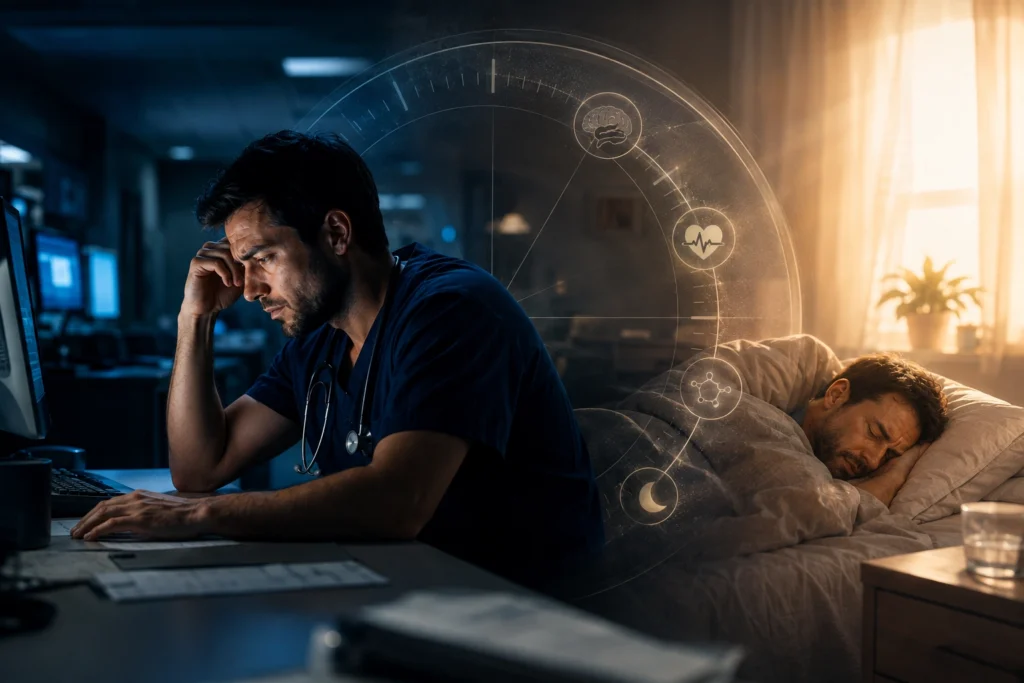
At night, the body expects sleep. During the day, it prepares for activity. When a person regularly works during the hours normally reserved for rest, circadian misalignment can develop. The brain may understand that it needs to stay awake, while the internal clocks in the liver, gut, pancreas, and other organs continue following their usual daily rhythm.
Research presented by the US National Institutes of Health found that even a few days of staying awake at night can change the timing of certain metabolic processes. At the same time, the main clock in the brain may barely adjust. As a result, some systems in the body receive the message that it is daytime, while others continue behaving as if it were night. Research on how night shifts disrupt metabolism.
Why Daytime Sleep Does Not Always Solve the Problem
Sleep after a night shift is essential. However, daytime sleep is often shorter and lighter than nighttime sleep. Sunlight, noise, household responsibilities, and the body’s natural alerting signal can wake a person before recovery is complete.
According to the US National Institute for Occupational Safety and Health, the body’s drive for wakefulness begins rising during the day, even if a worker only went to bed that morning. This means a night worker may fall asleep quickly because of accumulated exhaustion, then wake several hours later and struggle to fall asleep again. Why sleep after a night shift may be insufficient.
This creates a difficult combination. At night, the biological clock pushes the person toward sleep, even though work requires alertness. During the day, that same clock promotes wakefulness, even though the person now needs rest. The body keeps trying to move in one direction while the work schedule forces it in another.
Sleepiness is often strongest between two and six in the morning. During these hours, attention, reaction time, and the ability to make quick decisions can decline. For doctors, drivers, factory workers, security staff, and equipment operators, this is more than an uncomfortable feeling. It is a real safety issue.
What Happens to the Brain
Lack of sleep and circadian disruption can affect memory, concentration, thinking speed, and emotional stability. A person may process information more slowly, miss mistakes, and react later when something unexpected happens.
One part of the problem is that a tired brain does not always judge its own condition accurately. People may believe that they have adapted to night work even while their attention, reaction time, and performance are gradually getting worse. Coffee can temporarily reduce sleepiness, but it cannot replace proper sleep or eliminate circadian misalignment.
The risk does not end when the shift is over. The drive home can be one of the most dangerous moments of the day. If your eyes keep closing, your attention disappears, or you cannot remember the last few minutes of the trip, continuing to drive is unsafe. Stopping to rest or finding another way home may prevent a serious accident.
Why Metabolism Changes
Biological clocks regulate more than sleep. They also help control appetite, digestion, insulin production, and the way the body uses glucose. Food eaten at night enters the body at a time when many systems are preparing for rest rather than active digestion.
The US Centers for Disease Control and Prevention reports that night and rotating shift work is associated with a higher risk of type 2 diabetes. Possible reasons include changes in cortisol and insulin rhythms, insufficient sleep, irregular eating patterns, and reduced physical activity.
A small controlled study found that eating at night during simulated night work raised average glucose levels. Participants who ate only during the daytime did not experience the same increase. This does not mean that one late meal will cause diabetes. It shows that metabolism may be affected not only by what we eat, but also by when we eat it.
Night schedules can also change the signals that regulate hunger and fullness. A tired person may be more likely to choose sugary, fatty, or highly processed food. At the same time, finding the energy and time for regular physical activity becomes more difficult. Over time, the combination of poor sleep, irregular meals, and circadian disruption may contribute to weight gain and reduced insulin sensitivity.
What Science Says About Cancer
Cancer risk requires especially careful language. The International Agency for Research on Cancer classifies night shift work as probably carcinogenic to humans. This classification is known as Group 2A.
This does not mean that night work will cause cancer in every worker. It also cannot predict the personal risk of a specific individual. The classification is based on limited evidence from human studies, stronger evidence from animal studies, and information about possible biological mechanisms.
Researchers are studying several possible mechanisms, including circadian disruption, exposure to light at night, changes in melatonin production, and disturbed sleep cycles. They also consider how long a person has worked nights, how often those shifts occur, the age when night work began, and other lifestyle factors.
There is a major difference between saying that a possible connection is being studied and claiming that night work directly causes cancer. The scientifically accurate approach is to discuss a probable risk factor and the need for further research, not an inevitable disease.
One Night Shift Is Not the Same as Years of Night Work
A single sleepless night can cause fatigue, irritability, poor concentration, and slower reactions. After proper rest, these effects usually improve. The greater concern is a chronic schedule in which disrupted sleep and biological rhythms continue for months or years.
The effects of night work are not identical for everyone. Age, general health, shift length, the number of consecutive night shifts, recovery time, nutrition, physical activity, and the ability to adapt can all make a difference.
Night work should not be treated as a guarantee of future illness. At the same time, it is dangerous to assume that the body has fully adapted when exhaustion, sleep problems, weight changes, or poor concentration have become normal parts of life.
How to Reduce the Strain on Your Body
If night work is unavoidable, sleep after the shift must become a true priority. It should not be treated as spare time for errands and household tasks. The bedroom should be as dark, cool, and quiet as possible. Blackout curtains, a sleep mask, earplugs, and silenced phone notifications can protect daytime rest from light and noise.
Caffeine is best used during the first part of the shift and stopped several hours before sleep. Alcohol may make it easier to fall asleep, but it can reduce sleep quality and cause early waking. A heavy meal immediately before bed may also interfere with rest.
Planning meals in advance can help prevent nighttime exhaustion from leading to sweets or whatever is available from a vending machine. Regular meals with enough protein, vegetables, and fiber may support steadier energy.
Physical activity remains important, but it should not take time away from sleep. A realistic routine that can be followed regularly is more useful than occasional exhausting workouts intended to compensate for a difficult schedule.
Regular checks of blood pressure, glucose, body weight, and other health markers can help identify changes earlier. A person should talk to a doctor if they repeatedly struggle to sleep after work, wake frequently, or experience severe sleepiness while working or driving. Persistent fatigue can sometimes be connected to a sleep disorder, including sleep apnea, that requires separate evaluation.
Your body does not know that you are scheduled for a night shift. It does not read a work calendar or understand why the lights are on at three in the morning. It simply tries to follow biological clocks that developed long before hospitals, factories, delivery services, and other workplaces began operating around the clock.
Night work is often necessary, and for millions of people it is a permanent part of their profession. The goal is not to frighten every night worker. The goal is to stop treating chronic sleep loss as a normal price of earning a living and to take recovery as seriously as the work itself.