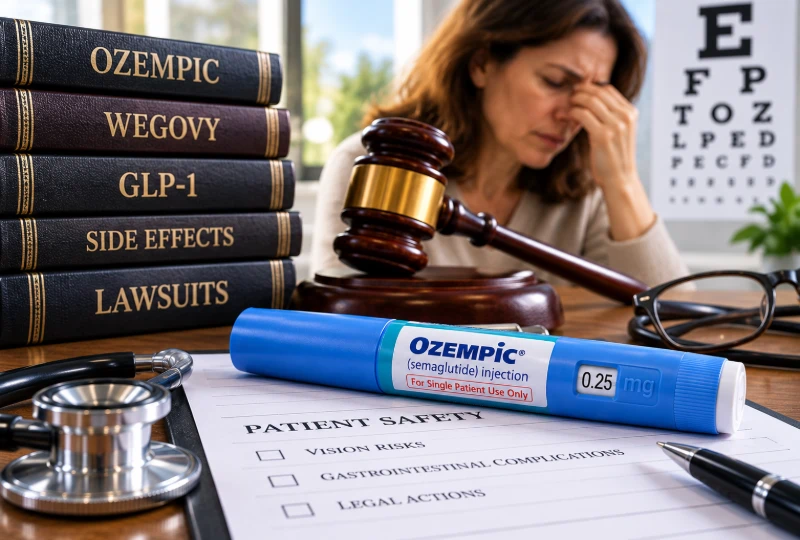
Ozempic and Wegovy have become two of the most talked about medications in the world. For millions of people, they offer a way to better control type 2 diabetes, lose weight, and reduce certain serious health risks. But now another word is appearing more often alongside stories of successful treatment: lawsuits.
As of September 1, 2026, the main federal litigation, MDL 3094, included 4,022 active lawsuits. Another 216 active cases were being handled separately in MDL 3163. Those cases involve claims of a rare optic nerve injury known as NAION. These numbers come from the official United States Judicial Panel on Multidistrict Litigation, not from an estimate published by a law firm.
The numbers may sound alarming, but a lawsuit does not mean that a medication has already been proven to cause an injury. In an MDL, similar cases are grouped together so the court can review evidence and expert testimony more efficiently. Every claimed injury still needs medical evidence and must be considered by the court.
The main litigation, MDL 3094, involves medications that work through the GLP-1 receptor. They include Ozempic, Wegovy, Rybelsus, Mounjaro, Zepbound, Trulicity, and several other drugs. The defendants include drugmakers such as Novo Nordisk and Eli Lilly. The plaintiffs say they developed serious gastrointestinal complications after treatment and did not receive clear enough warnings about the possible risks.
The complaints mention gastroparesis, intestinal obstruction, prolonged vomiting, and other serious digestive problems. Gastroparesis means that the stomach empties too slowly even when there is no physical blockage. A person may feel full after eating very little and experience nausea, bloating, pain, and vomiting. In severe cases, the patient may be unable to eat normally and may develop dehydration, weight loss, unstable blood sugar, or a need for hospitalization.
GLP-1 medications slow the movement of food out of the stomach, help people feel full longer, and support blood sugar control. The question before the court is whether this effect became severe and long lasting in some patients and whether the warnings available at the time were complete enough.
The current FDA prescribing information for Ozempic, revised in May 2026, directly addresses gastrointestinal reactions that can sometimes be severe. It also states that Ozempic is not recommended for patients with severe gastroparesis. The most common reactions include nausea, vomiting, diarrhea, abdominal pain, and constipation. The FDA also warns about dehydration and acute kidney injury in people who lose a large amount of fluid because of vomiting or diarrhea.
The lawsuits do not prove that Ozempic is dangerous for every patient. But severe symptoms should not be treated as a minor inconvenience that a person simply needs to tolerate. Someone who cannot keep water down, is vomiting repeatedly, has severe pain, or develops major bloating and a long absence of bowel movements needs medical evaluation.
A separate case group, MDL 3163, involves NAION. Its full name is nonarteritic anterior ischemic optic neuropathy. In simple terms, part of the optic nerve suddenly does not receive enough blood and oxygen. This usually causes rapid and painless vision loss in one eye. Some people lose part of their visual field or develop a dark or blurry area. The lost vision may not fully return.
The patients in these cases claim that NAION developed after they used semaglutide and that the manufacturer did not warn them about the possible risk. However, a condition occurring after treatment does not by itself prove that the medication caused it. Diabetes, high blood pressure, sleep apnea, age, and other factors can also increase the risk of blood flow problems affecting the eye.
NAION should not be confused with diabetic retinopathy. They are different conditions. The current Ozempic label includes a warning about diabetic retinopathy complications and recommends monitoring patients who already have a history of the disease. The NAION claims are being considered separately, which is why they have their own federal litigation.
For an ordinary patient, the most important issue is not the number of lawsuits but how to respond. People should not stop prescribed treatment because of one frightening headline. Ozempic may be important for blood sugar control and for protecting the heart and kidneys. Suddenly stopping treatment without medical advice can make a health condition worse. Any decision to continue treatment, lower the dose, or change medications should be made with a doctor.
New symptoms should not be ignored either. Sudden changes in vision, a dark area, or the loss of part of the visual field require urgent medical attention. Severe and persistent abdominal pain, repeated vomiting, an inability to drink water, signs of dehydration, major bloating, or a prolonged inability to pass stool also need medical evaluation. These symptoms do not prove that a medication caused an injury, but they deserve prompt attention.
Another area of concern involves compounded semaglutide. These products are prepared by specialized pharmacies and are not the original Ozempic or Wegovy pens. The FDA warns that compounded versions do not go through the same premarket review for safety, quality, and effectiveness as approved medications. They may also be sold in vials with different concentrations, requiring patients to draw a dose into a syringe themselves.
The FDA has received reports of dosing mistakes in which people injected five, ten, and even twenty times the prescribed amount. Reported effects after overdoses included nausea, vomiting, abdominal pain, dehydration, fainting, pancreatitis, and gallbladder problems. Some patients needed medical care or hospitalization.
Patients should know exactly which product they are receiving. If the medication does not come in an original prefilled pen, the patient should confirm the concentration, the prescribed dose, and the correct syringe marking. If the instructions are confusing, it is safer to stop and contact the doctor or pharmacy before injecting the medication instead of trying to calculate the dose using advice from social media.
Filed lawsuits should not be turned into a proven medical verdict. At the same time, the popularity of a medication should not make people stay silent about serious symptoms or accept them as the unavoidable price of weight loss. Safe treatment begins with an honest conversation between a patient and a doctor.
The most accurate description today is this: MDL 3094 includes 4,022 active lawsuits involving alleged gastrointestinal complications, while the separate MDL 3163 includes 216 active cases involving alleged NAION optic nerve injuries. The court has not yet made a final determination about causation or responsibility.
If someone close to you takes Ozempic, Wegovy, or another GLP-1 medication, send them this information. Sometimes one symptom noticed in time matters more than a hundred frightening headlines.
🔷 Please share this with your friends.