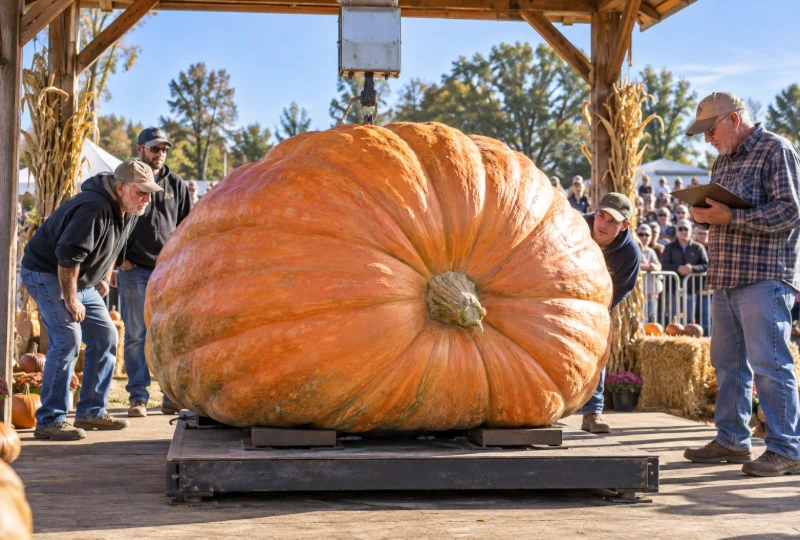
At the end of September, pumpkins that are hard to imagine next to ordinary vegetables will be placed on a scale near Sacramento. Some of them weigh more than a small car. Moving them requires special platforms, and the weigh in feels like the final round of a major sporting event. But instead of athletes, there are farmers. Instead of a stadium, there is a pumpkin farm. And the main star could become the first pumpkin in the world to weigh more than 3,000 pounds.
Organizers are ready to pay $75,000 for that achievement. This is not a publicity stunt or a rough estimate. The first contestant whose pumpkin officially crosses the 3,000 pound mark on certified scales will receive the prize. That is about 1,361 kilograms, or approximately 1.36 metric tons. In other words, the future record holder must grow a fruit that weighs more than many compact cars.
The National Pumpkin Weigh Off will take place on Saturday, September 26, 2026, at Bishop’s Pumpkin Farm, located at 1415 Pumpkin Lane, Wheatland, CA 95692. The farm is about 40 miles from Sacramento, so this unusual competition can easily become a family day trip. Admission and parking are free. Anyone can come and watch the attempt to break the world record.
The program will begin at 9:00 AM with the Future Farmers category for young contestants. The main giant pumpkin weigh in will start at 10:00 AM. At the same time, judges will evaluate enormous watermelons, tomatoes, sunflowers and other unusually large produce. The most exciting part of the event is expected around noon. The ten heaviest pumpkins will be saved for last, keeping the suspense alive until the final moments.
The total prize pool for 2026 exceeds $100,000 and is considered the largest among competitions of this kind. A winner with a pumpkin weighing less than 2,000 pounds will receive $7,500. If the pumpkin weighs more than 2,000 pounds, the prize rises to $15,000. A new world record is worth $37,500, while the first result above 3,000 pounds will bring the contestant a total of $75,000. Cash prizes are available for the top twenty pumpkins, so the competition remains serious even for growers who have not yet reached the astonishing 3,000 pound mark.
To understand the scale of the challenge, look at the current world record. In October 2025, twin brothers Ian and Stuart Paton from the United Kingdom presented a pumpkin weighing 2,819 pounds and 4 ounces. That is approximately 1,279 kilograms. The giant was named Muggle and was officially recognized by Guinness World Records as the heaviest pumpkin ever grown. Its circumference reached nearly 6.5 meters. Until recently, even experienced growers considered a result like this almost impossible.
Now, a contender for the top prize in Wheatland must beat that record by about 181 pounds. At first, the difference may not sound large when the fruit already weighs more than a ton. But for giant pumpkin growers, those final pounds are often the hardest to add. The pumpkin must continue growing while keeping its surface intact, its stem healthy and its structure strong enough to hold the weight. A crack, damage or signs of rot can erase months of work just before the official weigh in.
Pumpkins like these do not appear by accident. The process begins with genetics and seeds from lines that have already produced remarkable results. The plant then needs a huge amount of space, fertile and well drained soil, steady watering and constant attention. University horticulture experts recommend allowing only one fruit to develop on a strong plant when maximum weight is the goal. That way, water, minerals and the products of photosynthesis are directed toward one pumpkin instead of being divided among several.
Growers monitor the health of the vines, protect the leaves from disease and insects, check soil moisture and make sure the growing fruit does not become misshapen under its own weight. Simply adding more water or fertilizer is not enough. Too much water can create problems, while improper feeding can speed up tissue growth until the outer shell can no longer handle the pressure. The work resembles a long scientific experiment in which the weather changes the conditions every day.
Botanically, a pumpkin is the fruit of the plant, and the giant competition varieties belong to the species Cucurbita maxima. These plants can produce extremely large fruit when they receive enough light, water, warmth and space. But a record result depends on a rare combination of factors. Growers need the right seeds, a healthy root system, successful pollination, a long season without major stress and almost daily care. That is why a single giant pumpkin often represents months of hard work by an entire family.
A separate challenge begins after the pumpkin has finished growing. A fruit weighing more than a ton cannot simply be lifted by hand and placed in the back of a truck. Contestants use special straps, lifting frames, forklifts and reinforced platforms. During transportation, they must avoid damaging the skin or the stem. At the event, the pumpkin is carefully placed on the official scale, the judges inspect its condition, and only then does the final number appear on the display.
This is why spectators experience the final weigh in almost like a sporting event. Until the last moment, nobody knows the exact weight of a contender. Its visible size can provide an estimate, but only the scale gives the final answer. When the numbers stop moving, the crowd either erupts in applause or realizes that the world record will survive for another season.
For children, the event offers a clear lesson in biology, agriculture and patience. Behind every giant pumpkin are months of observation, calculation and care, not magic. School age contestants will compete in the Future Farmers category, and the best young growers will also receive cash prizes. Perhaps one of them will return to these same scales in a few years with the next world giant.
The schedule may change slightly depending on the number of entries. Visitors who want to see the leading contenders should arrive early. The main weigh in starts at 10:00 AM, and the top ten pumpkins are expected to appear around noon. Comfortable shoes, water and sun protection will be useful because the event takes place on a working farm.
On paper, the goal sounds simple: add another 181 pounds to the current record. In reality, it is a barrier that the best growers in the world have spent years approaching. If the scale shows more than 3,000 pounds on September 26, Wheatland will find itself at the center of international news, and the farm will become the site of a new agricultural record.
Even if the magic number does not appear, visitors will still see something rarely found in everyday life: fruit weighing hundreds of kilograms, people who have turned pumpkin growing into an exact science, and a competition where one successful season can bring a $75,000 prize. Would you travel to see a pumpkin heavier than a car, or would every ordinary pumpkin at the store look like a tangerine afterward? 😄