
Imagine, for a moment, that someone is offering you the chance to win a million dollars without risking a single cent of your own money, not through a lottery, not through blind luck, but simply because you understand a subject better than most people do. It sounds like a marketing gimmick. In reality, it is already a functioning model, and the man who built it had, by the age of twenty-five, already built one of the largest currency banks in post-Soviet Russia, before going on to rewrite the rules of several other industries entirely.
His name is ALEX KONANYKHIN, and he is currently in the process of proving something that sounds almost heretical: that a prediction market does not have to be a zero-sum game in which someone else has to lose for you to win.
The idea seems audacious right up until you learn the biography of the man behind it. By twenty-five, Konanykhin had built Russian Exchange Bank from nothing, one of the first banks in the country to receive a currency-trading license from Boris Yeltsin, Russia’s first president. He was included in the delegation that accompanied Yeltsin to his meetings with President George H.W. Bush in Washington. For someone that young, this wasn’t simply a success story, it effectively set a new standard for what could be built from the ground up in a country that didn’t yet have a functioning currency banking system.
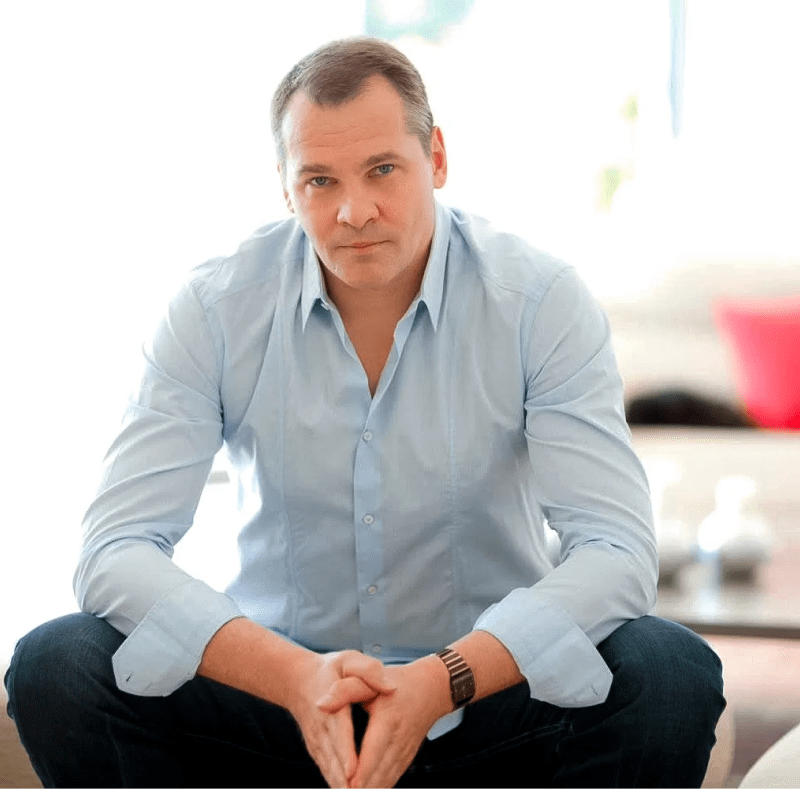
And then something happened that Konanykhin still recounts more often than almost anything else: he announced his retirement.
On paper, the logic was sound. He had achieved financial independence, and there was nothing stopping him from simply enjoying the results. His retirement lasted exactly two weeks. What he was missing wasn’t work, and it wasn’t money. What he was missing was a problem nobody else had already solved.
That same restlessness has shaped every project he’s taken on since, banking technology, the internet, digital assets: each time, he found himself somewhere the rest of the world was still watching from the sidelines, where the rules of the game hadn’t been written yet.
“Nobody is born confident. Confidence is earned, one success at a time.”
– Alex Konanykhin
Building a bank from absolute zero, he says, is precisely what gave him the standing to set goals that most people would dismiss as unrealistic.

Prediction markets turned out to be the next arena where, in his view, the existing rules had grown outdated. The traditional model is simple enough: a participant places a bet, the event plays out, one side wins and the other loses money. The industry, meanwhile, is expanding fast. Combined monthly trading volume across the largest platforms is already approaching $45 billion, and analysts, including Eilers & Krejcik and the investment bank Bernstein, project the sector could reach a trillion dollars in annual volume by 2030.
Konanykhin isn’t sentimental about that growth.
“The prediction industry has become one of the fastest-growing corners of global finance. But it was built with a flaw, and I say that as someone who believes deeply in its promise. On every major platform, you take part by putting your own money at risk, and in the aggregate, most participants end up worse off.”
– Alex Konanykhin
That flaw, he argues, is exactly why regulators from Minnesota to Madrid to Paris have moved to shut these platforms down as unlicensed gambling. Which led Konanykhin to a question that, within the logic of the existing industry, sounds almost absurd:
“What if you removed the possibility of losing money altogether, while keeping everything else intact: the excitement, the intellectual competition, the financial reward for being right?”
– Alex Konanykhin
That question is how SafeBets was born. Users neither deposit nor risk their own money. Upon signing up, they receive one hundred free Unicoins, the platform’s internal currency, and every prediction they make costs one coin. Get it wrong, and you lose a coin you were given for free. Get it right, and you earn more. At no point does a user ever transfer their own money to the platform.

The mechanics become clearer with a simple example. Say you’ve spent years reading oil price news purely out of professional curiosity, and you’re usually pretty good at guessing whether the price will rise or fall. In the conventional financial world, that skill is essentially worthless unless you’re willing to open a brokerage account and put your own savings on the line. On SafeBets, that same instinct converts into a result without that step: you make the call using free Unicoins, the platform records that you were right, and it becomes part of your personal accuracy record. Do the same thing with the price of bitcoin, the dollar-to-euro exchange rate, or the price of gold, and after a few dozen predictions, what you have is no longer a scattered handful of lucky guesses, but an actual track record the system can use as a trading signal.

Konanykhin sums up the philosophy behind the product in blunt, deliberate terms.
“SafeBets introduces something the financial world has never seen: risk-free betting.”
– Alex Konanykhin
And he’s specific about exactly who it’s built for.
“Many people have the analytical skill to read markets better than most market participants, but until now, there has been no accessible, risk-free way to be rewarded for it.”
– Alex Konanykhin
The distinction from the traditional model is fundamental. In a classic wager, one person’s win is literally subtracted from another person’s pocket. On SafeBets, the reward doesn’t come from someone else’s loss, it comes from profit the platform generates by putting its accumulated record of accurate predictions to work in real trades across equities, commodities, currencies, and crypto assets. Konanykhin frames the product itself in equally direct terms.
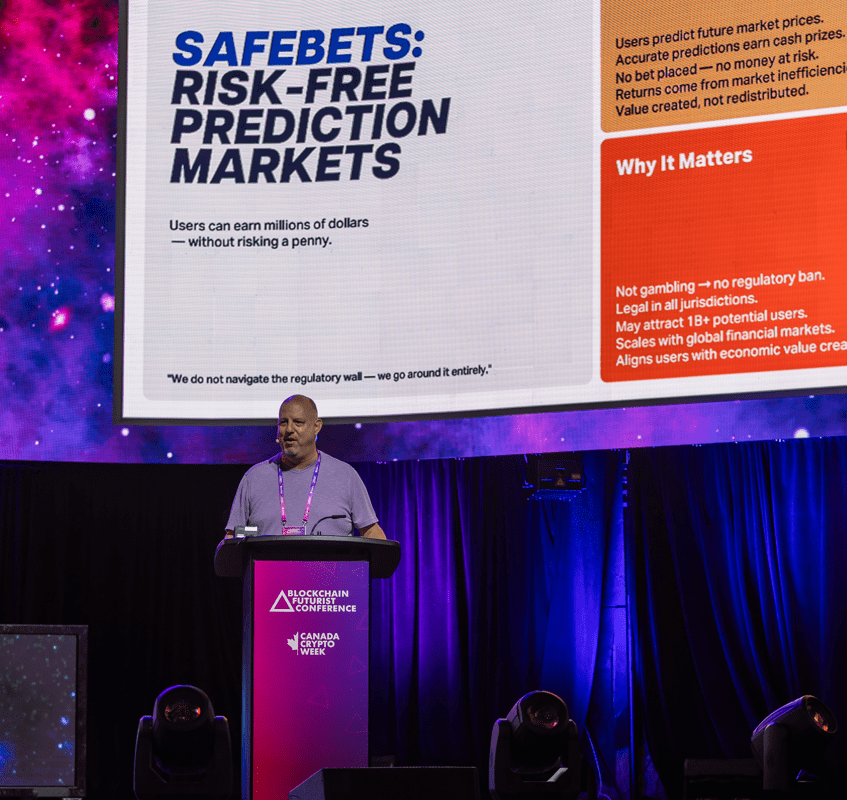
“SafeBets is a first-of-its-kind prediction platform where users can earn substantial rewards.”
– Alex Konanykhin
This is where the real mechanism reveals itself. SafeBets isn’t just collecting bets, it’s collecting data on who, specifically, predicts more accurately than everyone else, not once, but again and again. The company calls this its Collective Intelligence engine: the longer and more accurate a given user’s prediction history becomes, the more weight that user carries within the system, and the more confidently the platform can act on that signal when it places real trades.

The difference becomes clear with two hypothetical users. The first correctly calls a single price swing on one asset and then stops making predictions altogether, and to the system, he remains a statistical fluke. The second makes predictions across several markets nearly every week for six months straight, and is consistently wrong less often than most other participants. It’s the second type of user SafeBets is actually interested in: not a single flash of insight, but a reliably repeatable skill that, over time, translates into a growing share of rewards and a more prominent place on the platform’s leaderboard.
The scale of the ambition here is equally direct, because once a system is running on hundreds of millions of users rather than tens of thousands, statistics stop being merely statistics.
“In short, SafeBets can reach every market, including the 85-plus jurisdictions currently closed to its competitors, from day one.”
– Alex Konanykhin
That kind of expansion wouldn’t be possible if the whole thing were built on calculation alone. Konanykhin has a more personal motive as well, and he doesn’t hide it in any conversation about the project.
“Many people have the analytical skill to read markets better than most market participants, but until now, there has been no accessible, risk-free way to be rewarded for it.”
– Alex Konanykhin
But that admission is immediately followed by a far harsher observation.
“But people don’t love what gambling does to them. Gambling creates addiction. It destroys families. It empties retirement accounts. It drains savings that took decades to build.”
– Alex Konanykhin
For him, this isn’t an abstract statistic, it’s a problem he approaches like an engineer: keep the thrill, and strip out the specific element that causes the damage.
No platform, however, can simply declare its own model safe and expect the market to take its word for it. Financial technology has seen too many projects that described their own architecture beautifully and then failed to survive the first real scrutiny. Which is why Konanykhin’s next move wasn’t more marketing, it was bringing in someone whose entire reputation had been built on the opposite skill: making digital records impossible to forge.

That person was W. Scott Stornetta, widely regarded as one of the founding fathers of blockchain. Back in 1991, alongside Stuart Haber, he published research on cryptographically linking digital records to one another, work that would later be cited by the authors of the original bitcoin white paper. He then turned that theory into a business: his company, Surety, launched the first commercial digital timestamping service and, for thirty consecutive years without a single interruption, published a cryptographic fingerprint in the New York Times. He later founded SureMark Digital, which helps people prove the authenticity of their identity and their work in the age of deepfakes.
Stornetta joined SafeBets as chairman of its advisory board. His role follows naturally from his career: making sure every prediction on the platform is cryptographically verified, tied to a specific author and a specific moment in time, and impossible to quietly alter after the fact.
Konanykhin explains the hire as plainly as he explains everything else about the project.
“The prediction industry has a credibility problem, and credibility is exactly what Scott has spent his life engineering. That is our advantage.”
– Alex Konanykhin
Bringing in someone like that changes the tone of the entire conversation around the project. It’s one thing for a founder to talk up his own idea. It’s a different thing entirely when the person standing next to him built a three-decade career on the ability to tell a genuinely sound cryptographic architecture apart from an attractive but empty shell.
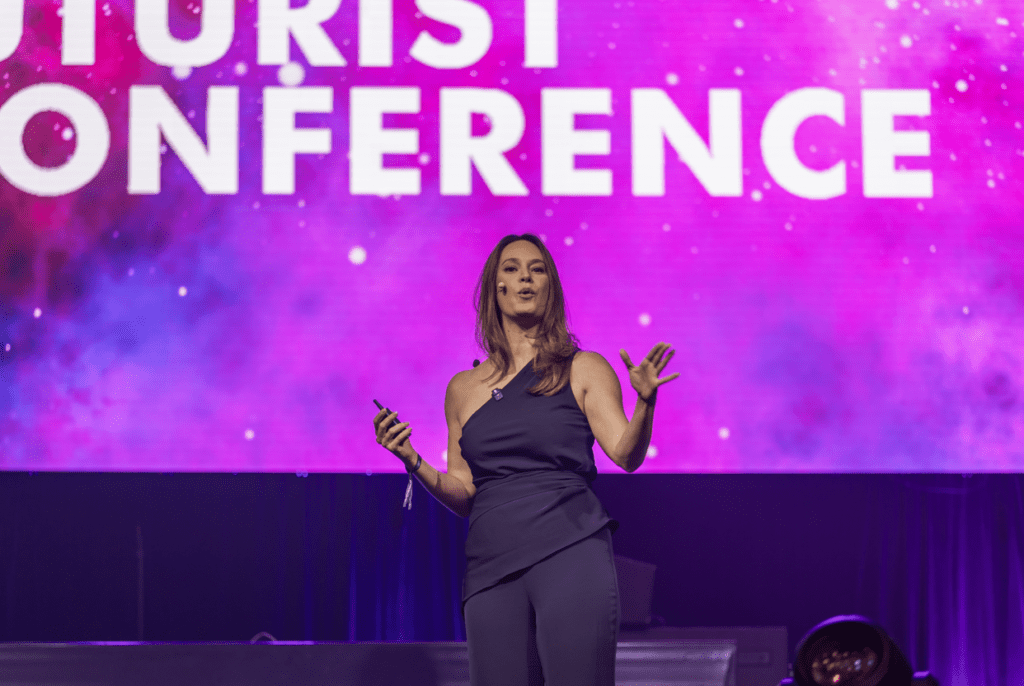
Alongside Stornetta, there’s another voice on the team, one aimed less at cryptographers and more at users. SafeBets executive director Gina Antoniello, who also teaches at New York University, puts the platform’s selection principle about as plainly as it can be put: anyone can join, but only those whose insight actually generates measurable value in real markets rise to the top. It’s the same principle that governs chess or sports statistics: access is open to everyone, and reputation is earned strictly through results.
For someone without starting capital, that distinction matters enormously. Picture a young analyst somewhere outside the major financial centers, someone with a genuine feel for commodity markets who has simply never had enough money to open a brokerage account and trade on their own. In the traditional market, that knowledge would never have converted into income. On SafeBets, the same analysis, repeated dozens of times with growing accuracy, gradually turns into an actual financial result, without a single dollar of starting capital.
Trust, of course, isn’t only something users need. Regulators need it too, and they’ve already shut traditional betting platforms out of their markets. Here, Konanykhin’s instinct isn’t to argue, it’s to invite scrutiny.
“I would say: please scrutinize us, and here is the test to apply. Ask one question. Can a user lose money on this platform? On a betting product, the answer is yes, by design. On SafeBets, the answer is no, because the user never puts money down in the first place. If no participant can suffer a financial loss, then the central harm that gambling regulation exists to prevent simply isn’t present.”
– Alex Konanykhin
That isn’t an attempt to slip around the rules, it’s an invitation to reframe the question the rules were written to answer in the first place. And the same logic is behind why Konanykhin doesn’t consider SafeBets a competitor to traditional betting platforms at all.
“Sportsbooks and prediction platforms are, at bottom, the same business: the customer puts money on something that hasn’t happened yet. Competition between them will be fierce. SafeBets simply isn’t part of that fight, because no one here is risking their own money.”
– Alex Konanykhin
Look at Konanykhin’s career as a whole, and the pattern becomes impossible to miss. He was never drawn to the product itself, he was drawn to the moment when the rules are still being written and one person has the chance to propose not just another company, but a different underlying principle for the market to form around. SafeBets, in that sense, isn’t an exception, it’s a continuation of the same line that runs from the currency bank he built at twenty-five, through decades of projects on the frontier of technology.
This model shifts the balance of power for more than just one platform, and for more than just one entrepreneur. Markets that have spent centuries measuring a person’s worth by the size of the bet they were willing to place are starting to measure it by something else: the quality of judgment, accumulated over years of being right. In a world where artificial intelligence is increasingly learning to predict how people and markets will behave, and where human instinct is increasingly treated as a resource that’s hard to digitize, the ability to separate signal from noise faster than everyone else is becoming one of the most valuable assets of the coming decade.
Behind that shift is not some abstract trend, but one very specific person, and for him, this feeling isn’t new. Konanykhin has been here before: building a bank while knowing the banking system around it barely existed yet. Thirty years later, he finds himself in a strikingly similar position, except this time the currency market has been replaced by the market for human judgment, which also hasn’t settled on its own rules yet. The difference is that this time, he isn’t the only one who believes in it: standing beside him is a man who figured out how to make digital truth impossible to fake, and tens of thousands of users who test, every single day, exactly what their own instincts are worth.

You can meet the man behind the SafeBets story in person: Alex Konanykhin will receive the Innovative Approach award at this year’s ceremony honoring the country’s best businesses, recognition that, as his entire career suggests, rarely comes from a single good idea, but from decades of decisions that turned out to be right.