For fifty four years the lunar surface has been a lonely place. Since the dust settled around the Apollo 17 descent stage in 1972 the Moon has existed only as a cold white disc in our sky or a grainy memory on a museum screen. We stopped going. We stayed in Low Earth Orbit building stations and launching satellites. We grew comfortable. But the era of staying close to home is coming to an abrupt end.
In February 2026 the silence will be shattered by the roar of the Space Launch System. This is not just another satellite launch. This is Artemis II. It is the moment we stop looking at the Moon and start reaching for it again. This is the story of how we are preparing to leave the cradle.
The Machine Built to Defy Gravity
At the heart of this return is the Space Launch System or the SLS. It is a beast of a machine standing taller than the Statue of Liberty and packing more thrust than any rocket ever flown. To get humans out of Earth’s gravity well you need raw unfiltered power. The SLS provides this by burning millions of pounds of propellant in just a few minutes.
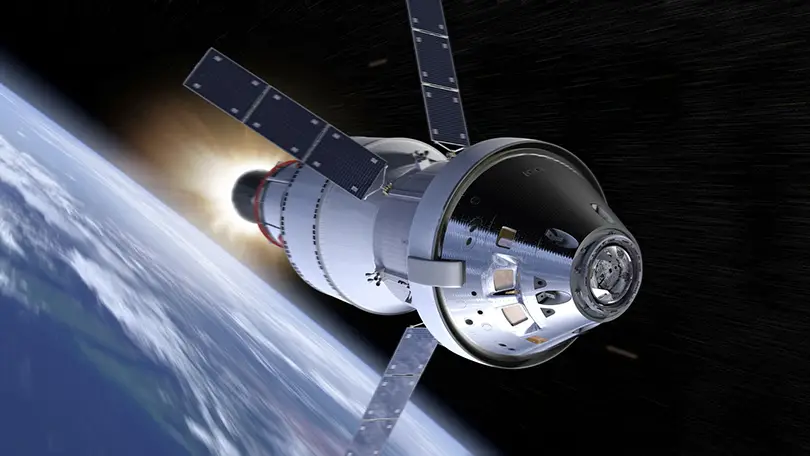
But the real star of the show sits on top of that pillar of fire: the Orion spacecraft. Unlike the fragile looking capsules of the sixties Orion is a marvel of modern shielding and digital intelligence. It is designed to keep four humans alive in the most hostile environment imaginable. It has to withstand the freezing vacuum of space and the scorching five thousand degree heat of re-entry. It is a lifeboat built for the deep ocean of the stars.
Meet the Crew of the Century
Who are the people brave enough to sit on top of this controlled explosion? They are not just pilots; they are the face of a new humanity. Reid Wiseman the commander brings a steady hand and years of flight experience. Victor Glover the pilot will be the first person of color to leave Earth’s orbit. Christina Koch an engineer who already holds records for the longest single spaceflight by a woman will become the first woman to see the far side of the Moon. Rounding out the team is Jeremy Hansen representing the global partnership that makes this mission possible.
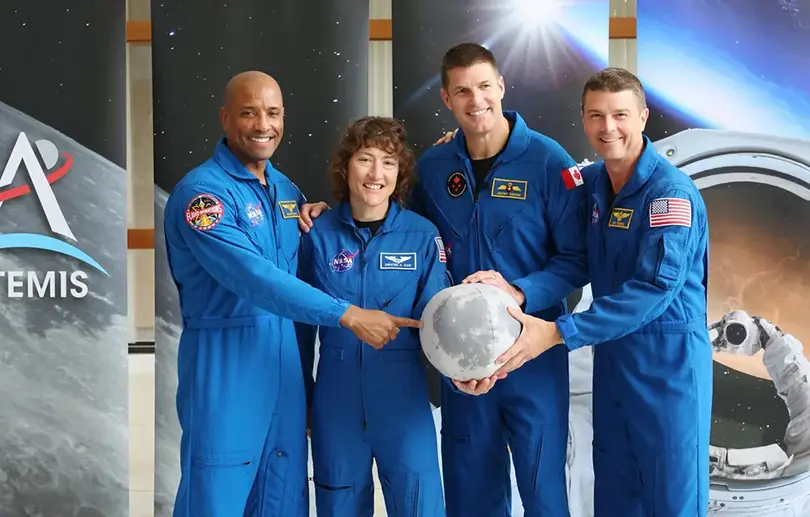
These four individuals have spent years training for these specific ten days. They have practiced every emergency and every manual docking procedure in simulators until their movements are muscle memory. They know that once the engines ignite there is no turning back. They are carrying the hopes of eight billion people on their shoulders.
The Ten Day Odyssey
The mission profile for Artemis II is a masterclass in orbital mechanics. After the initial climb into space the crew will spend the first twenty four hours in a high Earth orbit. This is a critical safety check. They need to ensure that the life support systems are scrubbing carbon dioxide and providing oxygen perfectly before they commit to the “Trans-Lunar Injection.”
Once the final burn happens they leave Earth behind. For several days they will coast through the blackness between worlds. The Earth will shrink from a giant landscape into a marble and then into a bright blue spark. On the fourth day they will reach the Moon. They won’t land yet. Instead they will perform a “free return trajectory” swinging around the lunar far side. Here they will be cut off from all radio contact with Earth. For a few moments they will be the most isolated humans in existence looking down at a cratered wilderness that has seen no visitors for half a century.
Why the Moon Matters Today
Some ask why we go back when we have robots and rovers. The answer lies in the human spirit and the reality of resources. The Moon is not just a rock; it is a treasure chest. At the lunar South Pole shadowed craters hold billions of tons of water ice. In the future that ice will be our gas station in the sky. We can turn it into oxygen to breathe and hydrogen to fuel rockets heading to Mars.
Artemis II is the bridge to that future. It proves that our ships can handle the radiation of deep space and that our crews can manage the psychological toll of being so far from home. We are learning how to be a multi planetary species. Every sensor reading from Orion is a data point that makes the future colony on Mars more likely to succeed.
The Economic Engine of the Stars
This mission is also a massive driver for the global economy. Thousands of companies across all fifty US states and multiple countries have contributed to the Artemis program. We are seeing the birth of a “Lunar Economy.” Private companies are now building lunar landers and delivery rovers. The technology developed for Orion’s communication systems is already being adapted to improve high speed internet on Earth. The heat shield materials are being used to protect firefighters. When we go to space we don’t just leave our problems behind; we invent the tools to solve them.
The View from the Far Side
Imagine being Christina Koch or Victor Glover looking out the small reinforced window of Orion. Below you is the lunar surface a desert of grey dust and ancient lava flows. Above you is the absolute black of the universe. And then suddenly you see it: a thin sliver of blue light. The Earthrise.
This view changed our world in 1968 and it will change us again in 2026. It reminds us that our planet is a fragile oasis. Seeing our home from the perspective of another world creates a shift in consciousness that astronauts call the “Overview Effect.” It is a reminder that we are one crew on one ship called Earth. Artemis II will bring that perspective back to a new generation through high definition 4K cameras and live streams that were impossible during the Apollo era.
Preparing for the Final Descent
While Artemis II is a flyby mission it is the essential precursor to Artemis III which will see boots on the ground. Everything the crew does in February every switch they flip and every maneuver they execute is a test for the landing mission scheduled shortly after. We are checking the maps and testing the gear.
The launch window remains open through April but the goal is February 6. The teams at NASA are working around the clock. The technicians are checking every bolt. The software engineers are running millions of lines of code. There is a sense of destiny in the air at Cape Canaveral. You can feel it in the ground and see it in the eyes of the workers.
A Legacy for the Next Generation
This mission belongs to the “Artemis Generation.” Today’s students will be the ones who live and work on the Moon. They will be the ones who look at the Moon not as a distant light but as a workplace or a home. Artemis II is our promise to them that we will not stop exploring. We are showing the world that even in divided times we can come together to do something truly magnificent.
The countdown is ticking. The rocket is waiting. The stars are calling. In February 2026 we don’t just launch a ship; we launch a new era of human history. We are going back to the Moon and this time we are staying.