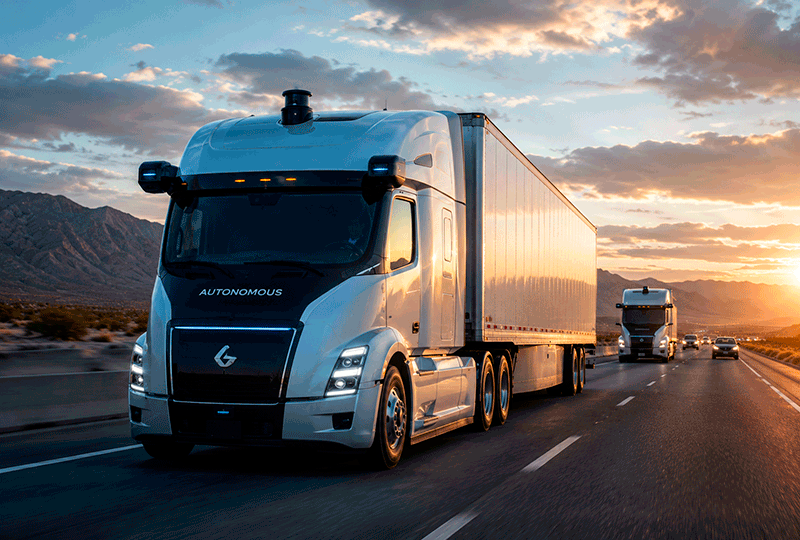
Right now, as you read this, a fully loaded truck is moving down a highway somewhere in Texas without a driver behind the wheel. There is no person watching the road, drinking coffee to stay awake, or talking on a radio during a long overnight haul. The vehicle is analyzing traffic, monitoring weather conditions, tracking surrounding cars, and making decisions in real time completely on its own.
Not long ago, this sounded like science fiction. Today, it is becoming part of America’s transportation system. And it may turn out to be one of the biggest economic transformations of the next decade.
Most people imagine technological revolutions the wrong way. We expect them to arrive with headlines, fanfare, and obvious warning signs. In reality, they usually start quietly. At first, few people take them seriously. Then one day the technology that seemed impossible suddenly becomes normal.
That is exactly what happened with the internet. The same thing happened with smartphones. More recently, it happened with artificial intelligence.
Now it is happening to trucking.
Companies such as Aurora, Kodiak Robotics, Gatik, and others are already running large scale tests of autonomous trucks across Texas, Arizona, and California. Their systems combine artificial intelligence, lidar, radar, and ultra precise cameras to create a detailed digital understanding of the world around them. In many situations, these trucks can process information faster than a human driver.
For Wall Street investors, this is no longer an experiment. It is the beginning of a new era. Goldman Sachs estimates that by 2027, at least 20,000 autonomous trucks could be operating on American roads. By 2030, that number could reach hundreds of thousands.
The reason is simple.
Economics.
Human drivers can only work a limited number of hours. They get tired. They get distracted. They need rest. Autonomous trucks can operate almost around the clock. For logistics companies, that means faster deliveries, lower costs, and billions of dollars in potential savings every year.
But the most interesting part of this story is not the technology itself.
It is what this change reveals about the future of work.
For decades, many people assumed automation would mostly affect office jobs. Truck drivers, mechanics, and other hands on professions were often viewed as safer from disruption.
Reality is proving otherwise.
Artificial intelligence is no longer learning only intellectual tasks. It is learning to navigate the physical world. Machines are beginning to see, predict, and react in environments that once required human judgment.
That is why autonomous trucks have become such a powerful symbol of the next wave of technological change.
Supporters argue that driverless systems could make roads safer. A machine does not text while driving. It does not fall asleep after a long shift. It does not lose focus after hours behind the wheel. Many experts believe autonomous systems could significantly reduce accidents caused by human error.
At the same time, another question is impossible to ignore.
What happens to the people whose livelihoods depend on driving?
For millions of Americans, trucking is more than a job. It is a career, a lifestyle, and a source of financial stability for entire families. That is why labor groups and industry organizations have raised concerns about the long term impact of autonomous transportation.
History suggests that technology rarely eliminates jobs without creating new ones.
When automobiles replaced horse drawn transportation, countless occupations disappeared. When computers entered the workplace, many feared massive unemployment. When the internet transformed commerce, experts predicted the collapse of traditional business models.
Yet every major technological shift created new opportunities that few people could have imagined beforehand.
Many analysts believe the same pattern will emerge in transportation. New roles are expected to appear in AI supervision, autonomous vehicle operations, cybersecurity, remote monitoring, and intelligent logistics management.
Still, the deeper lesson goes far beyond trucking.
We are entering a period where technology is beginning to compete with humans not only in calculation and information processing, but also in real world decision making. Tasks that once seemed uniquely human are increasingly being handled by algorithms.
That is why the story of autonomous trucks matters to everyone.
Because the real question is no longer whether machines can replace drivers.
The real question is which professions still feel untouchable simply because we are looking at the future through the lens of the past.
The future rarely arrives all at once.
More often, it quietly pulls into the next lane while most people are looking the other way.
And right now, it may already be driving down an American highway in a truck with nobody behind the wheel.