Lost keys, a backpack left in a cafe, or a suitcase that never appears on the baggage carousel have turned small Bluetooth trackers from unusual gadgets into useful everyday tools. For years, this market has been closely associated with the Apple AirTag. Android users had to choose devices from other brands and hope the tracking network was large enough. Now Google wants to close that gap with a product of its own.
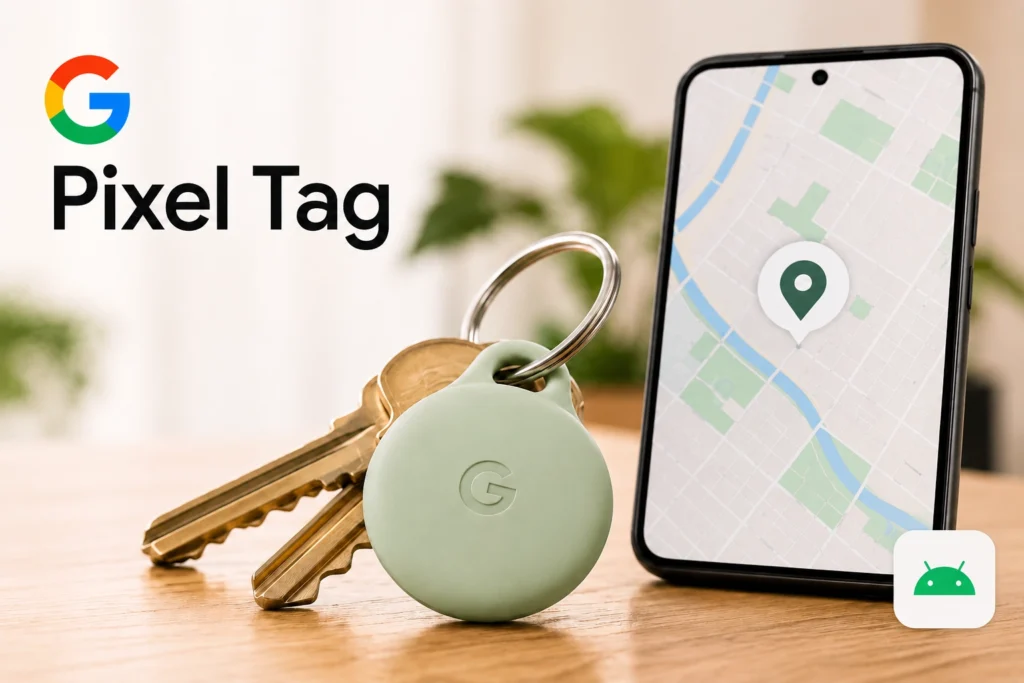
On August 12, 2026, the company introduced Google Pixel Tag, its first tracker designed to help people find personal items. One tag will cost $29, while a pack of four will cost $99. Sales are scheduled to begin on November 11. The price is exactly the same as the AirTag 2, so Google is not trying to win customers with a lower price. Instead, the company is betting on Android integration, precision finding, and the global Find Hub network.
At first glance, Pixel Tag solves a very simple problem. You can place it in a wallet, attach it to your keys, or put it inside a bag or suitcase, then check the location of that item on a map. But the importance of this product goes beyond one more small accessory. Google is effectively turning the enormous Android ecosystem into a shared system for finding lost belongings.
How Pixel Tag Finds Your Things
Google Find Hub is at the center of the tracker. If an item is nearby, the user can make Pixel Tag play a sound and locate it in a room, car, or office. For greater accuracy, the device uses Ultra Wideband and Bluetooth Channel Sounding. On a compatible phone, the app can show the distance to the tracker and the direction to move. Instead of searching blindly under the couch, the user gets visual guidance that can lead straight to the missing item.
When Pixel Tag moves beyond a direct Bluetooth connection, a much larger system begins to work. According to Google, the Find Hub network includes more than one billion Android devices. Nearby phones can anonymously detect the signal from a lost tracker and send an updated location to its owner. The location data is protected with end to end encryption. Google says the company itself cannot access information about where the item is located.
Google has also added alerts for items left behind. A user can receive a warning after walking away from something that has a Pixel Tag attached. This feature may be even more useful than the search itself because the system tries to prevent a loss before the owner realizes the item is gone.
A Small Tracker With Important Details
Pixel Tag has a thin stainless steel body and an IP67 rating for water and dust resistance. Ordinary rain, a wet table, or dust inside a travel bag should not cause serious trouble. Still, this protection is not permanent and can weaken through normal wear. The tracker should not be treated as completely waterproof.
A built in speaker helps users find an item by sound. The device also works in reverse. A button on Pixel Tag can make the connected phone ring. Many people know this situation well. The keys are in your hand, but the phone has disappeared somewhere between the cushions, clothes, or papers. In that moment, the small tracker becomes a remote control for finding the phone.
The device uses a replaceable CR2032 battery. Google promises up to one year of battery life, and owners can replace the battery themselves. This is a meaningful practical advantage. Buyers will not have to charge another gadget every few days or throw the tracker away when an internal battery wears out. Actual battery life will depend on how often the speaker, precision finding, and other features are used.
Pixel Tag does not have a built in clip or attachment ring. A separate holder may be needed for keys, a pet collar, or a bag strap. It is a small detail, but an important one. The tracker itself costs $29, although the final price of a ready to use setup may be higher after adding an accessory.
Simple Setup Without Extra Steps
To connect Pixel Tag for the first time, the user removes the battery tab and brings the tracker close to a device running Android 9 or newer. Fast Pair will offer to connect it. The owner can then name the item or choose a category inside the Find Hub app.
One tracker can be shared with up to ten people. This can be useful for family keys, shared luggage, a car, or a bag that holds a child’s belongings. Several trusted users can access the search, so finding the missing item does not depend on one phone alone.
Pixel Tag works with more than a smartphone. Users can locate the tracker or make it ring through Find Hub on a Pixel Watch or in a browser. Pixel Buds owners can ask Gemini to make the tag play a sound. Google is clearly selling more than a small tracking device. Pixel Tag is another part of an ecosystem that connects phones, watches, earbuds, artificial intelligence, and a global finding network.
However, not every Android owner will receive every feature. Basic connection begins with Android 9, but precision finding requires compatible hardware. Ultra Wideband needs a phone with the proper chip, while Bluetooth Channel Sounding depends on Bluetooth 6.0 support. On an older or lower cost phone, Pixel Tag can still appear on a map and play a sound, but the most advanced guidance with direction and precise distance may not be available.
Safety Against Hidden Tracking
Trackers have brought convenience, but they have also created a serious problem. Someone can secretly place one inside another person’s car, bag, or clothing and use it for surveillance. Protection against unknown trackers has therefore become an essential part of any responsible tracking system.
Google says an Android phone will automatically warn the user when it detects an unknown tracker moving with them. The system will also explain how to make the tracker play a sound and what to do next. This does not remove the risk completely, but it gives people a chance to notice a suspicious device before it becomes a long term tool for surveillance.
A Real AirTag Rival or Just a Strong Promise
On paper, Google has built a convincing product. Pixel Tag costs the same as AirTag 2, supports precision finding, resists water and dust, runs for more than a year on a replaceable battery, and uses a network of more than one billion Android devices. For someone who owns a Pixel or another compatible Android phone, it looks like a logical alternative to Apple’s tracker.
But the success of Pixel Tag will not be decided by a list of specifications. The real test begins outside the home, when a lost item ends up in an airport, a parking lot, or another city. Apple has spent years developing the Find My network and teaching customers to trust AirTag. Google still has to prove that Find Hub can update locations quickly and accurately without letting privacy settings weaken the search.
Pixel Tag sales will begin on November 11, 2026. One tracker will cost $29, while a pack of four will cost $99. It is too early to declare a winner against AirTag before independent testing begins. Still, the arrival of Pixel Tag changes the market. Android users are no longer being offered only a compromise from another brand. They are getting a Google product connected directly to Find Hub, Pixel Watch, Pixel Buds, and Gemini.
A small tag weighing about 12 grams could become one of Google’s most practical devices in years. The real question is whether we will remember it after buying it, or truly appreciate it for the first time when our suitcase fails to appear on the baggage carousel.