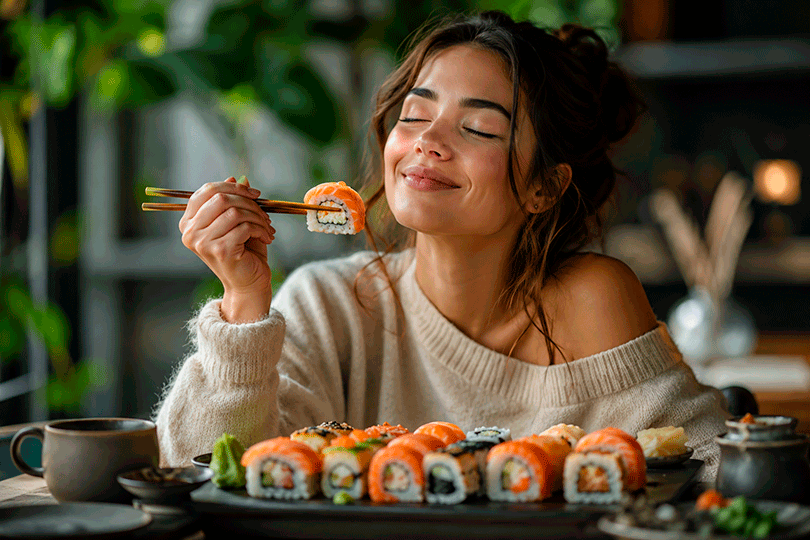
You may not have noticed the pattern yet. But after a difficult day, when your patience has worn thin and your temper feels dangerously close to the surface, you find yourself reaching for one thing. Not chocolate. Not wine. A tray of salmon rolls.
There is a reason for that. And it is not a craving. It is an instinct.
Recent nutritional studies have quietly confirmed what many women have sensed for years. Wild red fish such as salmon, trout, and chum salmon contain a powerful combination of omega‑3 fatty acids, iodine, and B vitamins. This trio directly supports the nervous system. Omega‑3 rebuilds the membranes of nerve cells. Iodine regulates the thyroid gland, a small organ with an outsized influence on mood. B12 and B6 help produce serotonin and dopamine, the very chemicals that keep anxiety and irritability in check.
In other words, sushi does not just taste good. It changes your brain chemistry for the better.
Consider the typical response to stress. Many people turn to sugar or alcohol. Sugar offers a brief rush followed by a crash and guilt. Alcohol numbs the senses but leaves a chemical hangover that worsens anxiety. Neither solves the underlying problem. Both deplete the nutrients your nerves actually need.
Sushi works differently. A moderate portion of rolls with raw or lightly salted salmon provides a steady release of neuroprotective compounds. Regular consumption, perhaps once every three or four days, lowers your baseline level of stress. You become less reactive. Small annoyances no longer trigger large explosions. You sigh instead of scream. That quiet shift is not willpower. It is biochemistry.
This explains why women in regions with high raw fish consumption, such as Japan and Scandinavia, show lower rates of depression and chronic tension. It is not only culture. It is nutrition.
And here is the paradox that makes sushi so effective for busy lives. It requires no cooking, no cleanup, almost no time. Ten minutes and you have delivered a dose of nervous system repair. You are not indulging a weakness. You are practicing a very practical form of self care.
Of course, quality matters. Warm smoked mackerel from a supermarket has lost most of its omega‑3 to processing. Salted red caviar is rich but also high in sodium and expensive. The best choice remains fresh or properly frozen sushi made from wild salmon. That is where the science meets the plate.
So the next time someone questions your order, a partner who says it is too expensive, a colleague who calls it a pointless luxury, you can answer calmly. Tell them this. It is not a whim. It is a mental health strategy. And it works better than any well meaning advice to just relax.
Because genuine self care is not a spa day once a month. It is the small daily choice to feed your nervous system exactly what it needs. Even if that choice comes in a small wooden tray with a side of soy sauce.
Think about your own life. How many times has a quiet dinner with salmon rolls turned your entire evening around? How many fights did you not start? How many tears did you not shed? That is not imagination. That is the quiet power of understanding what your body has been trying to tell you all along.
🪭Save this. Share it with a friend who needs to hear that she is not crazy for loving sushi. She is just smarter than she knows.