Picture this. A young screenwriter sits alone in his kitchen late at night. Cheap coffee on the table. A blinking laptop screen showing a dialogue scene he’s been rewriting for three weeks straight. He’s exhausted.
Then another person opens AI.
Forty seconds later, he already has five versions of the scene. Two minutes later, there’s a monologue. Ten minutes later, almost a complete screenplay.
Now here’s the real question.
Which one of them will Hollywood call in two years?
That’s why the new Oscar rules caused such an explosion online.
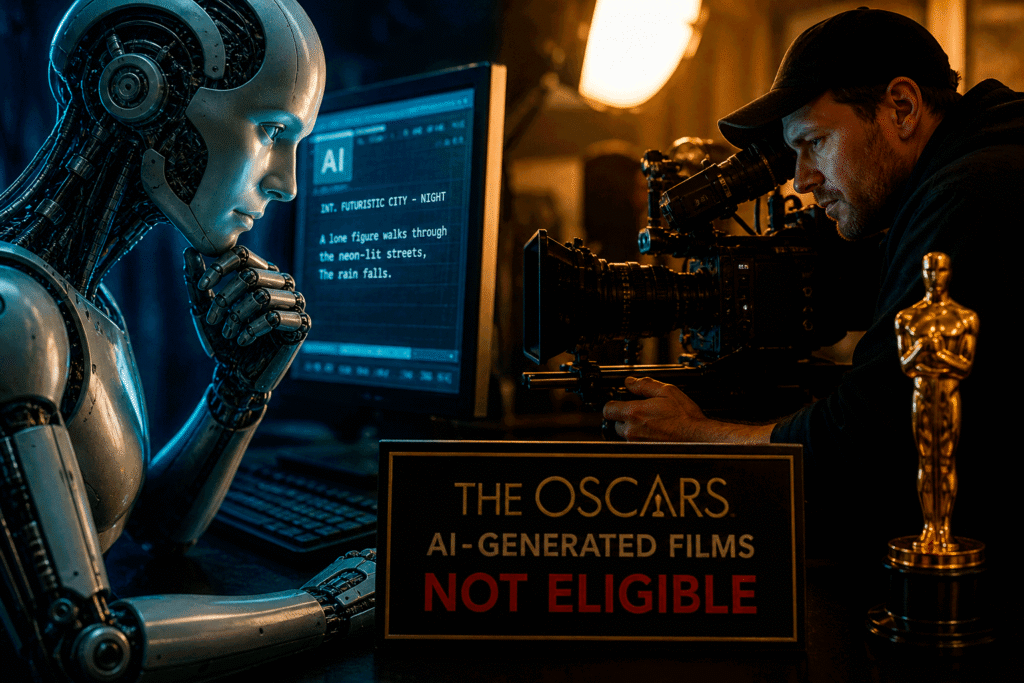
The Academy of Motion Picture Arts and Sciences officially approved new rules ahead of the 99th Academy Awards. Films that use artificial intelligence without meaningful human involvement will no longer qualify for awards.
All performances must be done by real people with their consent.
Screenplays must be fully written by humans.
On paper, it sounds like a defense of art.
But online, people instantly split into two camps.
Some celebrated:
“Finally.”
“Stop replacing humans with machines.”
“Cinema should stay human.”
Others laughed:
“They’re trying to stop a tsunami with a spoon.”
And honestly?
Both sides are right.
Because this is no longer just a debate about technology.
We’re watching humanity become afraid of its own creativity for the first time.
Machines replaced physical labor.
Then calculations.
Now they’ve reached the most painful place of all.
Human imagination.
That changes people psychologically.
Since childhood, we were taught one thing.
Creativity is what makes humans special.
You can lose in speed.
You can lose in strength.
You can lose in memory.
But not in the ability to feel, imagine, write, and tell stories. That was supposed to be humanity’s final territory. Now imagine being an actor realizing your face can be copied. A screenwriter watching AI build a movie structure in seconds.
A VFX artist spending years mastering skills only to see a teenager create something similar in one evening.
People are not afraid of technology. They are afraid of becoming replaceable. That’s why the Academy’s decision feels less like a rule and more like emotional panic from the industry itself.
Because everyone understands one uncomfortable truth. AI is already inside cinema.
It already helps write scenes.
De ages actors.
Enhances frames.
Changes voices.
Generates ideas.
Speeds up editing.
Creates digital faces.
And this is only the beginning. The irony is incredible. Hollywood spent decades making movies about machines taking over 🤖
Then technology finally arrived, and the industry realized it wasn’t emotionally prepared.
But there’s an even more uncomfortable truth. Most viewers won’t notice the difference. That part hurts the most.
If tomorrow a brilliant movie written by AI and a human comes out, millions of people will still cry in theaters.
They’ll still fall in love with the characters.
Still replay scenes in their heads. Still feel something real.
And that leads to a dangerous question.
If the emotion is real, does it matter who created it?
That question destroys the old value system.
Because art used to be proof of the human soul.
Now the world faces a strange paradox.
Machines cannot feel.
But they can create things that make us feel.
And this is where the real conflict begins.
Not technological.
Philosophical.
People are not arguing about movies.
They’re arguing about the value of being human in a new world.
Because if a machine can write music, paint images, create films, and clone voices, then what is left that belongs only to us?
That’s why AI news creates such emotional reactions.
This stopped being about neural networks a long time ago.
This is about the fear of disappearing.
The same people outraged by AI in cinema already live beside algorithms every day.
Netflix recommends what they watch.
TikTok controls their attention.
Spotify understands their taste better than friends do.
YouTube knows exactly what keeps them watching.
But while AI stayed behind the curtain, nobody protested.
The panic started only when technology stepped onto the stage and said:
“I can create too.”
And that hit humanity’s ego harder than anything else.
Because creativity was our last exclusive privilege.
The scariest thing for the industry is not job loss.
It’s the collapse of a myth.
The myth that great art can only come from humans.
But history has seen this before. When photography appeared, painters said art would die. When television arrived, people said cinema would disappear.
When the internet exploded, people claimed books would become irrelevant.
Every time humanity thought technology would destroy creativity.
Every time creativity evolved instead.
And maybe that’s exactly what’s happening now.
Maybe ten years from now, the best directors won’t be the ones who do everything manually.
They’ll be the ones who know how to direct AI better than anyone else.
Technology rarely destroys professions completely. It destroys the old version of them.
And many people are still not emotionally ready for that reality.
Because it hurts to realize the world is not obligated to stay the same for our comfort.
Creative people feel this fear the strongest.
They spent years building skills that suddenly no longer feel rare.
Imagine being an editor who studied for ten years only to watch an app perform basic editing automatically.
A voice actor whose voice can now be cloned.
A writer reading AI generated text and realizing most readers can no longer tell the difference.
This is not just competition.
It’s a psychological attack on identity itself.
Humans tied self worth to uniqueness for centuries.
And AI is destroying that feeling faster than society can emotionally adapt.
But here’s the thought almost nobody says out loud.
Maybe the problem is not AI.
Maybe humanity spent too long building self worth around the idea of being irreplaceable.
And now that structure is cracking.
Because human value may not come from outperforming machines.
It may come from something deeper.
The ability to feel. To love. To suffer. To doubt. To choose. To fail.
A machine can write a monologue about pain.
But it has never lost someone in real life. A machine can generate a love scene. But it has never waited for a message at three in the morning.
And maybe that will become the new value of art.
Not perfection. Not speed. Not technological superiority.
But human depth.
The smarter machines become, the more people search for something truly human.
Real emotions. Real voices. Real stories.
Mistakes. Imperfections. Things that cannot be perfectly generated.
And that’s why banning AI from the Oscars feels both logical and meaningless at the same time.
Logical because the industry is trying to protect people.
Meaningless because the technological wave can no longer be stopped.
That train has already left the station.
AI is already here.
Beside the screenwriter. Beside the director. Beside the actor. Beside the audience.
And the biggest question of the next decade is not whether AI will replace humans.
It’s something deeper.
Can humanity preserve itself in a world where it no longer needs to be the best at everything?
Because the future probably belongs not to those who fight technology. But to those who remain human beside it.
And maybe that is both the most terrifying and the most beautiful story of our time. Because for the first time in history, humanity is not competing for strength.
It’s competing for meaning.
And maybe the real Oscar of the future will not go to the movie created without AI. But to the one that reminds people why being human matters at all.