Ice cream has been living under suspicion for decades.
It shows up in conversations about sugar spikes, weight gain, and heart disease. It is often treated like a guilty pleasure at best and a dietary mistake at worst. Something you enjoy, but quietly, with a bit of regret.
Now imagine hearing that people who eat it regularly may actually be doing better than those who avoid it.
At first, it sounds like wishful thinking. But long term observational data tells a more interesting story.
For about 40 years, researchers tracked the health and habits of nearly 190000 people. Not in a lab for a few weeks, but in real life, across decades, through changing diets, lifestyles, and environments. The kind of data that tends to reveal patterns you cannot see in short experiments.
And one of those patterns stood out.
People who regularly ate ice cream had a noticeably lower risk of developing type 2 diabetes. Roughly 22 percent lower. That alone would be surprising.
But the pattern did not stop there.
These same individuals were not gaining more weight over time. In many cases, their weight remained more stable. Their metabolic markers looked better than expected.
Cardiovascular outcomes followed a similar trend.
This creates a tension with everything we think we know. A sweet, creamy dessert does not fit into the standard model of metabolic health. So what is going on here.
The answer begins with something most people never think about. The structure of food. Not just what food contains, but how it is built.
In real cream, fat is not simply mixed into liquid. It is organized into microscopic droplets called fat globules. Each of these droplets is surrounded by a natural membrane composed of phospholipids and bioactive compounds. This structure is known as the milk fat globule membrane.
It may sound technical, but its role is very practical.
This membrane changes how fat is digested and absorbed. It interacts with enzymes. It influences how quickly nutrients enter the bloodstream. It even affects how cholesterol is processed.
Research suggests that this structure can help lower LDL cholesterol while supporting a more balanced lipid profile. It also slows digestion just enough to prevent sharp spikes in blood sugar.
Instead of a quick surge followed by a crash, the body experiences a steadier rise in glucose. Insulin responds more smoothly. Energy remains more stable.
This is a very different response compared to many ultra processed foods that deliver rapid spikes and equally rapid drops.
And then there is another layer.
Milk fat naturally contains a fatty acid called conjugated linoleic acid, or CLA. It has been studied for its role in fat metabolism and inflammation. Some findings suggest it may support the way the body uses and burns fat. It has also been linked to protective effects on blood vessels.
Individually, each of these factors might seem small. Together, they create a different metabolic picture.
What looks like a simple dessert on the surface turns out to be a complex food system that the body processes in a more controlled and balanced way. But there is an important condition that changes everything.
The ice cream has to be real.
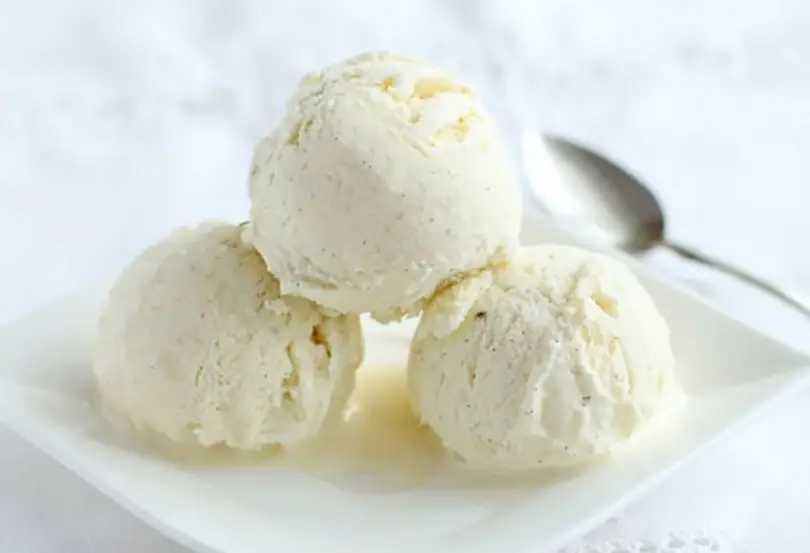
Traditional ice cream is made with a short list of ingredients. Cream, milk, egg yolks, sugar, and simple flavorings. That is it. In this form, the natural structure of milk fat remains largely intact.
Modern versions often tell a different story.
To reduce costs and extend shelf life, many products replace dairy fat with refined vegetable oils. They add emulsifiers, stabilizers, and texture enhancers. These ingredients recreate the mouthfeel, but not the original structure.
When that structure disappears, so do many of its benefits.
Without the natural membrane, fat is processed differently. Sugar enters the bloodstream faster. The metabolic response becomes less stable.
At that point, the product behaves much closer to what people expect from a typical processed dessert. This distinction is easy to miss because both products are labeled the same way. But inside the body, they are not the same at all.
There is also a human side to this story.
People who allow themselves small, regular pleasures tend to have a different relationship with food. They are less likely to swing between strict restriction and overeating. Their appetite signals are more consistent. Their eating patterns are more sustainable.
This reduces stress around food. It supports hormonal balance. Over time, it often leads to better weight stability.
So the observed effect is not just about molecules and metabolism. It is also about behavior and balance. That does not mean ice cream suddenly becomes a health food in the traditional sense. It still contains sugar. It still requires moderation. But it does mean that the conversation needs more nuance.
Not all desserts act the same way in the body. Not all fats are equal. Not all food labels reflect what is actually happening inside the product.
A diet built around whole foods with occasional inclusion of real ice cream can look very different from one dominated by ultra processed options.
Context shapes the outcome.
If someone eats balanced meals, stays active, sleeps well, and includes a small portion of high quality ice cream, it can fit naturally into a healthy pattern. If the overall lifestyle is out of balance, no single food will change that trajectory. And that brings us to the bigger insight. Food is not just a list of nutrients. It is structure, interaction, and context.
The way components are packaged inside a food changes how the body responds. Natural food systems often behave differently from isolated ingredients combined in a factory. This is why traditional foods sometimes show unexpected results in long term research.
They are not random collections of calories. They are organized systems that the body has learned to process over time.
So when you look at a bowl of real ice cream, you are not just looking at sugar and fat. You are looking at a specific structure, shaped by nature and only lightly modified. And that structure may be part of the reason the data looks the way it does. The takeaway is simple, but not simplistic.
Do not rush to extremes.
Avoiding entire categories of food without understanding context often creates more problems than it solves. Understanding how food actually works gives you more flexibility, more consistency, and better long term results. In that sense, ice cream becomes more than a dessert.
It becomes an example of how easily we can oversimplify nutrition, and how important it is to look deeper.
Because sometimes, the foods we were told to fear are not the problem. The problem is how little we understood them.