Heavier, your focus is broken, and even simple things feel harder than they should. Coffee does not fully work, sleep does not feel complete, and the whole day feels slightly misaligned, all because someone decided once again: “Let’s move the clocks.”
And now Congress is trying to end this madness for good.
The House Energy and Commerce Committee has backed a bill to make daylight saving time permanent. The Sunshine Protection Act passed with an overwhelming 48 to 1 vote. If it becomes law, the United States could finally stop this twice a year clock change that almost nobody can fully explain anymore, but everyone somehow feels in their body.
The most surprising part is not politics. It is how one single hour can quietly affect millions of people at the same time.
Most people treat daylight saving time as a small inconvenience, just losing one hour of sleep. But research over many years shows something very different. After the spring time change, traffic accidents increase, workplace injuries rise, and people make more mistakes. Even heart attack rates go up in the days that follow. Sleep disruption affects attention, reaction time, mood, and emotional stability. One lost hour does not stay just one hour. It spreads through the entire system.
And here is the paradox.
We live in a world obsessed with productivity and optimization. People buy smart watches, sleep trackers, meditation apps, premium mattresses, and supplements. We count steps, track stress, and try to improve every part of our daily performance. Yet twice a year society still forces a sudden shift that disrupts human biological rhythms on a massive scale, and we accept it as something normal.
That is why this topic triggers such a strong reaction. It is not really about clocks. It is about exhaustion.
It is about the morning when your alarm goes off and your body does not feel ready to exist yet. It is about children going to school in the dark, half asleep. It is about adults driving to work with heavy eyes and too much coffee. It is about the feeling that modern life already takes too much, and then time itself is adjusted on top of everything else.
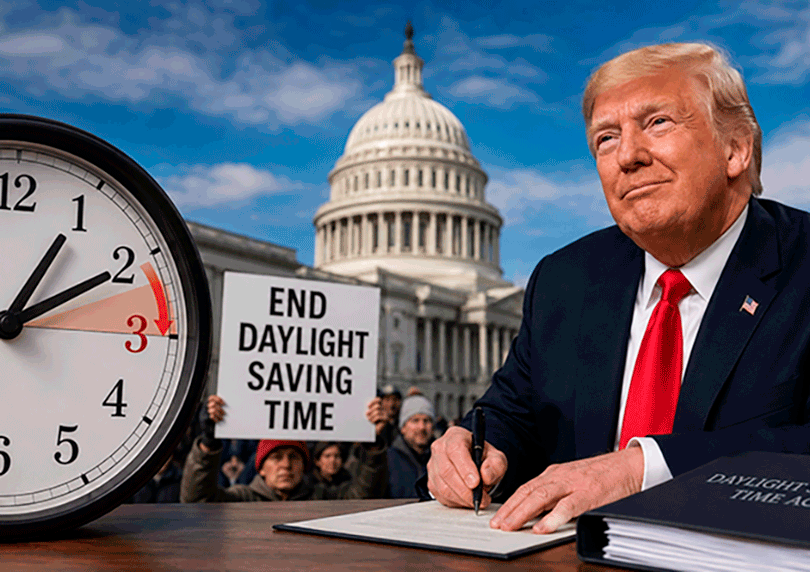
Donald Trump supported the bill and called daylight saving time a costly and inconvenient mess. For once, people across different political views found themselves agreeing on something.
Because nobody actually feels better after losing an hour of sleep.
Of course, there is opposition. Senator Tom Cotton argues that permanent daylight saving time would make winter mornings too dark, forcing children to travel to school before sunrise. That concern is real and cannot be ignored. There is no perfect solution that satisfies everyone.
But something deeper is happening in this debate.
People are starting to understand that sleep is not a weakness. It is not laziness. It is a biological foundation for mental health, emotional balance, physical safety, and basic human functioning.
A decade ago, sleeping four hours a night was treated like a badge of honor. Today it sounds like a warning sign. More people are realizing how destructive chronic sleep loss actually is.
That is why this issue feels so personal. It touches a universal modern experience, constant fatigue.
We live in a culture that normalizes stress, burnout, noise, pressure, and emotional overload. We are told to push harder, to keep going, to survive just one more deadline, one more week, one more difficult season.
But the body does not negotiate forever.
Eventually it reacts.
The strange part is that daylight saving time was originally introduced as something practical and efficient. It was meant to save energy and make better use of daylight. But decades later, the question has changed completely. How much does this “saved” hour actually cost us in real life.
How many accidents. How many mistakes. How many broken routines. How many exhausted parents. How many emotional arguments. How many people running on empty without even noticing it.
Modern civilization is full of contradictions. We can send rockets into space, build artificial intelligence, and perform complex surgery, but we still reset human biology twice a year as if it has no consequences.
And maybe the most powerful part of this story is how personal it feels.
Almost everyone remembers that day after the clock change when everything feels slightly off. The body is present but not aligned. Thoughts are slower. Emotions feel heavier. The entire day feels like it is running on the wrong timing.
So maybe the real question is simple.
Are we adapting to time, or forcing ourselves to fight against it?