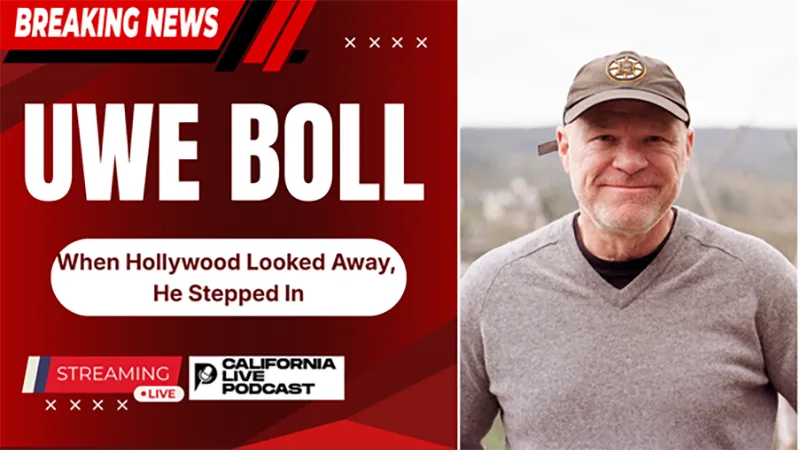
Why Uwe Boll Is Still One of Independent Cinema’s Most Uncompromising Voices
Hollywood has never suffered from a shortage of opinions.
Every Friday, another wave of reviews appears. Another panel of commentators explains why a film succeeded, why it failed, or why its creator should have made different choices. Entire careers have been built around evaluating the work of others. The internet has only amplified the phenomenon, transforming criticism into an industry where reactions often travel farther than the work itself.
But commentary has one remarkable advantage over creation.
It carries almost none of the risk.
Financing a feature film is risk.
Hiring a crew is risk.
Putting your own money on the line when no studio believes in your vision is risk.
Building a production company that survives for more than three decades while countless competitors disappear is risk.
Standing behind every creative decision, knowing millions of people may embrace it – or reject it – is risk.
There is an enormous difference between creating something and commenting on someone else’s creation. One requires conviction long before applause ever arrives. The other begins only after the work has already been done.
Whether one agrees with every film Uwe Boll has directed is almost beside the point.
He has done what countless aspiring filmmakers only dream about.
He built. More importantly, he never stopped building.
Long before we sat down for this conversation, I had already been studying Uwe Boll – not through headlines or internet commentary, but through the business decisions behind his career. As an independent filmmaker myself, I became less interested in the controversy surrounding him and more interested in a far simpler question: how had he managed to keep making films while so many others quietly disappeared?
In an industry where companies often vanish as quickly as they appear, that achievement deserves far more attention than it receives.
Whether one calls him controversial, provocative, fearless, or misunderstood, his longevity cannot be dismissed.
Success has a way of surviving headlines.
“I think the only way to learn movies is to make them,” Boll told me early in our conversation. “I was forced to finance them, forced to find the money, and in a way forced to sell them.”
There is something refreshingly honest about that statement.
Today’s entertainment landscape often celebrates specialization. One person develops. Another finances. Someone else produces. Distribution belongs to another department. Marketing belongs to another team. Responsibility becomes fragmented until almost nobody owns the final outcome.
Boll’s education was the opposite.
Nobody handed him the blueprint.
Nobody protected him from costly mistakes.
Nobody guaranteed success.
Instead, he learned by necessity.
His first film, produced on a remarkably small budget, became more than a creative project. It became his business school. Every contract, every negotiation, every financing decision became another lesson in survival. Over time those lessons accumulated into something considerably more valuable than theoretical knowledge – they became instinct.
“There are a lot of people in the movie industry who make money even if they never make anything,” he observed. “They don’t make movies. They control the money, they control the revenues, and the people who actually made the movie don’t make any money.”
That statement reveals something deeper than industry frustration.
It exposes the fundamental difference between builders and intermediaries.
Every industry develops them.
People who create products.
People who build companies.
People who take risks.
And people who become remarkably skilled at standing between creators and audiences.
Hollywood is hardly unique in that respect.
Perhaps what makes Boll unusual is his refusal to surrender ownership of the process.
He became the financier because he had to.
He became the producer because he had to.
He learned contracts because he had to.
The result was independence – not the fashionable kind celebrated at film festivals, but genuine independence earned through competence.
One moment in our discussion stayed with me.
Rather than proudly listing celebrities he has worked with or awards he has received, Boll reflected on something entirely different.
His company survived. More than thirty-five years.
While production companies opened, closed, merged, collapsed, or quietly vanished, his remained standing.
“I always stayed safe financially,” he said. “That makes me really proud because that’s the really hard part in the film industry.”
That sentence may be the least glamorous observation of the entire interview. Listening to him, I realized we weren’t discussing filmmaking anymore. We were discussing longevity – something far rarer in Hollywood than a successful opening weekend.
It may also be the most important.
Hollywood celebrates premieres.
Business celebrates sustainability.
Those are not always the same thing.
A filmmaker can direct an extraordinary movie and still lose everything financially.
Conversely, one can build a career by understanding that creativity without business discipline rarely survives for long.
This is where Boll separates himself from many contemporary filmmakers.
He does not romanticize filmmaking.
He respects it.
There is a difference.
To him, cinema is simultaneously art and enterprise.
Ignore either side and the entire structure begins to weaken.
Surviving Hollywood is one accomplishment. Surviving while Hollywood itself is changing may be an even greater one.
Streaming transformed distribution.
Algorithms replaced video store shelves.
Data increasingly replaced instinct.
The consequences, he argues, extend beyond technology.
They have changed how films themselves are discovered.
“I miss Blockbuster Video,” he admitted with surprising sincerity. “I miss walking through the store, picking up covers, finding movies.”
It would be easy to dismiss that observation as nostalgia. It isn’t.
It is actually philosophical.
Browsing demanded curiosity.
Algorithms reward familiarity.
Where audiences once wandered through aisles discovering unexpected stories, streaming platforms increasingly guide viewers toward content already supported by internal priorities and recommendation engines.
Independent filmmakers face a different challenge today.
The film may exist.
The audience may even want to watch it.
But discovery itself has become controlled by invisible mathematics.
Boll recalled one of his films performing remarkably well after a streaming acquisition despite receiving almost no promotion.
To him, that proved something encouraging.
Audiences still find good stories.
Sometimes they simply have to work harder to find them.
His criticism of contemporary Hollywood, however, reaches beyond technology.
It is fundamentally about decision-making.
About bureaucracy.
About creative authority.
Too many meetings.
Too many executives.
Too many voices attempting to influence decisions without carrying responsibility for the outcome.
“When I direct a movie, nobody should interfere,” he said plainly.
Some will hear arrogance.
Others will hear accountability.
I heard something else.
Leadership.
Every meaningful project eventually reaches a moment when someone must make the decision.
Not recommend.
Not advise.
Decide.
Leadership requires ownership.
Ownership requires consequences.
Modern institutions often become uncomfortable with both.
Boll described productions where numerous executives observe from monitors while offering constant input. For him, filmmaking becomes diluted when authority fragments into committee thinking.
History tends to support that observation.
Many of cinema’s most enduring works emerged because directors possessed unusually strong creative control.
Francis Ford Coppola.
Stanley Kubrick.
Oliver Stone.
Martin Scorsese.
None became legendary by polling committees before every scene.
As Boll reflected on films that shaped his own imagination – from The Godfather to Platoon – his admiration centered less on budgets than on courage.
Earlier generations often achieved remarkable cinematic impact with comparatively modest resources.
Today budgets expand while originality frequently contracts.
Money, he suggested, has become easier to spend than ideas are to create.
Perhaps nowhere was Boll more persuasive than when speaking directly to aspiring filmmakers.
His advice contained almost none of the motivational clichés that dominate commencement speeches.
He did not promise overnight success.
He did not encourage waiting for the perfect opportunity.
He recommended something considerably less glamorous.
Become useful.
Show up.
Work harder than expected.
Learn everything.
While discussing a production assistant who originally arrived simply to help manage a dog appearing in one of his productions, Boll described how the young man gradually demonstrated initiative far beyond his assigned responsibilities. By the end of production, Boll said he would hire him immediately for future projects because he had proven his value through action rather than titles.
There is wisdom hidden inside that story.
The entertainment industry often convinces young people that prestige precedes contribution.
Reality usually works the other way around.
Contribution creates opportunity.
Titles follow later.
As our conversation continued, another pattern emerged.
Whether discussing financing, directing, production, distribution, or mentorship, Boll consistently returned to one principle.
Do the work. Not someday. Now.
That philosophy explains far more about his career than any headline ever could.
Controversy may generate attention.
Discipline builds careers.
And perhaps that is why Uwe Boll remains such an unusual figure in modern cinema.
He refuses to separate filmmaking from responsibility.
He refuses to separate creativity from business.
Most importantly, he refuses to wait for permission before building something he believes should exist.
That mindset would soon lead our conversation toward his newest and perhaps most polarizing work, Citizen Vigilante – a film that would reignite debates about politics, censorship, artistic freedom, and the increasingly uncomfortable relationship between storytellers and the cultural institutions that judge them.
Those questions, however, deserve their own chapter.
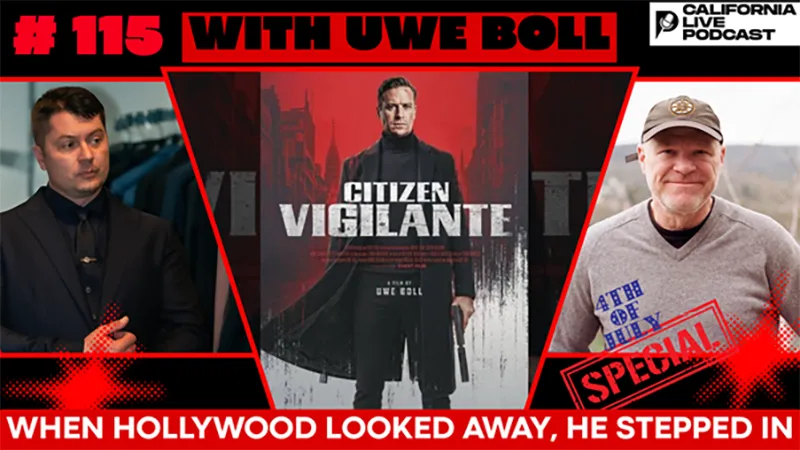
The Movie Nobody Wanted
As our conversation turned toward Citizen Vigilante, the discussion became less about filmmaking and more about the purpose of filmmaking itself. Why make a film that many studios would consider commercially risky? Why willingly step into a subject almost guaranteed to divide audiences? For Uwe Boll, the answer was remarkably straightforward. If a story raises questions that deserve to be explored, the possibility of controversy is not a reason to abandon it. It is simply another reality that must be accepted before the first frame is ever shot.
That perspective has defined Boll’s career for more than three decades.
Long before audiences see a finished film, countless decisions have already been made. Financing has been secured or rejected. Locations have been found. Crews have been assembled. Investors have accepted the possibility that every dollar they contribute could disappear. Months, sometimes years, of preparation take place before a single review is written. By the time critics begin evaluating a film, the difficult work has already been done.
That distinction became one of the central themes of our conversation.
Hollywood often celebrates the language of artistic freedom. It encourages originality, innovation, and bold storytelling. Yet the practical realities of modern filmmaking frequently move in the opposite direction. Large budgets create larger expectations. Larger expectations produce greater caution. Committees replace individual judgment. Risk becomes something to minimize rather than embrace.
Independent filmmakers live in a different world.
Every project begins with uncertainty. There are no guarantees that financing will materialize, that distributors will come on board, or that audiences will ultimately respond. Independence is not simply a creative label. It is a commitment to accepting responsibility when no institution is prepared to carry it for you.
That is precisely how Boll described the development of Citizen Vigilante. He never portrayed himself as someone waiting for Hollywood’s approval. If the project was going to exist, he understood that he would have to create the conditions for it himself. Rather than treating rejection as the end of the conversation, he viewed it as another obstacle requiring another solution.
Listening to him, I was reminded that entrepreneurship and filmmaking share far more similarities than many people realize. Both require conviction long before success becomes visible. Both demand financial discipline, resilience, and the willingness to continue despite uncertainty. Most importantly, both require accepting responsibility for outcomes that cannot be controlled.
That mindset also shaped one of the film’s most discussed casting decisions.
When I asked Boll about casting Armie Hammer, he approached the question from an angle that reflected his broader philosophy. Public controversy was not the starting point of his decision-making process. Professional ability was. His responsibility, as he described it, was to determine whether an actor could successfully perform the role required by the script.
Whether audiences ultimately agree with that decision is a separate discussion. What interested me was the consistency of his reasoning. Throughout our interview, Boll repeatedly returned to the work itself. Scripts. Performances. Production. Execution. Those remained his priorities, regardless of the noise surrounding them.
In many ways, that consistency explains both his supporters and his critics.
It also explains his longevity.
During our discussion, Boll spoke far more about production than publicity. He discussed financing, contracts, distribution, changing business models, and the practical realities of surviving in an industry where many companies disappear almost as quickly as they are formed. That perspective is rarely reflected in headlines, yet it may be the most important lesson aspiring filmmakers can learn.
Movies are not created by opinions.
They are created by decisions.
Someone must secure the financing.
Someone must hire the crew.
Someone must accept responsibility when production falls behind schedule, when budgets increase unexpectedly, or when creative problems appear that nobody anticipated. Every completed film represents thousands of decisions made under pressure, often with incomplete information and no guarantee of success.
That reality deserves greater appreciation.
Constructive criticism has always played an important role in the arts. Thoughtful critics can provide historical context, identify strengths and weaknesses, and help audiences engage more deeply with creative work. But criticism and creation remain fundamentally different disciplines. One evaluates what already exists. The other begins with nothing.
Creation carries a unique burden.
It demands action before certainty.
It requires commitment before validation.
It asks people to invest time, money, reputation, and often years of their lives in ideas whose success cannot be predicted.
Perhaps that is why Boll appears remarkably comfortable with disagreement. After directing films for more than thirty years, he understands that audiences will respond differently. Some projects will resonate widely. Others will provoke debate. Neither outcome changes the responsibility of the filmmaker to continue creating.
Before concluding our interview, I asked Boll what advice he would offer to younger people entering filmmaking or any other competitive profession.
His answer contained no promises of overnight success.
Instead, he spoke about work.
About developing practical skills.
About becoming useful rather than merely visible.
About earning opportunities instead of expecting them.
In an era increasingly dominated by algorithms, instant visibility, and carefully curated online identities, his advice felt almost refreshingly old-fashioned. Yet history suggests that enduring careers have rarely been built on shortcuts. They have been built through persistence, discipline, and the willingness to continue working long after public attention has shifted elsewhere.
As our conversation came to an end, I found myself reflecting on a simple reality.
Whether one agrees with every conclusion Uwe Boll reaches is ultimately a matter of personal judgment.
Whether one enjoys every film he has directed is equally subjective.
But there is one fact that remains difficult to dispute.
For more than three decades, he has continued to do what countless others only discuss. He has written, financed, produced, and directed films in one of the world’s most competitive industries while adapting to changing markets, changing technologies, and changing audiences. Many production companies that once appeared larger, stronger, and better connected have quietly disappeared.
He kept working.
Perhaps that is the most meaningful lesson from our conversation.
Creative industries will always generate opinions. Reviews will be written. Debates will continue. Headlines will come and go.
The work, however, endures.
Long after arguments have faded, audiences will still have the opportunity to watch the films, form their own conclusions, and decide for themselves.
That is how it should be.
Because in the end, culture is shaped not only by those who analyze it, but by those willing to create it in the first place.