Just a few years ago, the idea of a humanoid robot sitting in an airplane seat belonged to science fiction. Today, it has become real enough that major U.S. airlines are rewriting their policies.
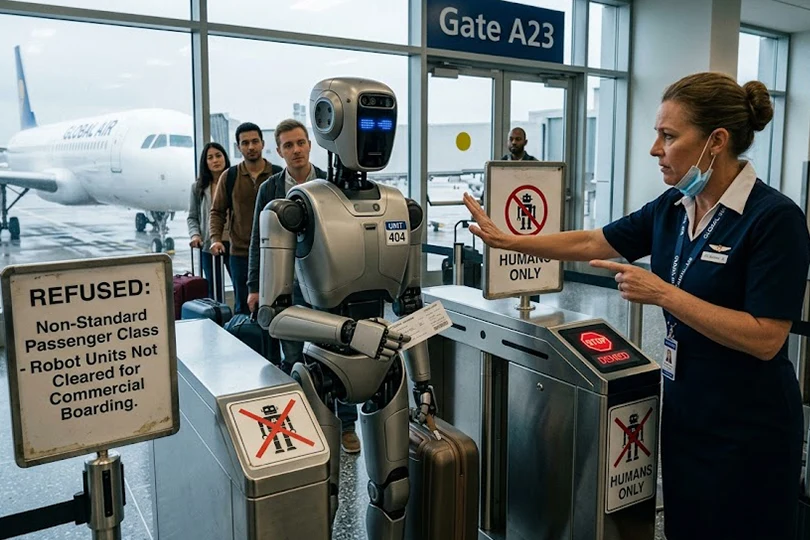
United Airlines and Delta Air Lines have officially banned passengers from traveling with humanoid and animal-like robots. The restriction applies to both carry-on and checked baggage. Southwest Airlines introduced a similar policy earlier.
The decision has nothing to do with fears of artificial intelligence taking control during a flight. Instead, the concern centers on the powerful lithium-ion batteries used in modern humanoid robots.
These batteries allow robots to walk, talk, recognize faces, and perform complex tasks. However, larger robots require larger battery packs, and if one overheats or becomes damaged, it can trigger a thermal runaway fire. While such incidents can be managed on the ground, they pose a far greater risk aboard an aircraft.
For that reason, airlines already enforce strict rules for transporting lithium batteries, power banks, and other high-capacity electronic devices. Humanoid robots introduce an entirely new level of complexity.
United’s baggage policy specifically states that humanoid and animal-like robots are prohibited in both the cabin and checked baggage. The airline defines these robots as AI-powered or remotely operated machines designed to imitate the appearance, movement, speech, or behavior of humans or animals.
Delta has adopted a similar approach, emphasizing that these robots are not considered assistive mobility devices or service animals and therefore do not qualify for special transportation accommodations.
The discussion intensified after several humanoid robots appeared on commercial flights earlier this year.
In one widely publicized case, a robot named Stewie flew aboard a Southwest Airlines flight from Las Vegas to Dallas. The robot occupied its own purchased passenger seat and quickly became a social media sensation. Shortly afterward, Southwest updated its policy and banned humanoid robots from future flights.
Another incident involved a four-foot-tall robot named Bebop, whose battery and transportation requirements delayed a flight by more than an hour before the aircraft was cleared for departure. The event highlighted the lack of standardized procedures for handling advanced robots at airports.
Not all robots are affected by the new rules. Small consumer robots, robotic vacuum cleaners, toys, laptops, smartphones, and other electronic devices remain permitted as long as they comply with existing airline battery regulations. The restrictions specifically target large humanoid and animal-like robots equipped with high-capacity battery systems.
Manufacturers argue that many robotic batteries are engineered with advanced safety features comparable to those found in electric vehicles and laptops. However, airlines have chosen a cautious approach until industry-wide transportation standards are established.
The situation illustrates how rapidly robotics is moving from laboratories into everyday life. Just a few years ago, airlines had no reason to consider whether a robot could occupy a passenger seat. Today, they are already creating entirely new policies to address that question.
Future regulations may evolve as technology advances. Manufacturers could develop removable battery systems, certified transport containers, or aviation-specific safety standards. Humanoid robots may eventually travel as specialized cargo—or perhaps even as passengers under new regulations.
For now, however, United, Delta, and Southwest have made their position clear: humanoid robots are not welcome aboard passenger aircraft.
It may sound like science fiction, but it marks the beginning of a new era. As robots become part of everyday life, society will need to create new laws, standards, and transportation rules to accommodate them.
Only a few years ago, people debated whether robots would replace human workers. Today, airlines are already deciding whether they should be allowed to board a plane.