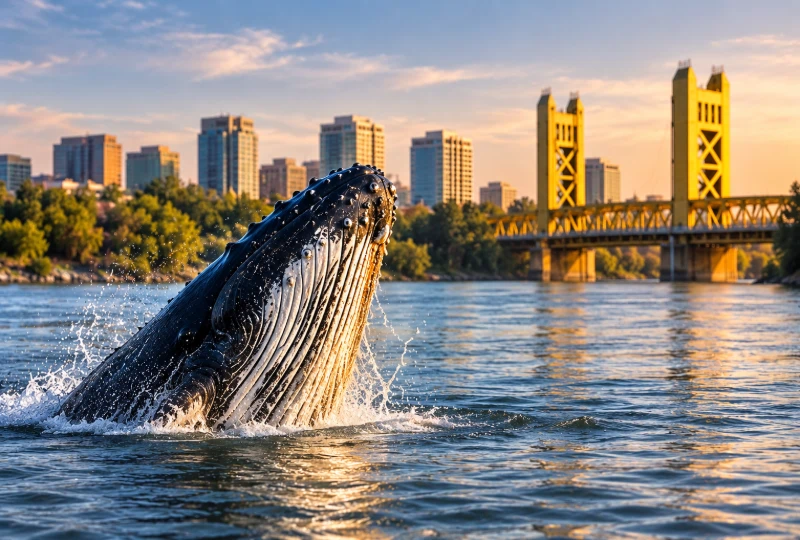
This week, Northern California is once again talking about an unusual visitor. A humpback whale traveled through San Francisco Bay and reached the Sacramento San Joaquin Delta near Rio Vista. But the most interesting part of this story is that this is far from the first time something like this has happened here.
Scientists already know this particular traveler.
The humpback whale is identified as CRC 11620 and has been given the name Rio. Researchers first documented him off the California coast in 2002. Over the past 24 years, he has been spotted at least 15 times off California and Mexico. In February 2026, he was seen near Baja California.
On September 15, Rio was spotted in San Francisco Bay. Instead of remaining there, he continued traveling east and eventually entered the Delta.
And that raises an obvious question. Why would an ocean giant swim toward Sacramento in the first place?
There is still no single confirmed answer.
One of the most reasonable explanations involves food.
Humpback whales feed on krill and small schooling fish. Off the California coast, their prey can include anchovies, sardines and herring. Whales can change their feeding locations as concentrations of prey move.
So food may influence where they travel. But there is currently no evidence confirming that Rio entered the Delta specifically because he was following fish.
There is also a simple geographical explanation.
For a whale, this is essentially one continuous waterway.
A whale can enter San Francisco Bay from the Pacific Ocean through the Golden Gate. From there, it can continue through San Pablo Bay and the Carquinez Strait before reaching the enormous Sacramento San Joaquin Delta system.
There is no wall telling the whale that the ocean has ended.
But that creates another mystery.
Why do some whales remain in San Francisco Bay while others continue traveling much farther into the Delta?
Scientists still do not fully understand why.
The Marine Mammal Center describes Rio’s current location as an unusual environment for a humpback whale. Experts are monitoring the animal, but they are not saying that his journey is necessarily the result of illness or disorientation.
For now, they want to give Rio an opportunity to choose his own direction and find his way back toward the open ocean.
And this is where the story becomes even more interesting.
Sacramento already has a remarkable history of visits like this one.
In 1985, a famous humpback whale named Humphrey entered the Sacramento River system and reached the area around Rio Vista. His unusual journey attracted national attention.
Eventually, Humphrey managed to return to the ocean.
Then, five years later, in 1990, he made another unusual journey deep into the San Francisco Bay system.
The story repeated itself again in 2007, this time with two whales.
A mother and her calf, later named Delta and Dawn, spent about 20 days in the Delta before eventually making their way back through San Francisco Bay toward the Pacific Ocean.
The Marine Mammal Center is now remembering those earlier cases while monitoring Rio.
There is another detail that makes the current situation a little less mysterious.
Humpback whales are extraordinary travelers.
Some populations migrate as far as 5,000 miles between their breeding and feeding grounds. For animals capable of traveling such enormous distances, entering San Francisco Bay is not necessarily extraordinary.
What is unusual is continuing much farther inland into the Delta.
So the answer to the question, “Why did a whale swim toward Sacramento?” may be more surprising than people expect.
We simply do not know for certain yet.
Perhaps Rio was following food. Perhaps he was exploring a waterway. Perhaps currents, prey and the behavior of this individual whale all played a role in taking him farther inland than usual.
Scientists are not rushing to choose one explanation without evidence.
For the rest of us, the story offers a rare chance to watch one of the largest animals on Earth navigate a waterway surrounded by cities, roads, bridges and communities.
Now we can only watch Rio and hope that his journey ends the same way as those of his famous predecessors, with the whale finding his own way back to the Pacific Ocean.
If you happen to see the whale, do not try to get closer just to capture a better photo or video. The Marine Mammal Center asks people to stay at least 100 yards away, reduce speed when traveling on the water and never move across the whale’s path.
Did you know that this is not the first time humpback whales have made such an extraordinary journey toward Sacramento? 🐋
🔷 Share this with your friends. They may also have thought that this year’s whale was Sacramento’s first unexpected ocean visitor.