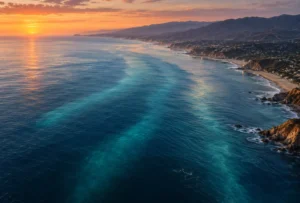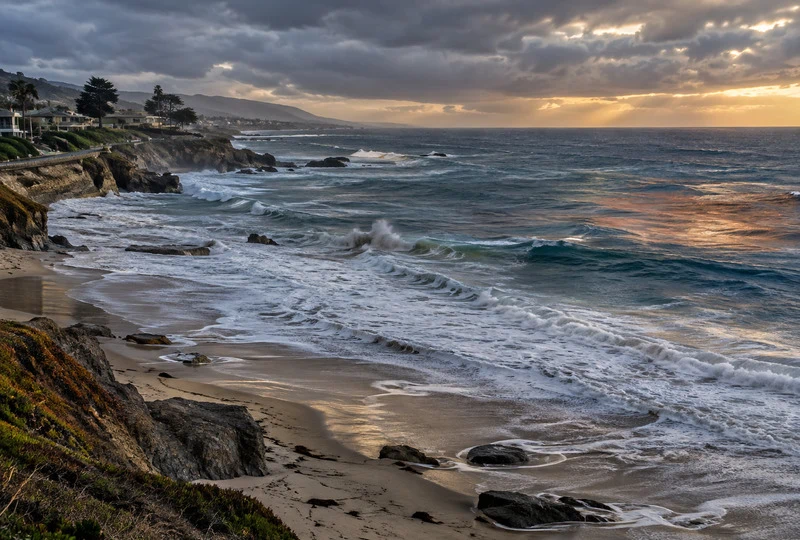
A giant wave is moving toward the California coast, but it will be almost impossible to see from the beach. It will not rise above the ocean like a massive wall, crash onto the shore, or look anything like a tsunami. Most of this movement is hidden beneath the surface. However, its effects could become very noticeable. The ocean may rise by about six inches and remain higher than normal for several weeks or even months.
This natural phenomenon is called a coastal Kelvin wave. Scientists expect it to reach Southern California in early October and then continue moving north along the American coast. The exact timing could shift slightly because the speed and direction of the wave depend on ocean conditions, winds, and the shape of the coastline.
The word “wave” can be misleading in this case. This is not a single towering wave that people can watch, photograph, or try to surf. It is a slow movement of an enormous mass of warm water. It stretches across thousands of miles of ocean and changes the height of the sea surface by only a few inches. A person standing on the beach may not notice anything unusual. For coastal communities, however, even a few extra inches of water can matter.
The formation of these waves is connected to El Niño. Trade winds normally push surface water across the equatorial Pacific Ocean from east to west. As a result, large amounts of warm water collect near Indonesia and other parts of the western Pacific. During El Niño, these winds weaken and sometimes temporarily reverse direction.
That allows the warm water to move back toward the east, in the direction of Central and South America. This movement creates an equatorial Kelvin wave. When it reaches the American continent, the wave splits. One section moves south, while the other travels north along the coasts of Mexico and the United States.
At this point, the water movement becomes trapped against the continent. In the Northern Hemisphere, a Kelvin wave moves with the coastline on its right side. This is why scientists call it a coastally trapped wave. The continental boundary prevents the energy from spreading freely into the open ocean and directs it along the shore.
The scale of this phenomenon is impressive. The wave can travel about 15,500 miles from the western equatorial Pacific to California and then continue toward Alaska. The entire journey takes about four months. There is no clearly visible front or towering wall of water. It is more like an extremely long underwater pulse that slowly changes water temperature, the depth of the thermocline, and sea level.
NOAA reports that these waves travel mostly below the surface but can produce a measurable sea level increase of about six inches. Satellites and coastal tide gauges can detect these changes. Earlier waves that formed during the spring and summer had already reached California in May and June, but their effects were relatively small. Scientists expect a stronger influence during the fall and winter. NOAA Fisheries
Six inches may not sound like much. That is roughly the height of an average smartphone. But the concern is not only the rise in water itself. What matters is what happens when that additional water combines with other coastal conditions.
If a Kelvin wave arrives during calm weather and an ordinary tide, many people may not notice it at all. But if the elevated sea level coincides with a King Tide, powerful surf, an atmospheric river, or a winter storm, water could travel farther onto beaches, parking lots, roads, and properties near the coast.
This combination of several factors is what worries scientists and coastal officials. A Kelvin wave creates a higher starting point for the ocean. High tides, storm surge, and powerful surf are then added on top of it. As a result, waves need less energy to cross protective barriers or reach places that normally remain dry.
Low beaches, lagoons, river mouths, coastal roads, and areas already losing sand are especially vulnerable. Additional water can accelerate coastal erosion. Surf can damage the lower sections of cliffs and remove more sand, making it harder for beaches to recover after each storm.
People who live far from the edge of the water may also feel the effects. Damage to a coastal road or railroad can cause closures and lengthy repairs. Narrower beaches can affect tourism, local businesses, and public access to popular recreation areas. Flooded storm drains can slow the removal of rainwater and increase the depth of local flooding.
Southern California is already dealing with serious erosion along some parts of the coast. In several communities, waves are moving closer to roads, parking lots, and buildings. This is why a small but persistent rise in water level cannot be separated from the overall condition of the coastline.
There is another reason scientists are watching the forecast closely. A Kelvin wave is part of a much larger process connected to El Niño. NOAA notes that water in the equatorial Pacific is already significantly warmer than normal. The effects of that warmth usually reach the West Coast of the United States after a delay. They can change coastal water temperatures, ocean currents, and the movement of marine animals.
As the wave travels north, it pushes the boundary between warm surface water and cold deep water farther down. Cold water that is rich in nutrients has a harder time reaching the surface. This can affect plankton, fish, seabirds, and the entire marine food chain. Some species that prefer warm water may begin appearing much farther north than usual.
However, the arrival of a Kelvin wave does not mean that California will definitely experience catastrophic flooding. Scientists are not predicting a tsunami or a giant wall of water. It is also impossible to know in advance which location will be affected the most. The outcome will depend on the timing of high tides, the direction of winter storms, and the condition of each section of coastline.
People who live in coastal areas should follow more than the regular weather forecast. They should also watch for high surf warnings, coastal flood alerts, and King Tide forecasts. Homeowners near the ocean may want to check drainage systems, move valuable belongings out of low areas, and avoid leaving vehicles in places where water has reached during previous storms.
Beach visitors should not assume that a calm looking ocean is always safe. When sea levels are already elevated, waves can suddenly travel farther up the beach, block escape routes near cliffs, or wash away belongings left on the sand. Extra caution is especially important when high surf warnings are in effect.
The invisible Kelvin wave is a powerful reminder of how complex the ocean really is. A major change can begin near the equator, travel across nearly half the planet, and affect a California beach, road, or home several months later. Most people will never see the wave itself, but they may still see its consequences.
Share this with your friends!
Do you think California’s coastal communities are prepared for changes in the ocean that are almost impossible to see, or will the sea send another bill without giving anyone advance notice? 😄