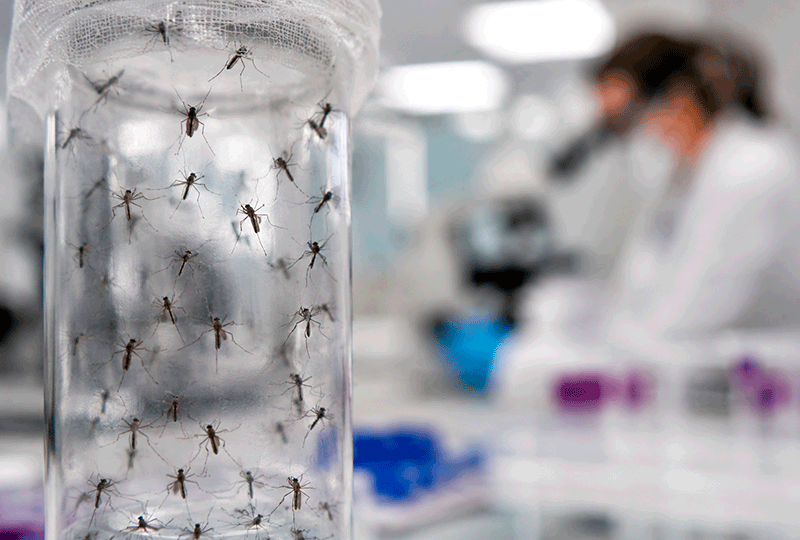
If someone told you that one of the world’s biggest technology companies wanted to release millions of laboratory mosquitoes across the United States, you would probably assume it was the plot of a science fiction movie.
But this is not fiction.
It is a real proposal currently being reviewed by U.S. regulators.
Through its biotechnology initiative called Debug, Google has submitted an application to the U.S. Environmental Protection Agency seeking approval to release up to 32 million mosquitoes in Florida and California over the next two years.
And this is where the story becomes truly fascinating.
Because the goal is not to create more mosquitoes.
The goal is to eliminate them.
It sounds like a paradox, yet modern science is increasingly built on exactly these kinds of unexpected solutions.
Most people think of mosquitoes as nothing more than an annoying part of summer. A few bites, some itching, and an unpleasant evening outdoors.
In reality, mosquitoes are among the deadliest animals on Earth.
According to the World Health Organization, mosquito borne diseases such as dengue fever, Zika virus, chikungunya, and malaria affect hundreds of millions of people and contribute to hundreds of thousands of deaths every year.
A tiny insect weighing less than a gram causes more human suffering than many of the world’s largest predators combined.
That is why researchers are looking for entirely new ways to fight back.
The mosquitoes proposed for release are not genetically engineered monsters from a Hollywood thriller. They are male mosquitoes carrying a naturally occurring bacterium called Wolbachia.
The most important detail is that these males do not bite people.
Only female mosquitoes bite because they need blood to produce eggs.
When Wolbachia infected males mate with wild females, the resulting eggs fail to hatch. Over time, the population of disease carrying mosquitoes declines naturally.
No large scale pesticide spraying.
No chemical clouds drifting through neighborhoods.
No toxic residue left behind.
Just biology being used to control biology.
For many scientists, that is precisely what makes the approach so promising.
For decades, mosquito control relied heavily on insecticides. But nature has a way of adapting. Many mosquito species have gradually developed resistance to chemical treatments, making traditional methods less effective and more expensive over time.
As a result, researchers are increasingly turning toward biological solutions that work with natural systems rather than against them.
What makes this proposal even more interesting is that the concept has already been tested.
Singapore conducted a similar program with impressive results. According to project data, target mosquito populations were reduced by 80 to 90 percent, while dengue cases fell by more than 70 percent in treated areas.
If similar outcomes can be achieved on a larger scale, public health experts believe this technology could become one of the most effective disease prevention tools developed in recent decades.
But this is also where the controversy begins.
Every time humans attempt to alter nature, the same question emerges.
What if there are consequences we cannot predict?
Critics argue that ecosystems are incredibly complex. Even small changes to a single species can create ripple effects that spread through food chains and local environments.
Skeptics ask a reasonable question: if millions of laboratory mosquitoes are released today, can anyone be completely certain about what happens five, ten, or twenty years from now?
That uncertainty is one reason public debate around the proposal has become so intense.
Supporters see a breakthrough in disease control.
Opponents see a large scale experiment whose long term effects remain unclear.
Yet the most important lesson may have little to do with mosquitoes.
We are entering an era where technology is no longer limited to computers, smartphones, software, or artificial intelligence.
Technology is beginning to reshape biology itself.
Not long ago, companies like Google were known primarily for search engines, mobile operating systems, and digital innovation.
Today, major technology firms are investing in biotechnology, genetics, environmental science, and public health. The boundary between technology and biology is becoming increasingly blurred.
And that shift is changing our understanding of what is possible.
When people first hear about 32 million laboratory mosquitoes, their reaction is often fear.
But perhaps the real question is different.
What sounds more dangerous: releasing millions of non biting mosquitoes designed to reduce disease, or continuing to accept illnesses that affect millions of people every year?
History has shown that some of humanity’s most important breakthroughs initially sounded impossible, risky, or even absurd.
If these mosquitoes succeed in reducing deadly diseases, this story may one day be remembered not as a controversial experiment, but as the moment science found an unexpected answer to a problem that has challenged humanity for centuries.