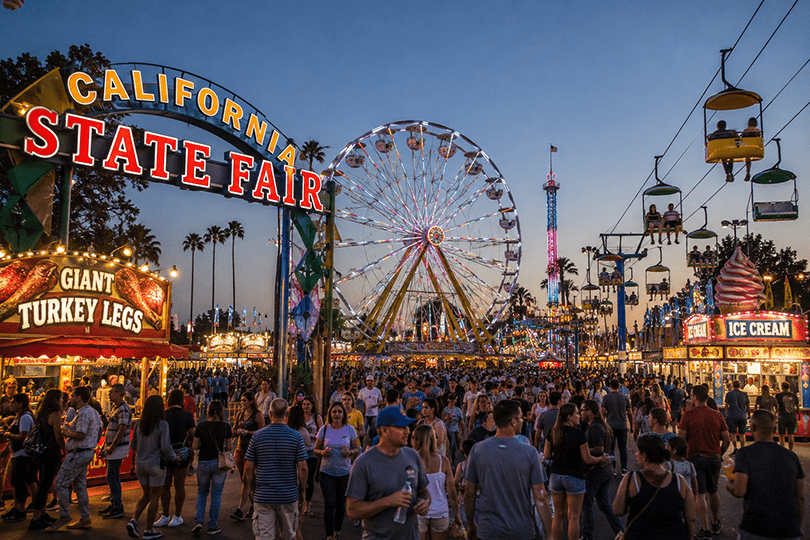
Every summer, the same scene unfolds in Sacramento.
Thousands of people pour through the gates of the California State Fair carrying oversized drinks, hunting for deep fried food, and mapping out which rides they want to try first. Within minutes, crowds form around roller coasters, carnival games, and food stands serving everything from giant turkey legs to chocolate covered bacon.
Most people think they know exactly what the fair is.
A few rides.
A few concerts.
A few photos.
Then home.
That is where they get it wrong.
After spending years attending the California State Fair, I realized something surprising. The attractions that dominate social media are often the least interesting part of the experience. The real story is hidden in places most visitors walk past without a second glance.
And once you see it, you never experience the fair the same way again.
The Fair Has Always Been About More Than Entertainment
At first glance, California State Fair looks like a giant summer festival.
In reality, it is something much bigger.
The event was originally created to showcase the best of California. Farmers, ranchers, winemakers, inventors, artists, and entrepreneurs all came together to display what they were building, growing, and creating.
That mission never disappeared.
It simply became hidden behind flashing lights and carnival rides.
If you look carefully, the fair still functions as a living snapshot of California itself.
The Future Often Hides in the Agriculture Buildings
Most visitors spend hours waiting for rides.
Meanwhile, some of the most fascinating exhibits sit nearly empty.
Walk into the agriculture halls and you will find technology that is quietly transforming how food is grown across the state.
Smart irrigation systems can measure exactly how much water a crop needs.
Drones scan fields from the sky and identify problems before farmers can see them from the ground.
Artificial intelligence helps predict harvests with remarkable accuracy.
It sounds futuristic.
But it is already happening.
For visitors, this is not just an agricultural story. It is a glimpse into how food prices, water use, and farming practices may change in the years ahead.
The Best Food Is Not Always Where the Longest Lines Are
Crowds naturally gather around the most famous food vendors.
Locals know better.
Some of the most memorable flavors can be found inside producer showcases and specialty exhibits where smaller California businesses introduce new products to the public.
You might taste a locally made cheese that has not reached grocery stores yet.
A small batch honey produced in the foothills.
A hot sauce created by a family business hoping to become the next statewide success story.
What feels like a snack often turns into a preview of the next big food trend.
The Morning and Evening Tell Two Different Stories
Most visitors arrive during the hottest hours of the day.
That means longer lines, larger crowds, and fewer opportunities to explore.
Locals often arrive early.
Morning offers something rare at a major event: space.
You can actually talk to exhibitors. Ask questions. Hear stories. Learn something unexpected.
Then there is the evening.
As the sun begins to disappear, the fair transforms.
Lights flicker on across the grounds.
Music drifts through the air.
The Ferris wheel becomes a glowing landmark visible from almost anywhere.
For a few hours, the fair stops feeling like an exhibition and starts feeling like a small city celebrating itself.
The Hidden Wine Experience
California produces some of the most respected wines in the world.
Yet many visitors never realize that one of the state’s major wine competitions is connected to the fair.
Award winning wines are showcased alongside producers that may become household names in the future.
Wine enthusiasts understand what this means.
You are not simply tasting wine.
You are tasting the future reputation of California’s wine industry.
A bottle that wins attention here may be featured in restaurants across the country a few years later.
Why Locals Keep Coming Back
This is perhaps the biggest secret of all.
The California State Fair changes every year.
New food appears.
New exhibits arrive.
New ideas emerge.
The fair reflects what California is thinking about right now.
That constant evolution keeps it fresh.
A person who attended five years ago would find things today that did not exist then.
The same will be true five years from now.
What the Fair Is Really Showing Us
Most people see a summer attraction.
I see something else.
I see a place where California introduces itself every year.
Not the version found in travel brochures.
The real version.
The one built by farmers, engineers, artists, scientists, small business owners, and families.
The fair gathers all of those stories in one place and puts them on display.
That is why the event remains relevant after generations.
It is not preserving California.
It is documenting California as it changes.
As I walked out one evening, the fairgrounds glowed under thousands of lights. Music echoed in the distance. Families were still arriving while others headed toward the exits carrying prizes, food, and bags full of souvenirs.
And it struck me that most people leave thinking they spent a day at a fair.
What they actually experienced was something much more interesting.
They spent a day watching California reinvent itself in real time.
The future rarely announces its arrival.
More often, it quietly blends into everyday life until one day we realize it has been here all along.