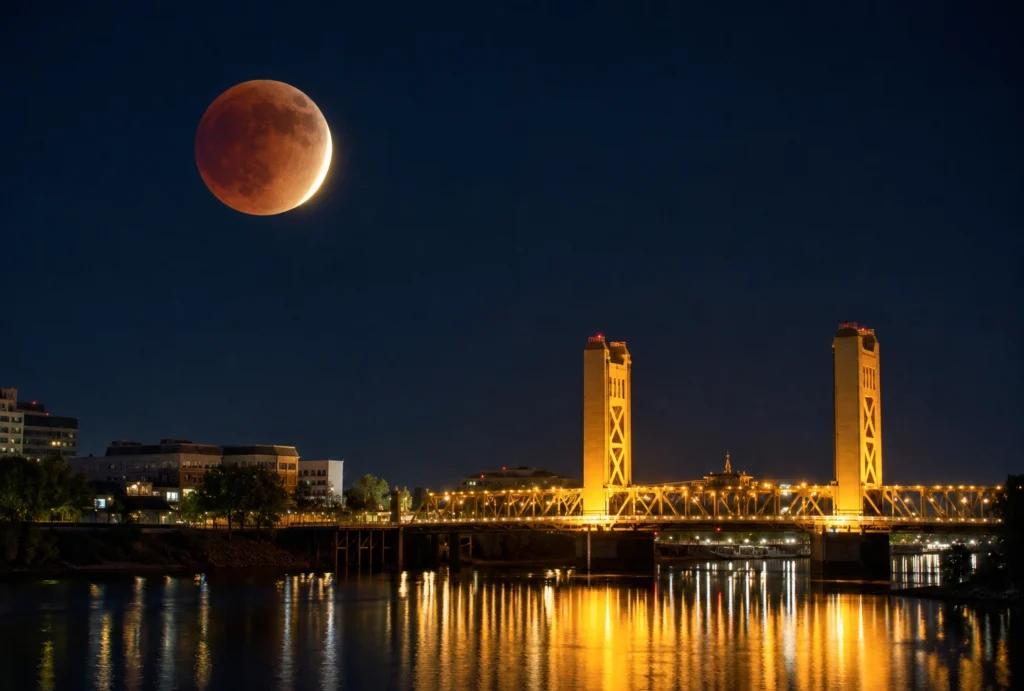
On the evening of August 27, people across California will have a good reason to pause, step outside, and look toward the eastern sky. The Moon will rise while already moving through Earth’s shadow. As the evening continues, its familiar bright surface will grow darker and may take on deep copper, red, and orange tones.
This will be a deep partial lunar eclipse. At maximum, Earth’s shadow will cover about 94 percent of the visible lunar surface. The Moon will come very close to being completely eclipsed, but a narrow bright edge will remain outside the darkest part of the shadow.
That small strip of light will make the event especially dramatic. Most of the Moon will appear dark and reddish, while one thin section will continue reflecting direct sunlight. The contrast could make this one of the most memorable sky events of the year.
The best part is that anyone can watch it. You do not need a telescope, special glasses, or a trip to an observatory. If the sky is clear, the eclipse will be visible to the naked eye from a backyard, park, riverfront, or any location with an open view of the horizon.
According to Timeanddate, the penumbral phase will begin in Sacramento at 6:23 PM local time. The Moon will still be below the horizon, so this early and subtle stage will not be visible from the city.
The partial phase will begin at approximately 7:33 PM. Moonrise in Sacramento is expected around 7:35 PM, which means the Moon will already be partially eclipsed when it appears above the horizon.
The first few minutes may be difficult to see. The Moon will be extremely low in the eastern and southeastern sky, and much of its usual brightness will already be gone. Buildings, trees, hills, smoke, and haze near the horizon could hide it completely.
The eclipse will reach its maximum at approximately 9:12 PM. By then, the Moon will be about 17 degrees above the horizon and much easier to find. This will be the most impressive part of the event, with almost the entire lunar disk inside Earth’s dark central shadow.
The partial phase will end at approximately 10:51 PM. A subtle penumbral darkening may remain visible after that point. The entire eclipse will end around 12:01 AM on August 28.
All times listed here are in Pacific Daylight Time. The moment of maximum eclipse will be nearly the same across California, but the time of moonrise and the conditions near the horizon may vary slightly from one city to another.
A lunar eclipse happens when Earth moves between the Sun and the Moon. Our planet blocks direct sunlight and casts a shadow into space. When the Moon enters the darker central part of that shadow, a partial or total lunar eclipse begins.
Earth’s shadow is not always completely black. Some sunlight passes through the planet’s atmosphere before reaching the Moon. Blue light is scattered more strongly, while red and orange light continues through the atmosphere and falls on the lunar surface.
We see a similar effect during sunsets and sunrises. During a lunar eclipse, the reddish light from countless sunsets and sunrises around Earth is projected onto the Moon.
The exact color is difficult to predict. It can be affected by clouds, dust, smoke, volcanic particles, and atmospheric conditions in different parts of the world. The Moon may look copper, brick red, dark orange, brown, or almost gray.
During a deep partial eclipse, the most interesting feature may be the contrast between the dark portion of the Moon and the narrow bright edge that remains in direct sunlight. Even without a telescope, viewers should be able to watch that boundary move slowly across the lunar surface.
NASA calculations place the greatest phase at 04:13 Universal Time on August 28. In California, that corresponds to the evening of August 27. NASA lists an umbral magnitude of 0.9299, confirming that the event will come very close to totality without becoming a total lunar eclipse.
Watching a lunar eclipse is completely safe. No protective filters or eclipse glasses are required. This is very different from a solar eclipse, when looking directly at the Sun without certified eye protection can cause serious and permanent eye damage.
Binoculars and telescopes are also safe to use when viewing the Moon. They are not necessary, but they can reveal lunar craters, surface details, color changes, and the curved edge of Earth’s shadow. Even a small pair of binoculars can make the experience more impressive.
For Sacramento viewers, the most important requirement will be an open view toward the east and southeast. The Moon will rise while already eclipsed and will remain very low for the first part of the evening. Buildings, tall trees, and nearby hills could block the view.
It is worth choosing a viewing location in advance. A park, riverfront, open field, spacious parking area, or elevated location can work well. You do not need to travel far outside the city because the Moon remains bright enough to see in areas with light pollution.
Moving away from bright streetlights and illuminated signs can still improve the experience. A darker location will make it easier to notice subtle colors and take better photographs.
Safety should remain a priority. Avoid stopping along busy roads, entering restricted property, or choosing an isolated location with difficult terrain. A clear horizon is useful, but a safe and accessible viewing spot is more important.
Modern smartphones can photograph the eclipse, although getting a large and detailed image of the Moon without additional equipment can be challenging. Automatic camera settings often turn the Moon into a featureless white circle.
Place the phone on a tripod or another stable surface. Turn off the automatic flash because it cannot illuminate an object located nearly 239,000 miles from Earth. If your camera allows exposure adjustments, lower the brightness until surface details become visible.
Use digital zoom carefully. Heavy digital enlargement often reduces image quality. A wider photograph showing the eclipsed Moon above the Sacramento skyline, Tower Bridge, trees, or another recognizable landscape may be more interesting than a blurry close view.
The Moon will become much darker near the maximum phase. The camera may need a longer exposure, which makes a tripod especially helpful. Even a small movement of the phone can blur the image.
People using dedicated cameras should experiment with several exposure times and ISO settings. The narrow illuminated edge and the dark red portion of the Moon will have very different brightness levels. Taking a series of images with different settings will improve the chances of getting a strong photograph.
Clouds remain the biggest uncertainty. Even the most dramatic eclipse cannot be seen through a thick cloud layer. Forecasts can change quickly, so check the local cloud cover during the day on August 27 and again shortly before leaving home.
Rain is not the only concern. Thin high clouds, wildfire smoke, and haze near the horizon can also reduce visibility. This matters in Sacramento because the Moon will rise while already eclipsed and will initially appear very low in the sky.
If clouds are concentrated over one part of the region, traveling a short distance may provide a clearer view. Satellite cloud maps and local air quality information can help viewers choose the best direction.
Lunar eclipses are a reminder that remarkable events can happen directly above us without tickets, expensive equipment, or complicated preparation. On August 27, Californians will need only clear weather, an open horizon, and a little free time.
For Sacramento, the best viewing period will begin after moonrise and continue until the partial phase ends at 10:51 PM. The most dramatic moment will arrive around 9:12 PM, when almost the entire Moon is covered by Earth’s shadow.