Most children see a playground as a place of complete freedom. They can climb a ladder, race down a slide, swing high, and reach the top of a play tower. But for a child who uses a wheelchair, a traditional playground often ends where the first set of stairs begins.
A new park in the Sacramento area was created around a different idea. A child should not have to watch from the sidelines simply because their body moves differently. Every child should have the opportunity to play together.
On August 29, 2026, emPOWERment Park officially opened on Bell Street. It is located at 1124 Bell Street, Sacramento, CA 95825, in the Arden Arcade area of Sacramento County. This is more than a new playground. It is a socially inclusive space with play, sensory, and sports areas designed for people of different ages and physical abilities.
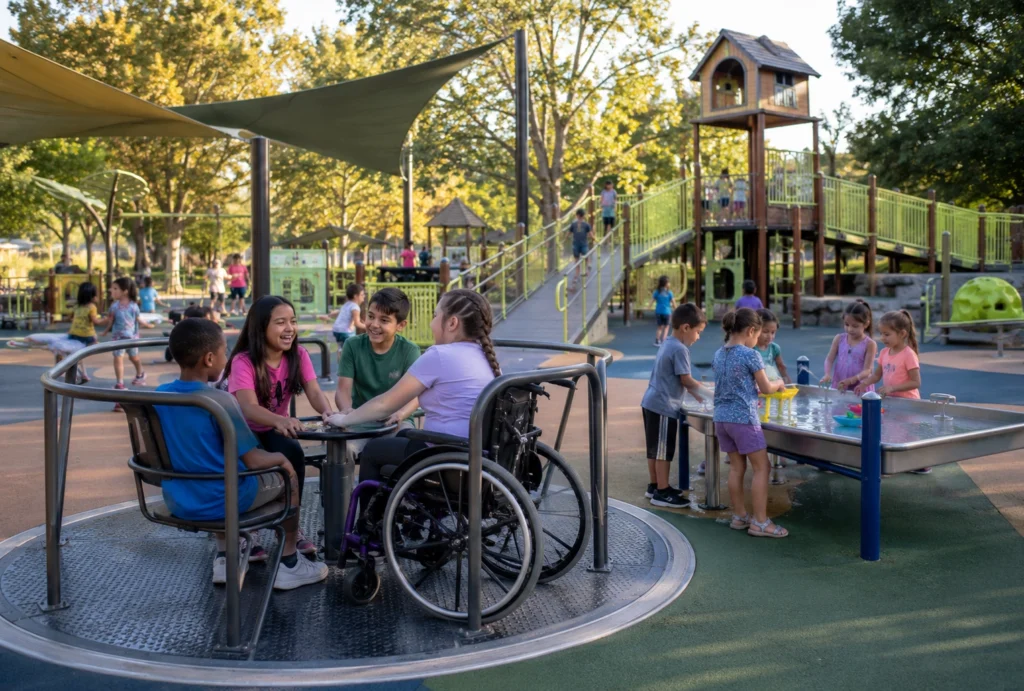
The centerpiece of the park is a tall play tower. A long, gently sloped ramp leads all the way to the upper level. This allows a child using a wheelchair to reach the top independently and see the playground from the same height as every other child.
At many traditional playgrounds, an accessible path ends at the base of the play structure. A child may technically be able to approach the equipment, but cannot enter it, use the slide, or reach the upper level. The designers of emPOWERment Park tried to remove that invisible barrier.
Mike Grace, executive director of the Sacramento Parks Foundation, explained that children using wheelchairs rarely get to experience height at a playground. At this park, they can travel to the top, look across the space, and play beside their peers.
The park includes swings that can accommodate a wheelchair. Traditional swing seats are located nearby, allowing children with different abilities to swing together. There is also an accessible merry go round, adaptive rocking equipment, slides, and a soft, colorful rubber surface that is easier to cross with a wheelchair or another mobility device.
Special attention was also given to sensory experiences. The playground has panels with sounds, textures, colors, and movable pieces. These features allow children to choose between calmer and more active forms of play, explore surfaces with their hands, listen to sounds, and watch light effects.
Some of the equipment follows an energy theme. Children can activate the mechanisms themselves, causing lights to turn on or sounds to play. Two towers also feature fans that children can control, creating a moving display of color that resembles a kaleidoscope.
The energy theme was not chosen by accident. The approximately 1.43 acre property belonged to SMUD. The public utility donated the unused land for the park through its Shine program, which supports neighborhood development and revitalization across the Sacramento region.
For years, the property was simply an empty lot. Families living nearby saw unused land every day, even though many children live in the surrounding neighborhood. The park is close to Greer Elementary School and Encina High School. Officials also hope the new space will reduce pressure on nearby Swanston Park, which can become crowded on weekends.
Planning for the project began around 2017. The Sacramento Parks Foundation and Mission Oaks Recreation and Park District were searching for a location in an area with very little undeveloped land left for new parks. Before creating the final design, organizers held neighborhood meetings and visited local schools to ask children what they wanted to see.
That is why emPOWERment Park was not designed as a standard collection of swings and slides. It includes separate areas for younger children and school age children, spaces for quieter sensory activities, sports features, water, shade, and places where parents can remain close.
One section of the park includes equipment for children ages 2 through 5. Another has taller structures for children ages 5 through 12. The park includes roller slides, rocking equipment, sensory panels, and activity stations positioned along accessible routes.
The sports section includes a Bankshot court. It uses basketball hoops at different heights and backboards placed at different angles. This allows people with different heights, coordination levels, and physical abilities to participate in the game.
Exercise equipment is installed around the play area for parents and other supervising adults. This helps turn a visit to the park into a shared family activity instead of leaving adults to simply wait on a bench.
The project also includes a sensory water area, shade structures, community garden beds, an open lawn, game courts, picnic and barbecue areas, a restroom, accessible parking spaces, landscaping, lighting, and public art. The complete project description is available through Parks for All Californians.
The state grant for the project totaled $6.28 million. The funding was awarded to the Sacramento Parks Foundation through the Prop 68 Statewide Park Program. The total cost of the park approached $10 million. In addition to the state grant, the project used money from the local park district and federal pandemic relief funds provided through Sacramento County.
Construction became more complicated and expensive than originally expected. The pandemic, permitting delays, and rising construction costs increased the budget. The ceremonial groundbreaking took place on October 3, 2022, but the main construction work was not completed until 2026.
After construction, responsibility for operating the park passes to Mission Oaks Recreation and Park District. Information about the project and its equipment is available on the district’s official website.
The value of a place like this cannot be measured only by counting its play structures. Play helps children move, communicate, negotiate, evaluate risk, develop their imagination, and feel that they belong to a group. When a space is inaccessible, a child loses more than access to one slide or swing. The child loses an opportunity to participate in the shared life of their peers.
In a CDC publication about playground infrastructure, researchers explain that access to active play is connected with children’s physical, social, emotional, and mental health. The authors specifically discuss playgrounds where an accessible pathway ends in front of a staircase while the actual play equipment remains out of reach.
This is where the difference between formal accessibility and genuine inclusion becomes clear. A park can install one adaptive feature off to the side and claim that the requirements have been met. But the child may still remain separated from everyone else. At emPOWERment Park, the playground itself is designed to bring children together through shared play.
This also matters for children without disabilities. From an early age, they see that people may move, communicate, and experience the world in different ways. Playing together makes those differences a natural part of life instead of a reason for distance or discomfort.
Sensory areas can also benefit many families. Bright, noisy, and crowded playgrounds do not work equally well for every child. The ability to choose between sound, touch, water, movement, and calmer activities helps children with different sensory needs participate in their own way.
The name emPOWERment Park carries two meanings. The word power reflects the energy theme and SMUD’s role in the project. At the same time, empowerment means having the ability to act independently, feel confident, and rely less on assistance when the surrounding environment is designed to be accessible.
The park is located at:
1124 Bell Street
Sacramento, CA 95825
Before visiting, families should check current announcements and possible restrictions through Mission Oaks Recreation and Park District. Information is also available by calling (916) 488-2890.
One park cannot solve every accessibility problem. But emPOWERment Park demonstrates what public space can become when designers begin with the right question. The question is not how to add one special feature for a child with a disability. The real question is how to create a place where no child is excluded from the shared experience of play.
Hopefully, playgrounds like this will stop being rare and become part of every California community. Would You like to see a park like this in Your city?