For most of its existence, Bennu was just another dark rock drifting through space. No atmosphere. No light. No sign that anyone would ever pay special attention to it. Then scientists opened a sealed container in a lab on Earth and realized this small asteroid was carrying something extraordinary. Not life itself, but the ingredients that make life possible.
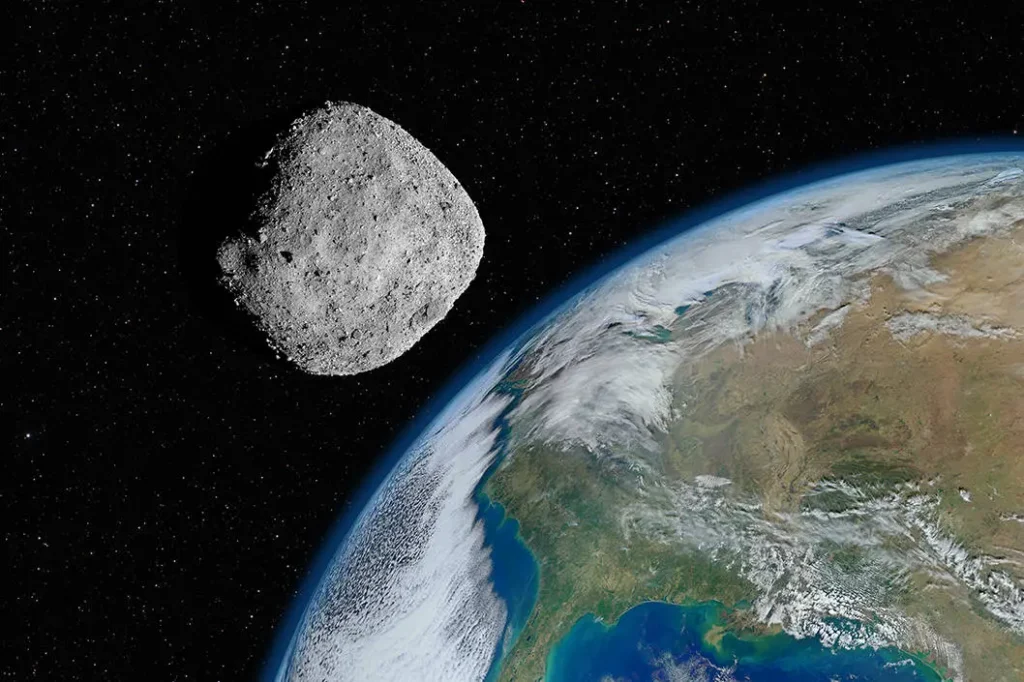
This is the story of how a piece of space, older than Earth, is reshaping what we think we know about where life comes from.
Bennu is not large by cosmic standards. It measures about 1,600 feet across and was discovered in 1999. Yet scientists believed it held a rare secret. Unlike planets, asteroids like Bennu have remained mostly unchanged since the birth of the solar system. They are time capsules. Whatever chemistry exists inside them has been preserved for billions of years.
That idea drove NASA’s OSIRIS REx mission. In 2020, a robotic spacecraft touched Bennu’s surface, collected a small amount of material, and began its long journey home. When the samples finally arrived on Earth, they were treated with extreme care. Even the smallest contamination could ruin the science.
What researchers found inside was worth the wait.
In December, studies published in Nature Geosciences and Nature Astronomy revealed that Bennu contains ribose and glucose, two sugars that play a central role in biology. Ribose, in particular, is essential. It forms the backbone of RNA, a molecule many scientists believe came before DNA and helped launch life on Earth.
This discovery did not happen in isolation. Earlier research had already identified all five nucleobases that make up DNA and RNA, along with phosphates. Together, these components form a complete chemical toolkit for building RNA. In simple terms, Bennu contains the same basic parts needed to assemble life’s earliest molecules.
That realization changed the conversation.
For decades, scientists have debated how life began. Did Earth create everything on its own, or were some of the ingredients delivered from space? Bennu now offers strong evidence for the second idea. It suggests that the early Earth may have been seeded with life ready chemistry from asteroids crashing into its surface.
Then there was another surprise.
Hidden in the samples was a strange sticky organic substance, rich in oxygen and nitrogen. Some scientists jokingly call it space chewing gum. But its role may have been serious. One theory suggests it acted like a chemical glue, helping molecules stay together long enough to form more complex structures.
In the violent environment of the early solar system, that kind of stability could have made all the difference. Molecules that might normally break apart could instead combine, react, and evolve.
It is important to be clear about what this does not mean. There is no evidence that Bennu ever hosted living organisms. No microbes. No cells. No fossils. But the presence of these molecules shows that the chemistry of life is not rare or fragile. It can exist in cold, airless space.
Harvard astrophysicist Avi Loeb has argued that findings like this make life elsewhere in the universe feel more likely, not less. If asteroids naturally carry the ingredients for life, then planets forming in similar environments may receive the same chemical gifts.
For Californians, this story reflects something familiar. The state has long been at the center of space exploration, innovation, and scientific risk taking. Missions like OSIRIS REx represent decades of planning, engineering, and curiosity driven research. They also show how discoveries made far from Earth can change how we see ourselves.
There is something humbling in the idea that life on Earth may have cosmic roots. That we are, in a very literal sense, connected to ancient space rocks drifting through the solar system.
Bennu’s samples will continue to be studied for years, perhaps generations. Each test may reveal new compounds, new reactions, new clues. This is not a finished story. It is the beginning of a deeper investigation into how chemistry turns into biology.
What Bennu has already taught us is powerful. Life may not be a miracle that happened once against impossible odds. It may be the natural result of the right ingredients meeting at the right time, again and again, across the universe.
And somewhere, quietly orbiting the Sun, asteroids like Bennu are still carrying those ingredients, waiting to be discovered.