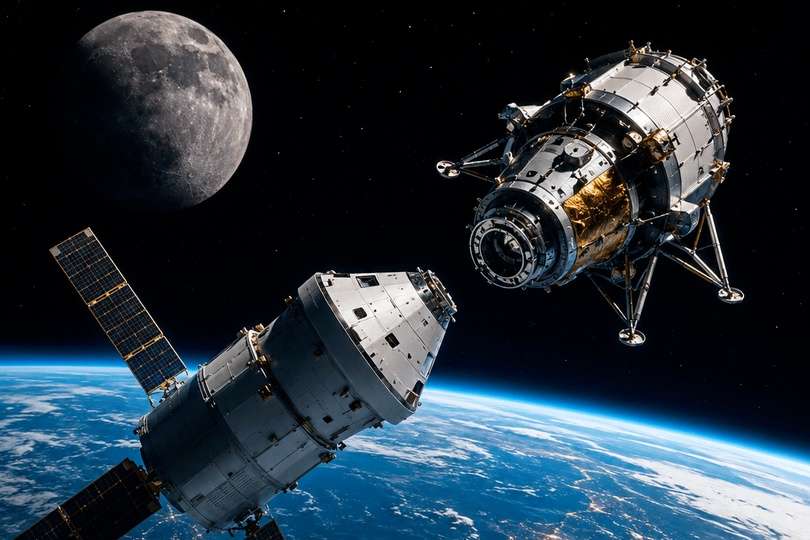
Orion Becomes One Spacecraft: A Major Step Toward Artemis III
An important event has taken place at NASA’s Kennedy Space Center. It can be described in one short sentence, but it represents years of design, assembly, and testing. Engineers have joined the Orion crew module and service module built for the Artemis III mission. The two main sections now form a single system that will carry four astronauts into low Earth orbit.
From the outside, this operation may look like a routine assembly step. One large component was placed on another, the connections were secured, and the work continued. In reality, engineers must unite electrical circuits, data channels, control systems, fluid lines, and life support equipment. Once connected, the modules must operate not as two separate machines, but as one spacecraft.
This is an especially important moment for the Artemis program. NASA has changed the structure of its upcoming missions, and Artemis III is now planned as a crewed test flight in Earth orbit. Its purpose is not to land astronauts on the Moon. Its purpose is to test the operations that must work before a future lunar landing can be attempted safely.
What Is Inside Orion
The crew module is the part of Orion where the astronauts will live and work during the mission. It contains seats, displays, controls, computers, communications equipment, and systems needed by the crew. This is also the part of the spacecraft that protects the astronauts during launch, orbital flight, and atmospheric reentry.
A heat shield is installed on the lower side of the crew module. During the return to Earth, it must withstand extremely hot airflow and prevent dangerous heat from reaching the interior of the spacecraft. In the summer of 2026, technicians completed the installation of the Artemis III heat shield and began preparing the crew module for connection with the service module.
The service module has a completely different role. It can be described as the energy and technical heart of the spacecraft. It supplies Orion with electricity, regulates temperature, carries water and oxygen for the astronauts, and performs orbital maneuvers using its engines.
The service module was provided by the European Space Agency. Airbus leads its assembly, while companies from several European countries contribute hardware and expertise. Artemis III will use the third European Service Module built for the Orion program.
A special adapter sits between the crew and service modules. It connects their electrical, data, and fluid systems. Commands, information, power, and vital resources pass through it. Without this connecting structure, the two complex modules could not function as one spacecraft.
Before the modules were joined, the service module completed acoustic testing. Engineers surrounded it with powerful speakers and exposed it to intense noise and vibration similar to the environment of a rocket launch. Sensors measured how the structure responded so teams could confirm that the equipment would survive the real flight.
Who Will Fly on Artemis III
The Artemis III crew includes four experienced astronauts. NASA astronaut Randy Bresnik will serve as commander. Italian European Space Agency astronaut Luca Parmitano will pilot Orion. NASA astronauts Andre Douglas and Frank Rubio will serve as mission specialists.
NASA astronaut Bob Hines has been named as the backup crew member. The primary crew has already started training, learning the Orion systems and becoming familiar with the operations involving commercial lunar landing vehicles.
The selection of Luca Parmitano highlights the international nature of the program. He has spent 366 days in space during two long missions aboard the International Space Station, completed six spacewalks, and served as commander of the station. He will now help operate a spacecraft whose technical heart was built by European specialists.
NASA officially announced the crew on June 9, 2026. The agency also confirmed that Artemis III will take place in low Earth orbit and serve as a preparation stage for a future lunar landing. NASA’s official announcement about the Artemis III mission and crew.
Why Test Lunar Systems Near Earth
During Artemis III, Orion is expected to perform rendezvous and docking maneuvers with test versions of commercial human landing systems. Blue Origin and SpaceX are developing these vehicles. NASA plans for Orion to conduct demonstrations with one or both prototypes, depending on their readiness.
Bringing two spacecraft together is one of the most difficult operations in human spaceflight. A spacecraft cannot simply point toward another vehicle and stop beside it. Each object is moving at tremendous speed. A small calculation error can cause them to miss each other by kilometers or approach each other too quickly.
The crew and ground teams must verify navigation, communications, software, engines, sensors, and mechanical interfaces. Orion must detect the second vehicle, approach it along a safe path, match its movement, and complete the docking. Every part of this process must work as a single coordinated sequence.
Testing in low Earth orbit reduces the overall risk. The spacecraft will remain relatively close to Earth, and the crew can return more quickly if a serious problem occurs. At the same time, the environment of space will allow engineers to test equipment that will later be needed much farther from the planet.
The mission will act like a full rehearsal before a much more difficult performance. Artemis III will not carry astronauts to the lunar surface, but it should reveal whether Orion and the commercial systems are ready to operate together. Problems found near Earth can be corrected before a lunar landing depends on them.
Why Artemis III Is No Longer Landing on the Moon
Artemis III was originally intended to return astronauts to the lunar surface. However, the development of landing systems, spacesuits, spacecraft, and rockets requires more time. NASA redistributed the tasks among upcoming missions so that the most complicated operations could be tested first in safer conditions.
The first new crewed expedition to the lunar south pole is now planned for Artemis IV in 2028. Artemis III is expected to prepare the technology, procedures, and crews needed for that mission. This sequence allows NASA to complete critical tests instead of skipping them to meet a symbolic date.
Keeping Artemis III near Earth does not make the mission simple. NASA has described it as one of the most complex human spaceflight operations in recent years. The tests may require several launches of powerful rockets, while different spacecraft must enter coordinated orbits and meet at the right time.
The teams will test more than the physical act of docking. They will evaluate interfaces, engines, communications, and software. Different companies and organizations are building individual systems, so one of the central challenges is making all of them work together reliably.
What Happens After the Modules Are Joined
Connecting the crew and service modules does not mean that Orion is fully ready for launch. Engineers still need to inspect the connections, conduct integrated electrical tests, and confirm that commands travel through the entire spacecraft without delays or errors.
Four European built solar arrays will then be installed on the service module. In space, they will open into a cross shaped configuration and provide electrical power. Teams will also continue testing life support, propulsion, communications, software, and crew equipment.
Orion will later receive its launch abort system. This system is designed to pull the crew module away from the rocket if a dangerous situation develops during launch. Once ground preparation is complete, the spacecraft will be moved to the Vehicle Assembly Building and placed on top of the Space Launch System rocket.
At the same time, assembly of the rocket continues at Kennedy Space Center. Its solid rocket boosters, core stage, and engines are being prepared and integrated. Before Artemis III can launch, all these elements must come together in one place and in a carefully planned sequence.
A Test That Could Shape Humanity’s Return to the Moon
The Artemis program is not built around a single spacecraft or rocket. It brings together NASA, the European Space Agency, private companies, and industrial teams from many countries. Orion, the SLS rocket, and the landing systems from Blue Origin and SpaceX must eventually become parts of one larger transportation system.
That is why joining the two Orion modules matters far beyond the assembly floor. It is the moment when separate structures begin to become a spacecraft and years of work by thousands of people take the physical form of a future mission.
Artemis III will not carry people to the Moon, but it may determine how confidently they travel there on the next mission. If rendezvous, communications, and docking work as planned, Artemis IV will have a tested foundation for its lunar expedition.
Humanity’s return to the lunar surface does not begin at the moment of landing. It begins here on Earth, when engineers connect modules, inspect cables, and make thousands of components work as one. Orion has now taken another step from a collection of complex parts toward a true spacecraft.