You Rang the Doorbell. The Camera May Already Remember Your Face
You visit friends, press the doorbell, and calmly wait for someone to open the door. But in those few seconds, the camera may have done more than record a video. It may have isolated your face, created a separate digital profile for it, and stored it, even though you turned nothing on, agreed to nothing, and did not even know you were taking part in a facial recognition system.
That everyday moment is now at the center of a class action lawsuit against Amazon and its Ring subsidiary. Virginia resident Charles Sigwalt filed the case in federal court in the Western District of Washington. He says he has never used Ring, yet his biometric data may have been collected when he visited friends and relatives. The amount in controversy exceeds $5 million, and the potential group of affected people could include millions of Americans, according to the complaint.
The court has not decided that Amazon or Ring broke the law. The allegations still have to be proven. But the question raised by the lawsuit affects almost everyone: can one person give a camera permission to recognize another person’s face?
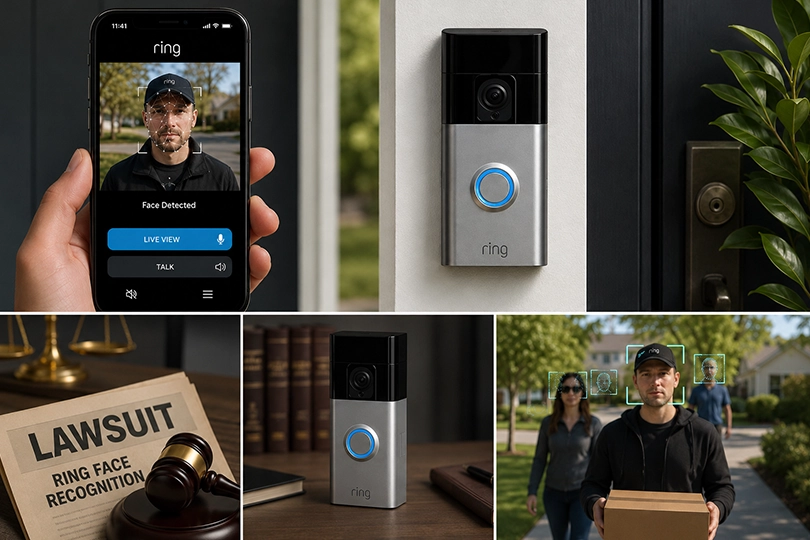
The feature is called Familiar Faces. It sounds harmless, even helpful. A regular video doorbell might tell its owner, “Person at the Front Door.” The new system can send a more personal alert, such as, “Chris at the Front Door.” The camera learns to recognize friends, relatives, and frequent visitors. The homeowner can give profiles names and choose whose arrival should trigger an alert.
According to Ring’s own instructions, once Familiar Faces is turned on, the camera detects a face and automatically adds that person to a library. The library may include not only relatives whose profiles have been named, but also unknown visitors. A delivery driver, utility worker, neighbor, babysitter, party guest, or passerby can become a separate profile without pressing a single button.
Here is the central paradox. The owner of the camera must choose to turn on the feature, so the owner gets a choice. The person standing outside the door does not. That visitor may never see a warning, know that facial recognition is active, or have a chance to refuse before the system has already processed the person’s face.
Most people have learned to accept ordinary video recording as part of daily life. Cameras are outside stores, in parking lots, inside apartment buildings, and along city streets. But facial recognition changes the meaning of surveillance. A recording answers the question, “What happened at the door?” A biometric system tries to answer a very different question: “Who was there, and has this person appeared before?”
A face is no longer treated as just a photograph. The system analyzes facial features and creates a mathematical template that can be compared with future images. You can change a password. You can cancel a bank card. You cannot cancel your face and get a new one. That is why privacy experts treat biometric information as especially sensitive.
The lawsuit says Sigwalt visited the homes of friends and family members who used Ring cameras with Familiar Faces. He says he did not receive adequate notice and did not consent to the collection of facial recognition data. He also says he feels anxious because he does not know where else his face may have entered such a system or whether Ring still stores the template created from it.
Ring says Familiar Faces is turned off by default. The company also recommends telling people whose profiles a user plans to save, and it notes that some laws require explicit consent from visitors. According to Ring, profiles and facial recognition information are encrypted and stored in the cloud. An unnamed profile is automatically removed after 30 days without another recognition. All profiles and related facial recognition information are deleted after 180 days without recognition.
For the company, these safeguards point to user control and limited storage. For the plaintiff, they do not answer the central question. If a person never agreed to the creation of a biometric profile in the first place, does automatic deletion months later make the original collection acceptable?
One detail in the complaint makes that question even sharper. Familiar Faces is not available to customers in Illinois, Texas, or Portland, Oregon, because of local laws. Ring itself lists these exceptions in its help materials. The plaintiff argues that this shows the company is technically capable of restricting the feature where privacy rules are stronger. In that view, the issue is not whether people can be protected. It is where the law forces the company to protect them.
Critics raised the alarm before the feature was launched. In October 2025, Senator Ed Markey called on Amazon to abandon facial recognition in Ring doorbells. He pointed to the same gap in consent. The owner of the camera can choose to participate, but guests, delivery workers, and passersby cannot. The Electronic Frontier Foundation also warned that a tool used today to recognize a friend at the door could be adapted tomorrow for much broader surveillance.
Privacy and security no longer sit on opposite sides of the front door. They now collide inside the same device. A camera that protects the homeowner can quietly take a choice away from the visitor. The smarter these devices become, the more important it is to ask not only what they can do, but who gets to decide what happens to the data they collect.
Ring’s history adds to the distrust. In 2023, the company agreed to pay $5.8 million to settle allegations brought by the Federal Trade Commission. The FTC accused Ring of allowing employees and contractors to have overly broad access to customers’ private videos. It also said weak security measures helped attackers take control of accounts, cameras, and recordings. Ring has also faced years of criticism over its close ties with law enforcement and the ways video footage has been shared.
The most disturbing part of this story is not one Amazon feature. It is how easily we are learning to accept convenience before consent. First, a device offers one useful option. Then that option becomes normal. Eventually, a person who does not want to be identified begins to look suspicious, even though the freedom to walk down a street or visit a friend without entering a digital profile once felt completely ordinary.
Technology rarely takes privacy away in one loud decision. More often, privacy disappears in small pieces. For a convenient alert. For a faster delivery. For the homeowner’s peace of mind. Each step seems minor until we realize that a system already recognizes us in places where we never agreed to introduce ourselves.
Sigwalt’s lawsuit could become an important test of the boundaries of artificial intelligence in everyday life. The court will have to examine specific laws, evidence, and corporate responsibility. The public faces a simpler and harder question: who owns your face when you are standing at someone else’s door?
If any camera owner can give permission for your face to be recognized, then it is not really your permission. And if we do not draw the line now, one day the door may know who we are before the person opening it does.