The Hobby That Could Save Your Career
Some of the busiest people in the world regularly do things that seem to have nothing to do with making money. Warren Buffett plays the ukulele. Richard Branson starts his day with tennis, cycling, or kitesurfing. Satya Nadella loves cricket and reads poetry. In the schedule of someone who runs a massive company, an activity like this can look like a charming weakness. A psychologist might see it differently. Perhaps it is not wasted time. Perhaps it is a way to avoid losing yourself.
We are used to thinking that success comes from constant pressure. Wake up earlier, respond faster, learn more, and make every free minute useful. Now even rest is expected to become a project. A walk should burn calories. Reading should make you smarter. Photography should attract followers. Baking eventually has to become a small business. A person may look relaxed, but inside, they are still taking an exam.
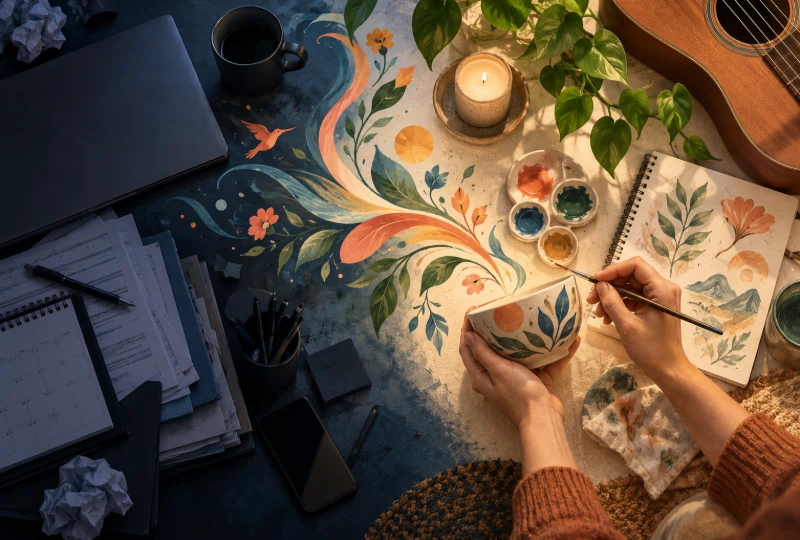
This is where the problem begins. The brain needs more than a switch from a work screen to a phone screen. It needs a different kind of experience, one without a boss, a report, a profit target, or the fear of falling behind. A real hobby creates that space. You can be an awkward beginner, ruin a piece of clay, play the wrong note, or draw a tree that looks like broccoli. Strange as it sounds, this permission to do something useless may support your ability to work better than another productivity course ever could.
The claim that exceptional people are nine times more likely to have hobbies sounds impressive, but the science is more interesting than the slogan. In 2008, Robert Root Bernstein and his colleagues studied the biographies of 510 Nobel Prize winners, members of leading scientific societies, and ordinary Americans. They looked for real adult activities, including music, painting, photography, literature, theater, dance, and crafts.
On average, Nobel laureates had almost three times as many creative pursuits as typical scientists in Sigma Xi. The differences were even greater in specific categories. Laureates were at least seven times more likely to practice visual arts and crafts, twelve times more likely to write fiction or other creative works, and twenty two times more likely to participate in theater, dance, or other performances. This means that nine times is not a universal conclusion from the study. A more accurate summary would be this: the more scientifically accomplished the group, the more often its members had a serious creative life outside their profession.
But we should not confuse a connection with a cause. The study does not prove that a pottery wheel will bring someone a Nobel Prize or that playing guitar will turn someone into a billionaire. Curious people may simply be interested in many things from the beginning. Another possibility is that creative activities develop skills that later become unexpectedly useful at work. Many prominent scientists themselves described art as something that stimulated their scientific thinking.
Psychology can explain this effect without any magic. During the workday, our attention stays locked on goals, deadlines, and problems. Even after work ends, the inner conversation may continue. What did I forget? Who has not replied? What will happen tomorrow? A hobby creates a psychological shift. When your hands are busy with wood, soil, paint, or a musical instrument, the usual chain of anxious thoughts begins to weaken. You are not escaping reality. For a while, you are stepping out of the role in which you must control everything.
There is another important mechanism. At work, self worth often depends on the reactions of other people. Clients, managers, colleagues, and audiences evaluate us. A favorite activity brings back internal motivation. You do something not because someone will pay or praise you, but because the process itself draws you in. This reminds the mind that your value is bigger than your title, income, and list of achievements. If one project fails, your entire identity does not collapse. It still has other supports.
Research on recovery after work connects healthy leisure with several experiences. These include psychological distance from work, relaxation, a sense of mastery, and freedom of choice. Creative activity has also been linked to better recovery and a stronger sense of creative problem solving at work. The key word is freedom. If a hobby becomes another obligation, much of its value disappears.
This is especially easy to see today, when almost any interest can be monetized. Someone starts baking bread for pleasure, then a month later begins worrying about orders. Someone opens a photography page and soon checks the statistics every ten minutes. Someone starts running to clear their head, but gradually turns every workout into a competition with a watch and everyone else’s results. Technically, the hobby is still there. Psychologically, it has become a second shift.
Finding the right hobby becomes easier when you stop asking, “What am I talented at?” That question immediately turns on evaluation. A better question is, “What did I enjoy before I started thinking about usefulness?” As a child, perhaps you built models, drew maps of imaginary cities, cared for plants, sang, cooked, carved little figures, or walked around for hours with a camera. You do not have to return to the exact same activity. That old interest simply points toward the kind of experience where your mind once felt free.
The best way to begin is with very small steps. Choose one activity that is clearly different from your work. If you spend all day in front of a screen, movement, manual work, nature, or live music may be more restorative. Give it one hour a week and protect that time in advance. Do not immediately buy professional equipment. Do not create a page to display your results. Do not set a goal of becoming the best. Your first few encounters with a new activity need to answer only one question: do you want to come back?
There is a simple psychological test. You may feel physically tired after the activity, but your thoughts should become a little quieter and your interest in the world should return. If you finish with guilt and another sense of failure, perhaps the activity is wrong for you, or perhaps harsh expectations have already taken control of it.
It also helps to set three rules. First, a hobby does not have to make money. Second, the result does not have to look beautiful. Third, you are allowed to do it irregularly and still call it yours. These rules sound simple, but for someone who is used to measuring personal value through results, they can become a real exercise in inner freedom.
Successful people are not interesting because they possess a secret list of perfect hobbies. Something else matters more. Many of them preserve a part of life where they can think differently, move differently, and stop being the chief executive of their own destiny around the clock. A hobby does not promise millions. It does not replace sleep, a vacation, or professional support for burnout. It does something even more important. It keeps a profession from taking over an entire identity.
Perhaps the best investment in your future career looks completely unserious today. Buy some paint. Plant basil. Pick up a guitar. Make a crooked cup that will never appear in an exhibition. Spend one hour without asking how to turn that hour into an achievement.